Table of Contents
Frosted glass vs. curtains is a question almost every homeowner and business owner faces sooner or later. Every window in your home or office has two jobs that pull in opposite directions. It should let daylight in, and it should keep prying eyes out. For decades, curtains have been the default answer in Pakistani homes. They are familiar, easy to find and available in every colour. But more homeowners, designers and business owners are now asking a different question: would frosted glass do this job better?
There is no single winner for every window. The right choice depends on the room, the amount of sunlight, how much privacy you need, and how much time you want to spend on upkeep. This frosted glass vs. curtains guide walks through both options in plain language, compares them side by side, and helps you decide without pressure to buy anything.
Frosted Glass vs. Curtains: What Is the Difference?
Frosted glass is glass that has been treated so its surface scatters light instead of letting it pass straight through. The treatment is usually done by acid etching, sandblasting or a fine ceramic coating. The result is a soft, milky look. Light still enters the room, but people outside see only a blur of shapes and shadows. Because the effect is part of the glass itself, it does not wear off, fold or fade.
Curtains are fabric panels hung on a rod or track in front of a window. They come in sheer, semi-sheer, blackout and lined varieties, and you control them by hand or by motor. They are not part of the window; they are an accessory placed over it.
That difference matters. Frosted glass is a permanent building material, while curtains are a flexible furnishing. Most of the comparison below comes back to this idea.
1. Frosted Glass vs. Curtains for Privacy
Privacy is the main reason people look at either option, so it deserves a careful look.
Frosted glass
Frosted glass gives constant privacy. You do not have to remember to close anything. Whether it is noon or midnight, a passer-by cannot see into the room. In the evening, when indoor lights are on, a shadow can still be visible on very light finishes, so the density of the frost matters. A heavier frost hides more, while a lighter one keeps more clarity.
Curtains
Curtains give controllable privacy. Fully closed heavy curtains block the view entirely, which beats most frosted finishes at night. The trade-off is that you have to operate them. Many people leave them closed all day to be safe, which defeats the purpose of having a window at all.
2. Frosted Glass vs. Curtains for Natural Light
A closed curtain blocks most daylight. Even a sheer one reduces brightness and can give a dull tint to the room. To get light, you open the curtain, and then you lose privacy.
Frosted glass does something clever: it lets in diffused light. Instead of a harsh beam, light spreads evenly across the room. Many people find this more comfortable, especially in bathrooms, stairwells and offices. There is no moment when you have to choose between light and privacy.
The only weakness of frosted glass is the view. If the window overlooks a garden, a skyline or a courtyard you enjoy, frosting removes it. Curtains let you open up and enjoy that view whenever you want. In that case you might frost only the lower part of the window, or only certain windows, and keep the rest clear.
3. Frosted Glass vs. Curtains for Heat, Glare and Noise
Pakistani summers make this a serious topic. Direct sunlight raises indoor temperatures and fades furniture and flooring.
Curtains, especially lined or blackout types, can block sun and reduce glare effectively when closed. They also add a little insulation. But they only work while drawn, and they cannot stop the heat from entering through the glass itself; they stop it after it has already come in.
Standard frosted glass reduces glare because it scatters light, but on its own it does not block a lot of heat. For serious heat control, frosted glass can be combined with double glazed glass, which adds an insulating air gap and also helps with street noise. Curtains add only a small amount of sound absorption, while double glazing makes a clear difference.
4. Frosted Glass vs. Curtains: Cleaning and Maintenance
Fabric collects dust, smoke, pet hair and cooking smells. Curtains in a dusty city need washing or dry cleaning several times a year, which is time-consuming for large or heavy panels. Rods, tracks and rings also need occasional care, and allergy-prone households often notice the dust.
Frosted glass is wiped with a soft cloth and a mild glass cleaner. The one thing to know is that acid-etched surfaces can hold fingerprints and oil, so bathrooms and kitchens need a slightly more regular wipe. Many modern frosted finishes are treated to resist smudging, which makes upkeep easier. Overall, glass is the lower-effort option over the years.
5. Frosted Glass vs. Curtains: Durability and Lifespan
Curtains age. Sunlight fades fabric, humidity encourages mildew, hooks break and hems fray. A set of curtains in a sunny room may need replacing every few years if you want them to look fresh.
Frosted glass lasts as long as the window does. The frost is part of the glass, so it does not fade, peel or yellow. It can also be made from toughened or laminated glass for added safety, which matters in doors, stairwells and children’s rooms. You can read more about this in our guide on why frosted glass is a must-have for privacy.
There is one limitation. Because it is built into the glass, you cannot change it on a whim. Once a window is frosted, it stays frosted. A curtain can be swapped in an afternoon.
6. Frosted Glass vs. Curtains: Style and Interior Design
Curtains bring colour, pattern and texture. A rich fabric can make a living room feel warm and finished, and nothing beats a curtain for softness. If your style is traditional, layered or colourful, curtains are hard to replace.
Frosted glass suits clean, modern and minimal spaces. It looks sharp in bathrooms, offices, entrances, kitchens and staircases. It can also be decorative: patterns, gradients, clear stripes and logos can be etched into the frost, creating a design feature instead of just a cover. For ideas, see our decorative glass installation service.
Neither is better in the abstract. It is about whether you want to add softness (curtains) or a streamlined, built-in finish (frosted glass).
7. Frosted Glass vs. Curtains: Cost Over Time
Curtains are usually cheaper on day one. A basic set requires a small outlay, and you can upgrade slowly. But the cost keeps coming: rods, cleaning, replacement as fabric fades, and motorised systems if you want automation.
Frosted glass costs more at the start, especially if you are replacing existing windows. If you are building or renovating, however, adding a frosted finish to new glass is a modest step compared to the overall project. Because it needs no cleaning service and no replacement, the gap narrows over the years. The right comparison is not the price this month, but the cost across ten years of use.
Frosted Glass vs. Curtains: Side-by-Side Comparison
| Factor | Frosted Glass | Curtains |
|---|---|---|
| Privacy | Constant, no action needed | Adjustable, strongest when fully closed |
| Natural light | Soft, diffused daylight all day | Full when open, reduced when closed |
| View outside | Blurred or hidden | Clear when open |
| Heat and glare | Reduces glare; pair with double glazing for heat | Blocks sun when closed; limited insulation |
| Cleaning | Wipe with cloth | Washing or dry cleaning, dust build-up |
| Lifespan | Lasts with the window | Fades and wears; replaced every few years |
| Style | Modern, clean, built-in | Soft, colourful, traditional or layered |
| Flexibility | Permanent once installed | Easy to change or remove |
| Upfront cost | Higher | Lower |
| Long-term cost | Low upkeep | Ongoing cleaning and replacement |
Frosted Glass vs. Curtains: Best Choice by Room
Bathrooms
Frosted glass is the clear winner. Fabric in a damp room invites mildew, while glass handles humidity and gives privacy while still letting daylight in.
Bedrooms
Curtains win here, particularly blackout ones. Good sleep depends on darkness, and fabric also adds a cosy feel. A sheer layer plus a heavy layer works well.
Living rooms
It depends on the view and the style. A window with a pleasant outlook suits curtains or clear glass. A window facing a wall or a busy lane suits frosted glass on the lower panes.
Kitchens
Frosted glass is practical. Curtains near a stove pick up grease and smoke, and they are a fire consideration, so glass is easier to live with.
Offices and meeting rooms
Frosted glass looks professional, protects confidential meetings and removes the need for blinds that collect dust. Our frosted glass partition installation page shows how it works for workspaces.
Staircases, entrances and side windows
These narrow, awkward windows are hard to dress with curtains. Frosted glass solves them neatly, with no hardware to hang.
Can You Use Both?
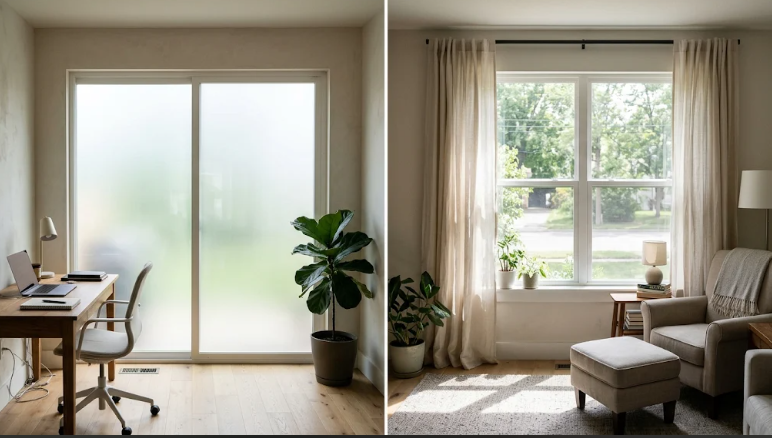
Absolutely, and many well-designed homes do. A common pairing is frosted glass on the lower half of a window for everyday privacy, with a light curtain or blind on top for style and extra darkness at night. In a bedroom, frosted glass gives daytime privacy while blackout curtains handle sleep. Combining them lets you keep the best of each: the permanence of glass and the flexibility of fabric.
Frequently Asked Questions
Frosted Glass vs. Curtains: Making the Right Choice for Your Windows
Choose frosted glass if you want permanent privacy, steady diffused light, a modern look and very little upkeep. Choose curtains if you want colour, softness, full darkness for sleeping and the freedom to change things easily. Choose both if you want privacy during the day and comfort at night.
Start by looking at each window on its own. Note what it faces, how much sun it gets and what you want from the room. Then pick the solution that fits that window, not one rule for the whole house. If you would like to see what frosted glass looks like in real spaces, browse our project references or talk to our team about your windows. There is no obligation, and a short conversation often makes the decision easy.