Table of Contents
Glass is the signature material of modern architecture. It brings in daylight, opens up views and makes a building feel light. But plain glass has its problems too: glare, heat build-up, a lack of privacy, and a flat, impersonal look.
Frit glass solves these problems and adds something extra personality. By printing patterns of ceramic enamel onto the glass, architects can turn a simple wall into a pattern, a picture or even a message. In this guide, we look at 10 stunning buildings around the world that use frit glass designs, what each one achieves, and what you can learn from them whether you are an architect, a developer or a homeowner planning your own project.What Is Frit Glass? A Quick Primer
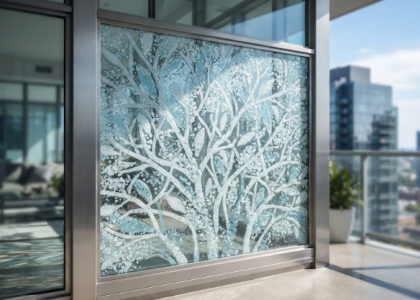
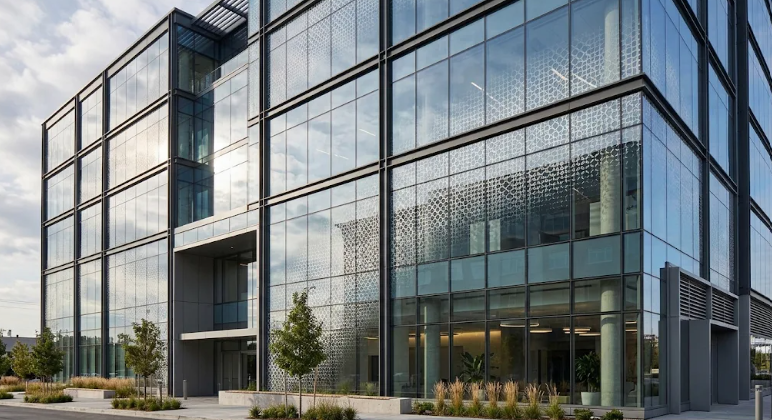
Frit glass (also called fritted glass or ceramic frit glass) is glass printed with a pattern of ceramic enamel. The pattern can be dots, lines, gradients or even photographic images. It is applied by screen printing, roller coating or digital printing, then fused permanently into the surface when the glass is tempered or heat strengthened. Because the enamel becomes part of the glass, it does not peel or fade like a sticker or paint would. Standard patterns usually cover roughly 20% to 60% of the glass area. The more coverage, the less light and solar heat pass through. In practice, frit glass offers four big benefits:- Glare and heat control: The pattern blocks part of the sun, lowering solar heat gain and cooling demand.
- Privacy: Views stay open between the dots or lines, while the pattern screens what is behind them.
- Bird safety: A visible pattern helps birds see the glass, reducing collisions.
- Design freedom: Colour, scale and density can all be customised, so no two buildings need to look alike.
10 Stunning Buildings Using Frit Glass Designs
1. Glass Farm, Schijndel, Netherlands
If you want proof that frit glass can be pure imagination, start here. For the market square of Schijndel, the architects MVRDV designed a building in the shape of a traditional farmhouse. Photographer Frank van der Salm photographed historic farms from the region, and a composite of those images was printed onto the glass facade with ceramic frit. The architects compared the technique to stained glass. The result is a building that looks like a ghostly, photographic farmhouse by day, while housing shops, restaurants and public uses inside. Lesson: frit is not limited to simple dots. It can carry full images and tell a story about a place.2. Diana Center at Barnard College, New York, USA
Designed by Weiss/Manfredi, this student centre combines coloured glass panels with fritted glass. Changes in reflectivity and hue mean the facade never looks quite the same twice: it shifts with the light and the weather. Lesson: pairing frit with colour creates a facade that feels alive, even though the glass itself never moves.3. Dazhou Public Library, Sichuan, China
Here the architects, China Southwest Architectural Design and Research Institute, wrapped the reading room in a double glass wall. The outer layer is fritted and the inner layer is frosted, which softens the daylight for readers. The double skin also helps reduce noise. Lesson: layering frit with frosted glass gives you gentle, even light, ideal for spaces where people read and concentrate.4. The Temple House, Chengdu, China
This hotel, designed by Make Architects and opened in 2015, faces the city with two dark brick wings. Around its inner courtyard, however, the facades are curtain walls of fritted glass. The pattern softens views and reflects daylight into the courtyard. Lesson: frit is perfect for hospitality, where you want light, calm and a degree of privacy at the same time.5. John and Frances Angelos Law Center, Baltimore, USA
Behnisch Architekten and Ayers Saint Gross designed this law school building with three distinct facades. The library facade is mainly fritted glass, which shades the interior from solar heat while preserving daylight and views. Lesson: you can tune frit by orientation. Facades that face harsh sun get more protection, others stay more open.6. Durham Performing Arts Center, North Carolina, USA
The theatre’s main facade, by Szostak Design, is a curtain wall of clear and fritted glass. It reveals the activity of the foyers to the street, especially at night, while the frit moderates sun and glare during the day. Lesson: mixing clear and fritted glass lets a building show off its life without overheating.7. Bridge for Laboratory Sciences, Vassar College, USA
Designed by Ennead as part of the Integrated Science Commons, this building spans a stream valley. One of its facades is a fritted glass curtain wall, and the pattern makes the glass visible to birds, which reduces collisions in a natural setting. Lesson: for buildings near trees, water or parkland, frit is one of the most practical bird-friendly choices.8. Springdale Library, Brampton, Canada
The architectural studio RDHA worked with a generative design specialist at the University of Toronto to craft a solar-responsive ceramic frit pattern for this library. Instead of a uniform pattern, the frit responds to how the sun actually hits the building. Lesson: modern design tools allow frit patterns that are both beautiful and performance-driven.9. National Museum of African American History and Culture, Washington, D.C., USA
This museum sits on the National Mall behind its famous bronze-toned Corona screen. According to the project’s glazing write-up, horizontal skylights carry a denser dot-pattern frit because the Corona does not shade them, while the sloped glass inboard of the screen has a lighter dot density. The lighter frit also helps give the zone between screen and glass a soft glow at night. Lesson: frit density can vary across one building, doing different jobs on different surfaces.10. State Street South, Chicago, USA
The architects at 4240 Architecture treated the glass here with a white ceramic frit pattern that references Sol LeWitt’s sculpture Lines in Four Directions on the building’s west face. On the Quincy facade, tiny lines of text written in frit are legible from inside the building. Lesson: frit can be a quiet storytelling tool, linking a building to art, history and its neighbours.What These Buildings Teach Us
Looking across all ten projects, a few patterns emerge:- Frit is functional and beautiful at once. Every example above controls light or heat and also improves how the building looks.
- One size does not fit all. Density, colour and pattern change with orientation, climate and purpose.
- It works at every scale. From a village shopping centre to a national museum, frit adapts.
- It pairs well with other glass. Frosted layers, tinted glass, low-e coatings and clear panels all combine well with frit.
- It supports sustainability. Less heat gain can mean lower cooling loads, and bird-safe patterns protect wildlife.