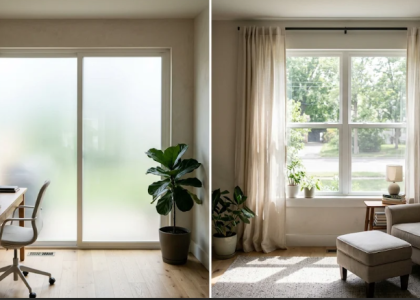
You already know you want privacy without losing natural light. Frosted glass does exactly that, and you have probably seen it in office partitions, shower cabins, entrance doors, and boutique shopfronts. But once you start asking suppliers for quotes, a new question appears: should it be acid etched or sandblasted?
The two names are often used as if they mean the same thing. They don’t. Both create a translucent, matte surface by roughening clear glass, but they do it in completely different ways, and that changes how the glass looks, feels, ages, and costs. Picking the wrong one can mean fingerprints you can’t wipe off, a finish that looks flat in your design, or a budget that doesn’t match the result.
This guide compares both options side by side so you can decide with confidence, whether you are fitting out a villa in Lahore, an office in Islamabad, or a restaurant in Karachi.
What Is Frosted Glass, Exactly?
Frosted glass is clear glass that has had one surface altered so that light passes through but is scattered, which blurs what is visible on the other side. You still get brightness, but you lose the sharp view. That makes it popular for:
- Office partitions and meeting rooms
- Bathroom windows and shower enclosures
- Entrance doors and sidelights
- Decorative panels, cabinet doors, and signage
- Retail and hospitality interiors
There are several ways to get a frosted look: acid etching, sandblasting, and also adhesive frosted films and ceramic frit coatings. Films are a quick, low-cost fix, but they can peel, bubble, and fade. For a permanent finish built into the glass itself, acid etching and sandblasting are the two main routes, and they are what we compare here.
What Is Acid Etched Glass?
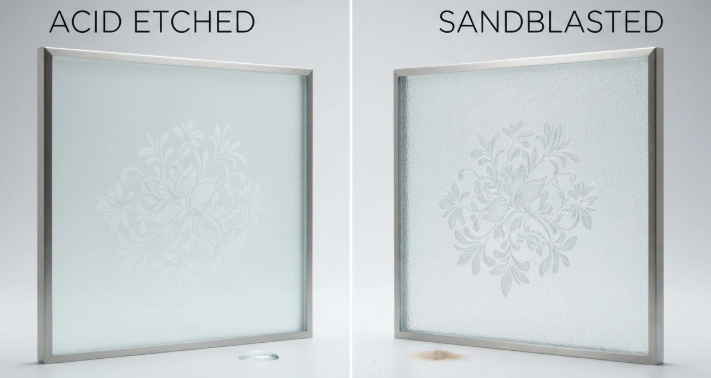
Acid etched glass is made by exposing the glass surface to a hydrofluoric acid-based treatment, either by dipping the sheet in an acid bath or applying acid paste or cream to chosen areas. The acid chemically dissolves a very thin layer of the surface, leaving a fine, uniform, satin-like texture.
How it looks and feels
The result is a smooth, soft, silky matte surface with an even, refined diffusion of light. Because the texture is so fine, it feels almost like polished stone rather than rough sand. The finish tends to look consistent across large sheets, which is why it is a favourite for contemporary, minimal interiors.
Key characteristics
- Very smooth, even, and satin-like finish
- Excellent light transmission with soft diffusion
- Resists fingerprints and smudges better than most alternatives
- Easier to clean because the surface is fine and not deeply pitted
- Best suited to full-sheet frosting and clean, uniform surfaces
- Fine detail work is possible, but it is less common than with sandblasting
A note on safety. Hydrofluoric acid is hazardous, so etching must be done by trained professionals in a controlled facility. This is a factory process, never a DIY project.
What Is Sandblasted Glass?
Sandblasted glass is created mechanically. A high-pressure stream of abrasive material, such as fine sand or aluminium oxide, is blasted at the glass surface through a nozzle. This physically scours the surface and creates a frosted texture.
The real strength of sandblasting is control. Fabricators can cover parts of the glass with a stencil or resist mask, so only the exposed areas are blasted. That makes it ideal for patterns, logos, borders, calligraphy, and artistic designs. Operators can also vary the pressure and the duration of blasting to create different depths and textures, including a deep, carved effect.
How it looks and feels
Sandblasted glass has a more textured, slightly grainy feel compared to acid etching. The surface looks a little more matte and “raw”, and it can show greater contrast when only part of the glass is frosted against clear areas.
Key characteristics
- Excellent for patterns, motifs, logos, and custom artwork
- Can create varied depths, from light frosting to deep carving
- Strong visual contrast between frosted and clear zones
- Slightly rougher surface that can hold oils and dirt more readily
- A natural choice for decorative and branded installations
Acid Etched vs. Sandblasted: Side-by-Side Comparison
| Feature |
Acid Etched Glass |
Sandblasted Glass |
| Process |
Chemical (acid-based) |
Mechanical (abrasive spray) |
| Surface feel |
Smooth, silky, satin |
Slightly grainy, textured |
| Appearance |
Even, uniform, refined |
More matte, higher contrast |
| Best for |
Full-sheet privacy, minimal design |
Patterns, logos, artistic designs |
| Design flexibility |
Moderate |
Very high |
| Fingerprint resistance |
High |
Lower, can show marks and oils |
| Cleaning |
Easy wipe-down |
Needs more care, as dirt can settle into texture |
| Light diffusion |
Soft and consistent |
Varies with depth of blast |
| Typical look |
Modern, clean, contemporary |
Decorative, expressive, bold |
Which One Is More Durable?
Both finishes are permanent because the texture is part of the glass, not a coating that can peel. The difference in durability is mostly about everyday maintenance and structural considerations.
Sandblasting physically removes material and can slightly reduce the strength of the surface if it is very deep, so deep blasting is best planned with your glass supplier, particularly on thinner sheets or large panels. When strength is a priority, such as in shower cabins, doors, and partitions, the glass is usually
toughened (tempered) as well. The usual practice is to complete the etching or blasting first and then toughen the glass, because cutting, drilling, and surface work cannot be done after tempering.
Acid etching removes only a very thin layer, so it has little effect on the structural properties of the sheet. In daily use, both finishes handle normal wear well, but the smoother acid-etched surface is easier to keep looking new.
Cleaning and Maintenance: What Daily Life Looks Like
This is where many buyers make their decision.
Acid etched glass: Wipe with a soft microfibre cloth and a mild glass cleaner. Fingerprints and light marks tend to come off easily. This makes it a practical choice for shower cabins, office partitions that get touched often, and doors.
Sandblasted glass: The textured surface can trap oil from hands, soap residue, and dust. Clean it gently with a soft brush or non-abrasive cloth and a mild cleaner, and avoid scouring pads. In high-touch areas, sandblasted glass will need a little more attention to keep it looking crisp.
If you want low maintenance and the glass will be touched or splashed regularly, acid etched usually wins. If the glass is mostly decorative, such as a feature panel, a high window, or a design on a door above hand height, sandblasting’s upkeep is rarely a problem.
Design Flexibility: Plain Privacy or Statement Piece?
Ask yourself what you want the glass to
do.
Choose acid etched if you want a clean, uniform, elegant finish across a whole panel. It suits modern offices, bathrooms, and contemporary homes where the glass supports the design rather than leading it.
Choose sandblasted if you want the glass to be a design feature, with geometric patterns, floral motifs, Arabic calligraphy, company logos, or a combination of clear and frosted zones. For restaurants, hotels, clinics, and branded spaces, a sandblasted design can double as signage and decoration.
Many projects also combine both: for example, an acid etched partition with a sandblasted logo or border. Talking through the look you want with a fabricator early helps you get the best of each.
Best Applications by Space
| Space |
Recommended Finish |
Why |
| Shower cabins and bathroom windows |
Acid etched |
Easy to clean, good privacy, resists soap marks |
| Office partitions and meeting rooms |
Acid etched, with sandblasted logo or band if wanted |
Uniform look plus branding and the privacy band at eye level |
| Entrance doors and sidelights |
Either |
Acid etched for modern; sandblasted for decorative motifs |
| Restaurants, cafes, and hotels |
Sandblasted |
Patterns and branding create atmosphere |
| Cabinet and wardrobe doors |
Either |
Acid etched for a sleek look; sandblasted for detailed design |
| Shopfront glass |
Sandblasted |
Logos, text, and window graphics |
| Decorative feature walls |
Sandblasted, sometimes combined with other finishes |
Depth and artistic detail |
If you are planning a commercial interior, you may also want to see how frosted glass fits into
office glass partitions or a complete frosted glass partition installation.
Cost Considerations
Exact pricing depends on glass thickness, sheet size, toughening, design complexity, and the volume of your order, so any number quoted without a design and measurements should be treated with caution. As a general guide to how the two compare:
- Acid etched glass is typically most cost-effective for large, plain, uniform panels, since the process suits full-sheet coverage.
- Sandblasted glass costs more as design complexity rises, because stencil preparation, masking, and detailed work add labour. A simple pattern can be modest, while an intricate custom artwork takes more time.
- Toughening, laminating, hardware, and installation often make a bigger difference to the final price than the frosting method itself.
The smartest way to compare quotes is to give every supplier the same specifications: finish type, thickness, tempered or not, dimensions, and design. Otherwise you are comparing different products.
Five Questions to Ask Before You Decide
- Where will the glass be installed? Wet areas and high-touch spots favour acid etched.
- Do I want a pattern or logo? If yes, sandblasting is almost always the better route.
- How much privacy do I need? Both can offer strong privacy, but a clear-and-frosted combination lets you control it. A frosted band at standing eye level is a classic office solution.
- How much cleaning am I willing to do? Be honest about maintenance.
- Does the glass need to be toughened or laminated? For safety-critical applications such as doors, shower enclosures, and railings, the answer is usually yes, and it must be planned before the frosting and fabrication stage.
Common Mistakes to Avoid
- Treating all “frosted glass” as the same. Always ask which method is being used.
- Choosing sandblasted glass for a high-touch shower door without considering upkeep.
- Ignoring the installation side. Frosted glass faces should be positioned according to your supplier’s guidance, since the finished side affects how easily it can be cleaned and how it looks in use.
- Deciding on price alone. A cheaper quote may mean thinner glass, no toughening, or a lower-quality finish.
- Skipping a sample. Seeing and touching a small sample in your own lighting tells you more than any photo.
So, Which Should You Choose?
Here is the short version:
- Pick acid etched glass for a smooth, elegant, low-maintenance finish across a whole panel, especially in bathrooms, shower cabins, and busy offices.
- Pick sandblasted glass for custom patterns, logos, and artistic detail, especially in hospitality, retail, and decorative interiors.
- Pick both together when you want uniform privacy plus a signature design.
There is no universally better option, only the better option for your space, your style, and your maintenance habits.
Frequently Asked Questions
Is acid etched glass the same as frosted glass? Acid etched glass is one type of frosted glass. “Frosted glass” is the general term for any glass with a translucent, matte surface, including sandblasted glass and film-covered glass.
Can I get a pattern on acid etched glass? Yes, selective areas can be etched, but sandblasting is generally the preferred method for detailed or deeply textured designs.
Which is better for a bathroom? Acid etched glass is usually the more practical choice thanks to its smoother surface and easier cleaning, though a well-maintained sandblasted design can work well in areas that don’t get touched often.
Can frosted glass be toughened? Yes. Frosting should be completed before toughening, and your supplier will plan the order of fabrication.
Does frosted glass block light? No. It diffuses light rather than blocking it, so rooms stay bright while privacy improves.
Can I see samples before ordering? Yes, and we recommend it. Viewing a sample in your own space is the best way to confirm the finish you prefer.
Plan Your Frosted Glass Project With Green Glass Designer
At
Green Glass Designer, we work with architects, interior designers, builders, and homeowners across Pakistan, including Lahore, Karachi, Islamabad, and beyond. With over 15 years of experience in glass design, supply, and installation, our team can guide you from the first idea to a finished installation: consultation, custom design and mock-ups, precise fabrication, and expert fitting backed by after-sales support.