Table of Contents
Walk into any old cathedral on a bright afternoon and you’ll understand instantly why stained glass has survived for more than a thousand years. Light pours through panels of ruby red, sapphire blue, and gold, scattering colored patterns across stone floors that have felt footsteps for centuries. It isn’t just decoration it’s a conversation between glass, light, and the people standing beneath it. That conversation hasn’t stopped. It has simply moved from cathedral windows to modern homes, boutique hotels, restaurants, and office lobbies, proving that stained glass is far more than a relic of the past.
This guide takes a deep look at the art of stained glass: where it came from, how it’s actually made, the techniques that define it, the meaning hidden in its colors and patterns, and why it continues to hold a place in contemporary architecture and interior design.
What Is Stained Glass, Exactly?
At its simplest, stained glass refers to colored glass that has been cut into shapes and assembled usually with strips of lead, copper, or zinc to form a decorative or pictorial design. The “staining” traditionally comes from metallic oxide compounds added during the glassmaking process, which produce the vivid colors glass is known for: cobalt for blue, gold chloride for red and pink, copper oxide for green, and so on.
But stained glass is also a broader idea. It covers everything from a small leaded lightbox to a fifty-foot rose window in a Gothic cathedral. It includes hand-painted religious scenes, geometric Art Deco panels, organic Art Nouveau florals, and the jewel-toned lampshades made famous by Louis Comfort Tiffany. What ties all of these together is the same basic principle: glass, color, and structure working together so that light itself becomes part of the design.
This is what makes stained glass different from almost any other visual art form. A painting reflects light. Stained glass transmits it. The artwork only fully comes alive when light passes through it, which means the same panel can look completely different at sunrise, midday, and dusk or under artificial light at night. No other medium changes its personality with the time of day quite like this.
A Brief History of Stained Glass
Ancient and Early Origins
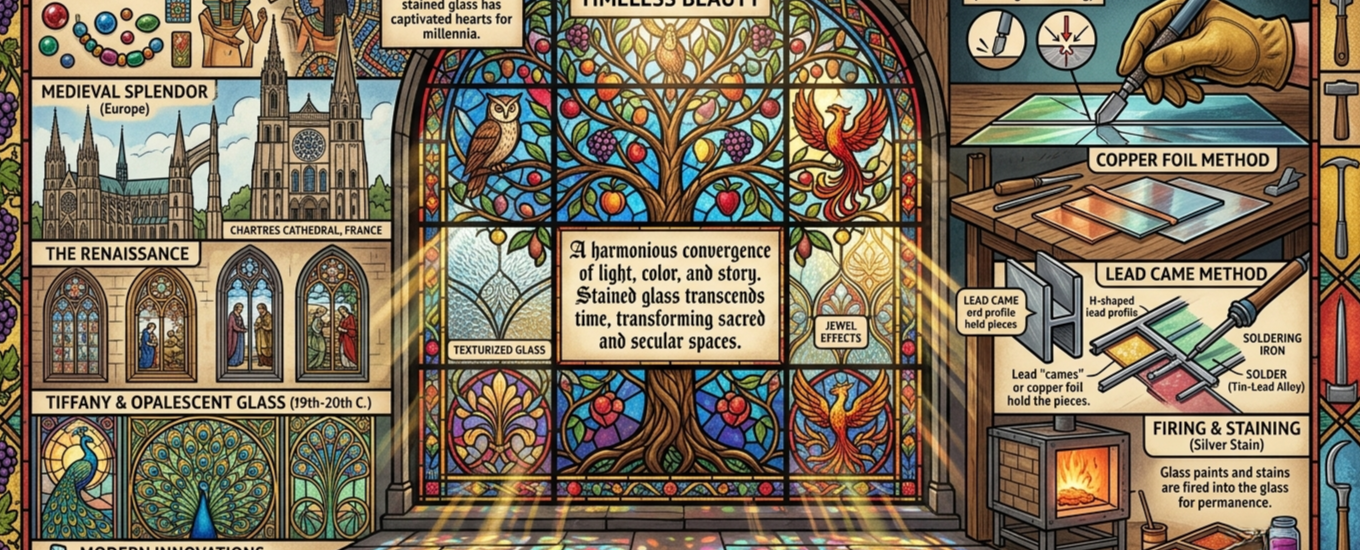
The story of colored glass goes back much further than most people expect. Egyptians and Romans were producing colored glass objects beads, vessels, small decorative pieces as early as 3,000 years ago. But glass as a building material used to admit colored light into architecture is a development most historians trace to the early Christian and Byzantine periods, roughly the 4th to 7th centuries CE, when small pieces of colored glass were set into stone or plaster window openings.
The Medieval and Gothic Explosion
Stained glass as we recognize it today truly came into its own during the Romanesque and Gothic periods in Europe, roughly the 10th through 15th centuries. As cathedral architecture evolved thinner stone walls, taller structures, flying buttresses that redistributed weight architects suddenly had room for enormous window openings. Stained glass filled that opportunity beautifully.
Cathedrals like Chartres, Notre-Dame de Paris, and Sainte-Chapelle became famous for windows that didn’t just decorate a building, they taught it. In an era when most people couldn’t read, stained glass windows told Bible stories in vivid, sequential imagery a kind of medieval graphic novel rendered in colored light. Craftsmen developed increasingly sophisticated techniques for painting facial details and drapery directly onto glass before firing it in a kiln, allowing for far more expressive figures than simple colored shapes alone could produce.
The Renaissance Shift
As the Renaissance took hold, artistic priorities shifted toward realism, perspective, and painterly technique. Stained glass windows during this period began to resemble framed paintings more than abstract mosaics of light, with artists like Albrecht Dürer contributing designs. The craft didn’t disappear, but it changed character, becoming more pictorial and less symbolic.
Victorian Revival and the Arts and Crafts Movement
By the 19th century, a Gothic Revival movement swept through Europe and North America, and with it came a renewed appetite for stained glass in churches, civic buildings, and even private homes. This period also saw the rise of the Arts and Crafts movement, which pushed back against mass production and celebrated handmade craftsmanship stained glass fit that philosophy perfectly.
The Tiffany Era
No history of stained glass is complete without Louis Comfort Tiffany, the American designer who revolutionized the craft in the late 1800s. Tiffany developed and popularized “favrile” glass, a technique that produced rich, opalescent color variations within a single sheet of glass rather than relying purely on paint. He also refined the copper foil method (as opposed to traditional lead came), which allowed for far more intricate, delicate designs perfect for his famous lamps and decorative panels. Tiffany didn’t just make beautiful objects; he changed what people believed stained glass could technically achieve.
Modern and Contemporary Stained Glass
Through the 20th century, stained glass found new expression in Art Deco geometry, Bauhaus minimalism, and later, abstract modernist compositions in churches and public buildings. Artists like Marc Chagall created stained glass windows that functioned as fine art in their own right, displayed in cathedrals, synagogues, and museums alike.
Today, stained glass has moved well beyond religious architecture. Contemporary designers use it in residential windows, doors, room dividers, skylights, and decorative wall features, blending traditional techniques with modern materials, LED backlighting, and sleek architectural glass systems. It’s proof that a centuries-old craft can keep adapting without losing what made it special in the first place.
How Stained Glass Is Made
Understanding the process behind stained glass makes it much easier to appreciate why a well-made panel is considered a genuine art object rather than a simple building material. While techniques vary between studios and traditions, the classic process generally follows these stages:
1. Design and Cartoon
Every stained glass piece begins as a design, historically called a “cartoon.” This is a full-scale drawing showing the exact shape, size, and placement of every piece of glass, along with the lead lines that will hold everything together. Traditionally this was drawn by hand; today it’s often refined digitally before being printed at full scale.
2. Glass Selection
This is where color decisions come to life. Craftsmen select sheets of colored glass based on hue, texture, and how light behaves when it passes through them. Glass can be smooth and transparent, textured and diffused, streaky with multiple colors blended together, or opalescent, meaning it lets through soft, milky light rather than a clear image. Choosing the right glass for each section of a design is as much an artistic decision as choosing paint colors is for a painter.
3. Cutting the Glass
Each individual piece is cut to match a section of the cartoon. Traditionally this was done with a hot iron and water to create controlled cracks; today, a glass cutter (a small tool with a hardened wheel) scores the surface, and the glass is then snapped along that score line. Curved and intricate shapes require a steady hand and a lot of practice, since a single mistake can crack a piece in the wrong place.
4. Painting and Firing (For Detailed Designs)
For designs that include faces, drapery folds, shading, or fine detail, artists apply a special glass paint made from ground glass, metal oxide, and a binding medium. The painted piece is then fired in a kiln at high temperatures, permanently fusing the paint into the surface of the glass so it won’t wash away or fade. This step is what separates simple colored-glass mosaics from the richly detailed figurative windows found in historic cathedrals.
5. Assembly: Leading or Foiling
Once every piece is cut (and painted, if applicable), it’s time to assemble the panel. There are two traditional methods:
- Lead came construction: Strips of H-shaped or U-shaped lead (called “came”) are fitted around the edges of each glass piece, forming a grid that holds everything together. This is the traditional method used in most historic windows.
- Copper foil method: Popularized by Tiffany, thin copper foil is wrapped around the edges of each glass piece, and the foiled edges are then soldered together. This method allows for far tighter, more delicate designs since copper foil is thinner and more flexible than lead came.
6. Soldering
Wherever lead or copper foil pieces meet, they’re soldered together using a hot iron and metal solder, creating a strong, permanent bond at every joint.
7. Cementing and Waterproofing
For lead came windows, a cement-like putty is worked into the gaps between the glass and the lead to add strength and weatherproofing, then cleaned off the surface. This step also darkens the lead for a more finished, uniform appearance.
8. Framing and Installation
Finally, the finished panel is set into a frame wood, metal, or masonry and installed into its window opening, door, or decorative feature. Larger installations often require additional structural support, particularly for exterior windows exposed to wind load and temperature changes.
Techniques and Styles Worth Knowing
Stained glass isn’t one single style it’s an umbrella term covering a wide range of techniques and visual traditions. Here are some of the most recognizable:
Traditional leaded glass uses simple geometric or symbolic patterns held together with lead came, often seen in historic churches and older residential homes with diamond or grid-patterned windows.
Painted and fired glass incorporates hand-painted detail fired into the glass surface, used for figurative scenes like biblical narratives, portraits, or detailed botanical illustrations.
Tiffany-style copper foil work allows for smaller, more intricate pieces and organic curves, commonly seen in decorative lamps, small panels, and mosaic-style artwork.
Fused and slumped glass involves melting layers of glass together in a kiln rather than joining pre-cut pieces with lead or copper, producing a smoother, more contemporary look often used in modern architectural features.
Faceted glass (dalle de verre) uses thick chunks of colored glass set into concrete or epoxy rather than lead, creating a bold, chunky, light-diffusing effect popular in mid-20th-century modernist buildings.
Modern decorative glass panels, increasingly used in contemporary interiors, borrow the visual language of stained glass color blocking, geometric patterning, light diffusion while using updated materials, lamination techniques, and sometimes LED backlighting for spaces where traditional lead-and-glass construction isn’t practical.
The Symbolism and Storytelling Behind Stained Glass
Stained glass has always been about more than decoration. For centuries, it served as a visual language.
In medieval churches, colors and imagery carried specific meaning. Blue often represented heaven, divinity, and truth. Red symbolized sacrifice, passion, or the blood of martyrs. Gold and yellow stood for divine light and glory. Green represented growth, renewal, and hope. Figures were arranged in specific sequences to guide the viewer’s eye through a story, often starting at the bottom of a window and moving upward, mirroring a spiritual ascent.
Beyond religious symbolism, stained glass has also long represented status and craftsmanship. In the Victorian era, a home with stained glass in its entryway or stair landing signaled taste and prosperity. Guild halls, universities, and civic buildings used stained glass to display coats of arms, historical milestones, or civic pride.
Even today, when stained and decorative glass is chosen for a home, restaurant, or office lobby, it often carries an implicit message: this space values craftsmanship, character, and detail over generic, mass-produced finishes. That emotional and symbolic weight is part of why stained glass continues to feel special, even in modern, minimalist interiors.
Why Stained Glass Still Matters in Modern Architecture and Design
It would be easy to assume stained glass belongs only in old churches, but its role in contemporary architecture has actually expanded in recent years. A few reasons why:
It transforms ordinary light into atmosphere. Interior designers increasingly treat natural light as a design element in its own right. A stained or decorative glass panel positioned to catch morning or afternoon sun can add warmth, color, and movement to a space without any additional lighting fixtures or electricity.
It adds privacy without sacrificing brightness. In bathrooms, entryways, and street-facing rooms, stained or textured decorative glass allows diffused natural light in while obscuring direct sightlines a practical benefit alongside the aesthetic one.
It offers a level of customization mass-produced materials can’t match. Because each panel is designed and assembled by hand, stained and decorative glass can be tailored to a specific color palette, brand identity, architectural theme, or personal story in a way that a standard window or partition simply cannot.
It works beautifully in hospitality and commercial spaces. Restaurants, boutique hotels, and retail storefronts increasingly use stained and decorative glass features room dividers, feature walls, skylights, and statement doors to create a memorable, photograph-worthy atmosphere that feels distinct from competitors relying on generic finishes.
It bridges tradition and modern architecture. Contemporary designers often pair the old craft of stained and decorative glasswork with modern architectural glass systems tempered panels, laminated safety glass, aluminum framing allowing the artistic character of stained glass to be integrated safely and durably into modern commercial and residential builds.
This is part of why companies working in architectural and decorative glass increasingly offer stained glass as one of several modern glass solutions alongside frosted glass, LED mirrors, and digital glass walls it lets clients bring genuine craftsmanship into spaces that are otherwise built with very modern materials and methods.
Caring for Stained Glass
Whether it’s a century-old church window or a newly installed decorative panel in a home, stained glass needs a bit of specific care to last:
- Clean gently. Use a soft, dry or slightly damp microfiber cloth. Avoid ammonia-based glass cleaners, which can degrade lead came and painted details over time.
- Avoid direct pressure. Never lean, push, or apply weight to a stained glass panel the structure, while durable, isn’t built to bear load the way structural glass is.
- Watch for bowing. Older leaded panels can bow slightly over decades due to the softness of lead. If you notice visible warping, it’s worth having a specialist assess whether reinforcement bars or restoration work are needed.
- Manage temperature extremes where possible. Rapid temperature swings can stress both the glass and the metal joints. Exterior storm windows or protective glazing can help shield older stained glass from harsh weather.
- Have it inspected periodically. Just as you’d have a roof or foundation checked, stained glass panels especially older ones or those in high-traffic entryways benefit from an occasional professional inspection to catch cracked solder joints or loose came before they become bigger problems.
Bringing Stained Glass Into Your Own Space
Part of what makes stained glass so enduring is its flexibility. It doesn’t have to mean towering cathedral windows it can be a single feature panel in a front door, a decorative insert above a kitchen cabinet, a room divider in an office, or a statement wall in a restaurant or hotel lobby. The same techniques that produced Chartres Cathedral’s windows nearly 800 years ago are still used, in updated form, to add color, privacy, and personality to modern homes and commercial spaces.
If you’re considering adding stained or decorative glass to a project, it helps to work with a team that understands both the artistic side of the craft and the practical realities of modern architectural glass structural safety, weatherproofing, and integration with contemporary door and window systems. This is exactly the kind of decorative glasswork that studios specializing in architectural and decorative glass, like Green Glass Designer, bring together: traditional stained glass artistry paired with the durability and precision of modern glass fabrication and installation.
Stained Glass vs. Other Decorative Glass Techniques
Because “stained glass” is often used loosely, it helps to understand how it compares to other decorative glass options you might be weighing for a project.
Stained glass vs. frosted glass: Frosted glass is treated or textured so it becomes translucent rather than transparent, obscuring the view while still letting light through it’s typically a single color (usually clear or lightly tinted) and is chosen mainly for privacy. Stained glass, by contrast, is built from multiple colored pieces and is chosen primarily for its visual and artistic impact, with privacy as a secondary benefit.
Stained glass vs. etched or sandblasted glass: Etched glass uses acid or abrasive sandblasting to create a pattern or design on a single sheet of clear glass, often used for logos, monograms, or subtle patterns. It’s a surface treatment on one piece of glass, whereas stained glass is an assembly of many individually colored and cut pieces joined together.
Stained glass vs. digital or printed glass walls: Modern digital glass printing can replicate colorful, image-based designs on large glass panels using UV printing technology. It’s faster and often more budget-friendly for large-scale features, but it lacks the dimensional quality and light-transmission behavior of true stained glass, where color comes from the glass itself rather than a printed layer on its surface.
Stained glass vs. mosaic glass: Mosaic work typically uses small pieces of glass or tile applied to a solid, opaque backing (like a wall or tabletop), meant to be viewed with reflected light. Stained glass is specifically designed to be viewed with transmitted light passing through it, which is why it’s used in windows, doors, and other spaces where light can pass from one side to the other.
Understanding these distinctions matters when planning a project, since each technique serves a different visual and functional purpose and a good glass studio should be able to help you decide which one actually fits your space, lighting conditions, and budget.
Frequently Asked Questions About Stained Glass
Is stained glass expensive?
Cost varies widely depending on size, complexity, glass type, and whether the design includes hand-painted detail. A small decorative panel will cost far less than a large custom window with intricate figurative imagery. Generally, the more individual pieces of glass and the more detailed the painting or cutting involved, the higher the cost, since stained glass is still largely a handmade craft.
Can stained glass be used in modern homes, or is it only for older or traditional architecture?
Modern stained and decorative glass work has evolved well beyond the ornate religious imagery most people associate with the craft. Contemporary designs often use bold geometric patterns, minimalist color palettes, or abstract compositions that suit modern interiors just as well as they suit a historic building. Many homeowners use stained or decorative glass in a single feature a front door insert, a stairwell window, or a bathroom privacy panel rather than throughout an entire home.
Is stained glass durable enough for everyday use?
Yes, when properly installed. Modern stained and decorative glass installations are often paired with tempered or laminated safety glass backing for added strength, particularly in doors, partitions, or high-traffic areas. As with any glass feature, proper installation and occasional maintenance are what keep it performing well for decades.
How long does a stained glass panel typically last?
With reasonable care, stained glass can easily last many decades some historic cathedral windows have survived for over 700 years. The lifespan mainly depends on the quality of materials used (particularly the lead or copper joints), exposure to weather, and how well the panel is maintained over time.
Do I need a specialist to install stained or decorative glass?
Yes. Beyond the artistic design and fabrication, proper installation involves structural considerations weight distribution, weatherproofing, frame compatibility, and safety glazing standards that are best handled by an experienced architectural or decorative glass installer rather than a general contractor.
Final Thoughts
Stained glass has survived Roman glassmakers, Gothic cathedral builders, Victorian revivalists, and Tiffany’s studio innovations, and it’s still finding new life in homes, restaurants, and offices today. That kind of staying power doesn’t happen by accident. It happens because stained glass does something no other material quite manages: it turns ordinary sunlight into color, story, and atmosphere, one pane at a time.
Whether you’re admiring a centuries-old cathedral window or considering a custom decorative panel for your own home, stained glass remains exactly what it’s always been proof that light, color, and craftsmanship, brought together carefully, can outlast almost anything.