Table of Contents
A shopkeeper renovating a storefront on a busy commercial road in Lahore has two fundamentally different conversations waiting for them, depending on which direction they lean. One conversation is with a fabricator who talks about mullion profiles, glass thickness, and how much of the street the shop’s interior will actually be visible from. The other is with a fabricator who talks about shutter mechanisms, security ratings, and how a solid metal front holds up against a decade of dust, monsoon humidity, and daily wear on a high-traffic road. Both conversations lead to a legitimate, functional storefront. Neither one is automatically the right answer, and the shopkeepers who get this decision wrong usually aren’t choosing badly out of ignorance they’re choosing based on whichever system a neighboring shop happened to use, rather than working through what their own specific retail category, security situation, and customer behavior actually require.
If you’re comparing a glass shop front against a metal front for a specific retail space, you’ve almost certainly already decided the current storefront needs to change. This guide isn’t here to convince you a renovation is worthwhile it’s here to walk through, in real practical detail, what genuinely separates these two systems, where each one performs better, and what questions to bring to a fabricator before committing either way. This is a decision with real financial and security consequences, and it deserves more than “glass looks modern, metal looks secure” as the entire basis for a choice.
The Two Systems in Brief
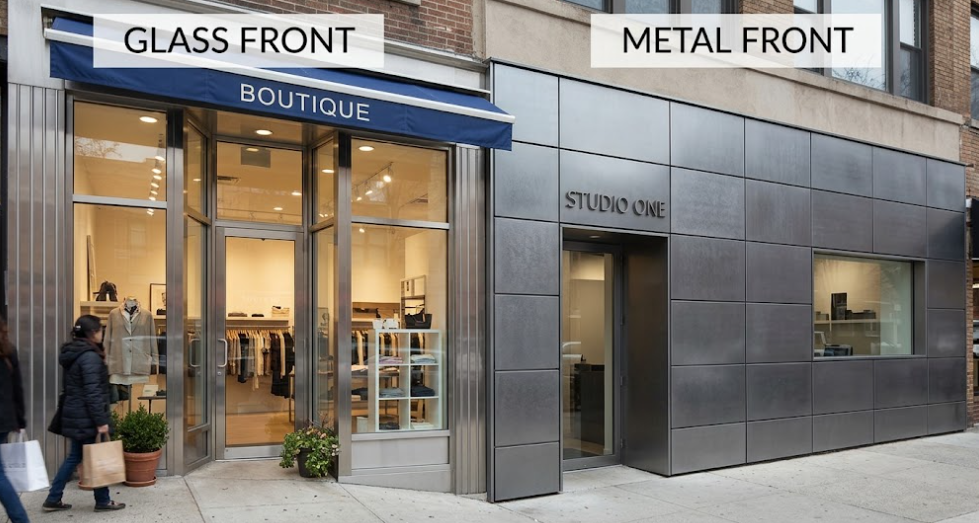
A glass shop front is a storefront system built primarily around transparent glazing, typically toughened or laminated glass set into a slim aluminum frame, with a glazed entry door and, in most cases, a separate security shutter that rolls down over the glass when the shop is closed. The defining feature is transparency during business hours the storefront is designed to let passersby see directly into the shop, view merchandise, and get a visual read on the space before ever walking through the door.
A metal front, sometimes built as a solid roller shutter system or a more architecturally finished metal-clad storefront, is fundamentally an opaque or largely opaque enclosure. Depending on the specific configuration, a metal front might include a smaller glazed window section or door, but the storefront’s primary surface area during both open and closed hours is solid metal, offering little to no visual connection between the street and the shop’s interior.
The core distinction is the same one that runs through most facade comparisons transparency versus opacity, and everything else about cost, security, maintenance, and customer psychology follows from that fundamental difference in what each system is actually designed to do.
Worth Noting
A lot of storefront decisions get made based on street-level observation “the shop next door uses glass, so we should too” without considering that the shop next door might be selling a completely different category of product to a completely different kind of customer. A jewelry store, a mobile phone retailer, and a hardware wholesaler all have genuinely different reasons to lean toward one system or the other, and copying a neighbor’s storefront choice without accounting for that difference is one of the more common, avoidable mistakes in retail fit-out.
Difference One: The Psychology of the First Impression
This is the difference that actually drives most of the real-world commercial case for glass shop fronts, and it’s worth grounding in the same principles covered in our earlier piece on transparent storefronts a glass storefront lets a potential customer see into a shop before they’ve made any commitment to enter it, which measurably lowers the psychological barrier to walking in. People are naturally more hesitant to enter a space they can’t see into, since doing so requires a small leap of trust that the space inside will match their expectations. A glass front removes that uncertainty before it ever becomes a decision point.
This effect is particularly strong for retail categories where browsing behavior matters clothing, home goods, electronics, cosmetics, or any shop where a customer benefits from seeing the actual merchandise, the actual lighting, and the actual atmosphere of the space before deciding to enter. For these categories, a glass front isn’t just a design preference, it’s a direct driver of foot traffic conversion, turning passersby into browsers at a meaningfully higher rate than an opaque storefront can.
A metal front doesn’t offer that same pre-entry visibility, which means it relies more heavily on signage, branding, and reputation to draw customers in, rather than the storefront itself doing persuasive work. This isn’t necessarily a disadvantage for every retail category some businesses genuinely don’t depend on impulse foot traffic or browsing behavior, and for those categories, the security and durability advantages of a metal front, covered below, can outweigh the loss of that visual draw. But for any retail business where a large share of customers are walk-ins rather than destination visits, the psychological cost of an opaque storefront deserves serious, honest consideration before defaulting to metal for reasons unrelated to the shop’s actual customer behavior.
Difference Two: Security, Realistically
Security is the argument most often raised in favor of metal fronts, and it deserves a genuinely honest answer rather than a simplified one in either direction.
A solid metal front, particularly a heavy-gauge roller shutter system, does offer a real physical security advantage over glass during closed hours, simply because there’s more material and more resistance to forced entry than a glazed panel, even a toughened or laminated one, can offer on its own. For retail categories carrying high-value, easily resold inventory jewelry, electronics, mobile phones, or cash-intensive businesses that additional physical resistance during closed hours is a genuinely meaningful factor, not a marketing exaggeration.
What’s frequently missed in this comparison, though, is that a properly specified glass shop front isn’t actually left unprotected during closed hours in most real installations. The standard, well-established approach pairs a glass storefront with its own security shutter, rolled down and locked over the glass when the shop is closed, which gives the business the security benefit of a metal barrier during closed hours while still delivering the transparency benefit of glass during open hours. In this configuration, the meaningful security comparison isn’t really glass versus metal at all it’s between two different shutter and locking systems, since both storefront types can be secured behind the same category of shutter overnight.
The genuine security difference that remains, once shutters are accounted for on both sides, is during open business hours, when the shutter is up and the storefront itself, glass or metal, is what stands between the street and the shop’s interior and inventory. During those hours, a solid metal front does offer more resistance to an attempted smash-and-grab or forced entry than a glass front does, which is a legitimate consideration for businesses in higher-risk locations or carrying particularly high-value, portable inventory, even during business hours.
| Factor | Glass Shop Front | Metal Front |
|---|---|---|
| Customer draw and browsing appeal | Strong lowers the barrier to entry through pre-visit transparency | Limited relies on signage and reputation rather than visibility |
| Closed-hours security | Strong when paired with a proper shutter system, standard practice | Strong, inherent to the solid material itself |
| Open-hours security | Moderate more vulnerable to forced entry than solid metal | Stronger resistance to smash-and-grab or forced entry |
| Typical cost | Generally higher, driven by glass and framing specification | Generally lower for a comparable storefront width |
| Maintenance needs | Requires regular cleaning to maintain the transparency effect | Lower cleaning demand, but may show dents, rust, or paint wear |
| Best suited retail categories | Browsing-driven retail clothing, electronics, cosmetics, home goods | High-value inventory, wholesale, or security-sensitive businesses |
| Natural light into the shop | Significant, reduces daytime artificial lighting dependence | Minimal to none unless supplemented with separate windows |
| Renovation and repair complexity | Glass replacement requires specialized handling and installation | Dent and surface repair generally more straightforward |
Difference Three: Cost, Directly
Glass shop fronts generally cost more than an equivalent metal front, and it’s worth being specific about the components driving that difference rather than leaving it as a vague generalization. Toughened or laminated glass, sized for a full storefront opening, is a more expensive material per square meter than the sheet metal or roller components used in a metal front system. The aluminum framing required to properly support and seal glass panels adds further cost. And because a well-specified glass front is generally paired with its own separate security shutter, as covered above, the full system cost includes both the glazed storefront and a shutter, rather than the shutter alone functioning as the entire enclosure the way it often does in a pure metal front configuration.
Metal fronts, particularly straightforward roller shutter systems without significant architectural finishing, are generally the more budget-efficient option for enclosing a storefront opening. The material and fabrication costs are lower, installation is typically more straightforward, and the system doesn’t require the same precision fitting that glass demands to seal properly and avoid stress-related cracking over time.
It’s worth noting, though, that this cost comparison shifts considerably if a metal front is being specified with high-end architectural finishing, custom cladding, or premium branding elements rather than a basic functional shutter. A heavily customized, brand-forward metal storefront can approach or exceed the cost of a straightforward glass front, which means the real cost comparison for any specific project should be based on actual quotes for the specific finish level being considered on each side, not a general assumption that metal is always the cheaper path.
Difference Four: Maintenance Over the Life of the Storefront
A storefront decision doesn’t end at installation, and the ongoing maintenance demands of each system differ in ways worth understanding before committing.
Glass shop fronts require regular cleaning to maintain the transparency effect that’s the entire point of choosing glass in the first place. On a busy commercial road, particularly in a dusty environment, glass can accumulate grime quickly enough that daily or near-daily cleaning becomes part of a shop’s actual operational routine, not just an occasional maintenance task. Beyond cleaning, glass panels can chip or crack from impact, and while toughened and laminated glass are considerably more resistant to this than standard glass, repair or replacement of a damaged panel requires specialized handling and installation, generally at a higher cost and with more lead time than a comparable metal repair.
Metal fronts require less frequent cleaning to maintain their basic function, since a metal surface doesn’t lose its purpose the way a dirty glass front loses its transparency benefit. Over the longer term, though, metal fronts face their own maintenance considerations, particularly in a humid or monsoon-affected climate paint and finish wear, dents from daily shutter operation or accidental impact, and, without proper finishing and maintenance, the risk of rust or corrosion developing over years of exposure. Dent and surface repair on a metal front is generally more straightforward and lower-cost than glass repair, but it’s a maintenance category that shouldn’t be assumed away simply because metal feels inherently more durable than glass.
A Question Worth Asking Early
Whichever direction a shop leans, it’s worth asking a fabricator directly what the realistic maintenance routine looks like over a five-year period, not just at installation. A glass front’s cleaning demand and a metal front’s finish and dent maintenance are both real, ongoing costs, and understanding them honestly before committing avoids the common experience of a shop owner being surprised by upkeep they hadn’t budgeted for.
Difference Five: How Each System Handles Branding and Visual Identity
This is a difference that gets less attention in most storefront comparisons, but it matters considerably for any retail business thinking seriously about how its storefront communicates brand identity to the street.
A glass shop front puts the interior of the shop itself, its merchandise, its lighting, its layout, its atmosphere, directly into the storefront’s visual presentation. This means a large share of a glass-fronted shop’s branding work happens through the actual retail environment behind the glass, not the storefront surface itself. For businesses with a genuinely well-designed, well-merchandised interior, this is a significant advantage, since the storefront essentially becomes free advertising for the interior experience. For businesses whose interior isn’t consistently well-presented, though, a glass front can work against the brand just as effectively, since there’s nowhere to hide a cluttered stockroom-adjacent display or an inconsistently maintained space.
A metal front puts the entire branding burden onto the storefront’s own surface, primarily through signage, color, custom finishing, and graphics applied directly to the metal itself. This gives a business more direct control over exactly what the street sees, independent of how the interior actually looks on any given day, which can be a genuine advantage for businesses that want tight control over their exterior brand presentation regardless of interior conditions. It also means the storefront’s branding impact is entirely dependent on the quality of that signage and finishing work, since there’s no interior visual content contributing to the first impression at all.
Applying This to Different Retail Categories
Clothing, footwear, and fashion retail. These categories are among the strongest cases for glass shop fronts, given how heavily fashion retail depends on browsing behavior and visual merchandising to draw customers in from the street, and how directly a well-styled window display converts passersby into browsers.
Jewelry and high-value electronics. These businesses face a genuine tension between the security case for metal and the browsing appeal of glass, and frequently resolve it with a hybrid approach a glass front with reinforced or laminated security glazing specifically, paired with a robust shutter system, giving the business meaningful transparency during open hours without abandoning the security profile these categories genuinely need.
Grocery and general wholesale. These businesses often lean toward metal fronts, or a smaller glazed entry within a larger metal storefront, since browsing-driven impulse traffic matters less to their customer base than durability, security for bulk inventory, and lower ongoing maintenance demand.
Cafes, restaurants, and food service. These businesses are frequently among the strongest cases for glass, since the visible atmosphere, activity, and social presence inside a cafe or restaurant is itself a powerful draw for passing foot traffic, in a way that’s directly comparable to the retail browsing effect but specific to hospitality.
Mobile phone and accessory shops. These businesses commonly face the same security-versus-browsing tension as jewelry retail, and the same hybrid solution, reinforced glass paired with a proper shutter, tends to serve them well, particularly on high-traffic commercial roads where both browsing conversion and closed-hours security genuinely matter.
Hardware, auto parts, and industrial retail. These categories frequently favor metal fronts, since their customer base is typically destination-driven rather than impulse-browsing, and the durability and lower maintenance of metal against heavy daily use, including frequent deliveries and equipment movement near the storefront, tends to outweigh the browsing benefit glass would offer.
A Quick Self-Check Before You Brief Your Fabricator
Before committing to either system, it’s worth honestly working through a few questions rather than defaulting to whichever storefront the shop next door happens to use.
Does this business depend meaningfully on impulse foot traffic and browsing behavior, or is the customer base primarily destination-driven, arriving with a specific purchase already in mind? Does the inventory carried include high-value, easily resold goods that genuinely warrant extra security consideration during open hours, not just closed hours? Is the location on a high-traffic road where daily cleaning of a glass front is realistically manageable as part of the shop’s operational routine, or would that maintenance demand become a genuine burden? And is the interior of the shop consistently well-presented and merchandised in a way that a glass front would actually showcase to advantage, or does the branding work need to happen primarily on the storefront’s own exterior surface?
If the honest answers point toward browsing-dependent retail with a well-presented interior and manageable maintenance capacity, glass is very likely the stronger choice. If the honest answers point toward destination-driven retail, high security sensitivity, or lower maintenance capacity, metal, or a metal-dominant hybrid, is very likely the more sensible direction.
Where These Two Systems Often Work Together
As with most facade decisions worth taking seriously, the strongest real-world answer for many retail businesses isn’t a purely glass or purely metal storefront, it’s a deliberate hybrid a glass storefront during business hours, protected by a proper security shutter when closed, giving a business the browsing and psychological benefits of transparency without abandoning the security profile a solid metal barrier provides overnight. This is, in practice, already the standard configuration for a large share of well-designed retail storefronts, and it’s worth treating “glass versus metal” less as a binary choice and more as a question of how much of the storefront’s total design should lean toward transparency during open hours, with security handled separately through proper shuttering rather than through the choice of primary storefront material itself.
This is also where an experienced storefront fabricator earns their value beyond simply installing whichever system a shop owner requests. Understanding which retail categories, locations, and customer behaviors genuinely call for glass, metal, or a specific hybrid configuration is a judgment call that benefits from having fitted out a genuinely wide range of retail storefronts, not just quoted a single system from a catalog.
Frequently Asked Questions
1. Is a glass shop front always less secure than a metal front?
Not when properly specified. A glass front paired with a proper security shutter offers strong closed-hours security comparable to a metal front, since both systems rely on the same category of shutter overnight. The genuine security difference is specifically during open business hours, when a solid metal front does offer more resistance to forced entry than glass.
2. Which system is more cost-effective for a small retail shop on a limited budget?
A basic metal front is generally the more budget-efficient option for a straightforward storefront opening, though this comparison shifts if the metal front is specified with significant architectural finishing or custom branding elements, in which case actual quotes for the specific finish level being considered should guide the decision rather than a general assumption.
3. Can a glass storefront be reinforced for businesses with genuine security concerns?
Yes. Laminated and toughened security glazing options exist specifically for retail categories with elevated security needs, such as jewelry or electronics retail, and these are commonly paired with a robust shutter system to give the business meaningful transparency during business hours without compromising overall security.
4. How often does a glass shop front realistically need to be cleaned?
On a busy commercial road, particularly in a dusty environment, daily or near-daily cleaning is often necessary to maintain the transparency effect that’s the primary reason for choosing glass. This should be factored into a shop’s operational routine and budget, not treated as an occasional maintenance task.
5. Does a metal front limit natural light into the shop’s interior?
Generally, yes, unless the metal front design includes separate windows or a glazed entry section. Shops relying primarily on artificial lighting as a result should factor that ongoing electricity cost into their comparison against a glass front’s daylight benefit.
6. What’s the most common storefront configuration for retail businesses that need both security and browsing appeal?
A glass storefront paired with a proper roller shutter system is the most common and generally most effective configuration for businesses needing both, giving full transparency and browsing appeal during business hours while providing solid security coverage overnight, without requiring a purely metal front that sacrifices the browsing benefit entirely.
Bringing the Right Storefront to Your Shop
Neither a glass shop front nor a metal front is the universally correct choice for every retail business, and the right decision comes from being honest about your specific customer behavior, inventory security needs, maintenance capacity, and branding strategy, rather than copying whichever system happens to be most visible on your commercial road. A fashion retailer, a jewelry shop, and a hardware wholesaler genuinely have different needs, and treating this as a single universal storefront decision is one of the more common, avoidable mistakes in retail fit-out planning.
If you’re currently weighing a glass shop front against a metal front for your business, whether it’s a straightforward choice or a hybrid configuration that balances both, it’s worth talking through the specifics with a team that has fabricated and installed both systems extensively across a genuinely wide range of retail categories, rather than defaulting to whichever system looks most familiar from the street.
Schedule for a Free Consultation or Get an Instant Quote via WhatsApp to talk through which system, or which combination of the two, actually fits your shop.