Table of Contents
If you’re reading this, there’s a decent chance noise has become a genuine problem in a space you care about. Maybe it’s traffic humming outside a bedroom window all night, a busy road outside a storefront that makes conversations with customers difficult, or an office where sound bleeds between rooms that are supposed to feel private. You’ve probably already searched a few terms “soundproof windows,” “noise reduction glass,” “how to block outside noise” and landed on laminated glass as an option that keeps coming up. What you’re less sure about is why it comes up so often, whether it actually works as well as people claim, and whether it’s the right fit for your specific situation before you spend money finding out.
That’s exactly what this guide is built to answer. We’ll walk through what laminated glass actually is, why its construction makes it uniquely effective at blocking sound compared to the other glass types you’ve probably already considered, what kind of noise reduction you can realistically expect, and how to think about whether it’s the right call for your home, office, or commercial space. Nothing here requires you to have already decided on anything this is the research stage, and the goal is to leave you with a clear, honest picture.
What Laminated Glass Actually Is
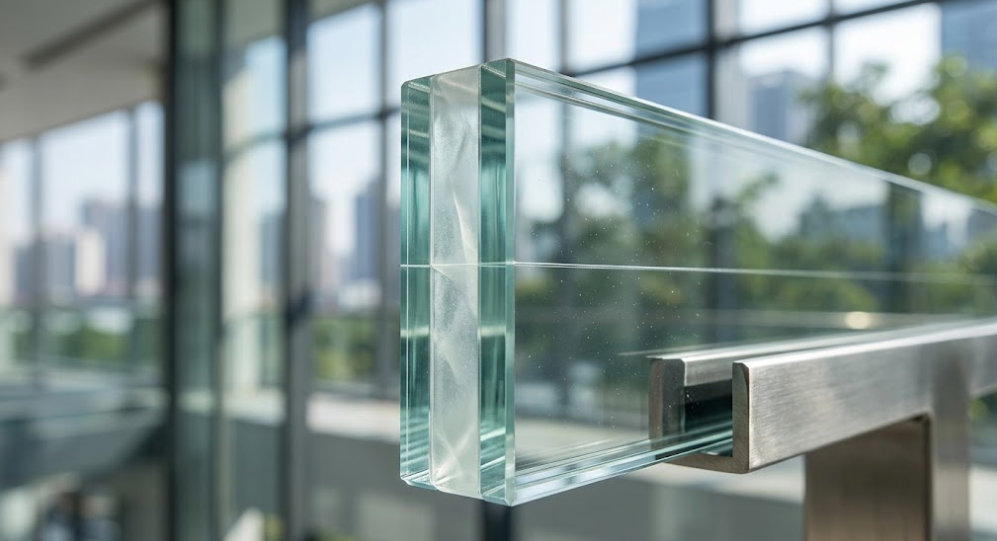
Laminated glass is made by bonding two or more layers of glass together with a tough, flexible interlayer sandwiched in between, most commonly polyvinyl butyral (PVB). Under heat and pressure, that interlayer fuses permanently to the glass on either side, creating a single, unified panel rather than two separate sheets stacked on top of each other.
That construction is the entire reason laminated glass behaves so differently from ordinary glass, both in terms of safety and in terms of sound. If a laminated pane is struck hard enough to crack, the glass fragments stay bonded to the interlayer instead of shattering into loose shards, which is why laminated glass shows up so often in car windshields, high-rise glazing, and skylights. But that same interlayer also does something less obvious and, for a lot of people, even more valuable day to day it disrupts sound waves in a way that a single sheet of glass, no matter how thick, simply can’t.
✓ The Core Idea in One Sentence
Laminated glass reduces noise because the flexible interlayer between the glass layers absorbs and dampens sound vibrations instead of letting them pass straight through, which is exactly what happens with standard monolithic glass.
Why Sound Moves Through Ordinary Glass So Easily
To understand why laminated glass performs so well, it helps to understand why regular glass performs so poorly. Sound travels as a vibration, and when it hits a rigid, uniform material like a single pane of glass, that vibration passes through the glass almost unchanged and re-emerges as sound on the other side. A single sheet of glass is essentially a stiff membrane with nothing to slow the vibration down or convert it into something other than more sound.
This is why a standard single-pane window does almost nothing to block traffic noise, barking dogs, or a neighbor’s music, and why even reasonably thick single-pane glass still lets a surprising amount of sound through. Thickness alone helps a little, but it’s a fairly weak lever on its own, because you’re still dealing with one uniform, rigid material with nothing to interrupt the sound path.
Double glazing improves on this somewhat by adding an air gap between two panes, and that gap does help reduce some noise. But air is still a relatively efficient path for sound to travel through, particularly at lower frequencies like traffic rumble or bass-heavy music, which is why plenty of people with standard double-glazed windows still notice more outside noise than they expected.
How the Interlayer Changes Everything
This is where laminated glass’s construction actually earns its reputation. The PVB interlayer sitting between the glass layers is a soft, viscoelastic material it flexes and absorbs energy rather than transmitting it cleanly the way rigid glass does. When a sound wave’s vibration hits the first pane, travels into the interlayer, and tries to continue into the second pane, a meaningful amount of that vibrational energy gets converted into heat inside the interlayer instead of passing through as sound. Acoustic engineers call this effect “damping,” and it’s the same basic principle used in soundproofing materials well beyond glass, from vibration-dampening pads under machinery to the rubber layers inside noise-reducing flooring.
The practical result is that laminated glass interrupts the sound path in a way that neither a thicker single pane nor a simple air gap can replicate on its own. It’s not that laminated glass eliminates sound entirely no glazing does that but it meaningfully reduces the amount of sound energy that makes it from one side of the glass to the other, particularly across the mid and high frequency ranges where a lot of everyday noise, conversation, traffic, and street activity, actually sits.
A Simple Way to Picture It
Imagine tapping a single rigid sheet of metal versus tapping two sheets of metal with a thick rubber pad glued between them. The first transmits the vibration cleanly through to the other side. The second absorbs a large share of that vibration in the rubber before it ever reaches the far sheet. That’s essentially what the PVB interlayer is doing inside laminated glass.
Laminated Glass vs. Other Common Options
If you’ve been comparing glazing options, you’ve probably already run into double glazing, thicker monolithic glass, and possibly acoustic or “secondary” glazing add-ons. Here’s how laminated glass actually stacks up against the alternatives people most often consider first.
| Glass Type | How It Reduces Noise | Typical Limitation |
|---|---|---|
| Single-pane standard glass | Minimal thickness alone offers only marginal noise resistance | Provides very little real sound reduction regardless of thickness |
| Double glazing (standard) | Air gap between two panes slows some sound transmission | Still lets through significant low-frequency noise like traffic rumble |
| Thicker monolithic glass | Marginally reduces some high-frequency sound | Adds weight and cost without addressing the underlying transmission path |
| Laminated glass | PVB interlayer dampens vibration and absorbs sound energy directly | Best performance typically comes from asymmetric laminated configurations, which need to be specified correctly |
| Laminated + double glazing combined | Combines the air gap of double glazing with the damping interlayer of lamination | Higher upfront cost, though it delivers the strongest overall acoustic result |
The table above isn’t meant to suggest every other option is useless double glazing genuinely helps with thermal performance and offers some noise benefit, and there are situations where it’s the right call for reasons that go beyond sound alone. But if noise reduction specifically is the priority driving your decision, laminated glass is consistently the option that addresses the actual physics of how sound moves through glass, rather than just adding mass or an air gap and hoping it’s enough.
What Kind of Noise Reduction Can You Actually Expect
This is usually the question people care about most, and it’s worth being straightforward about it the exact number depends on the thickness of the glass layers, the thickness and type of interlayer used, whether it’s a single laminated pane or laminated glass combined with an air gap, and the frequency of the noise you’re trying to block.
That said, there are a few general patterns worth knowing as you think through your own situation.
Laminated glass tends to perform especially well against mid- and high-frequency noise conversation, traffic at moderate speeds, general street activity, barking, and similar everyday sounds. This is the frequency range where the damping effect of the PVB interlayer is most effective, which is also the frequency range most people notice most in daily life.
Low-frequency noise, like heavy truck traffic, construction, or deep bass, is harder to block with any glazing solution, laminated included, simply because low-frequency sound waves carry more energy and are inherently more difficult to dampen. This is where combining laminated glass with an air gap, effectively laminated double glazing, tends to make the most noticeable difference, since the air gap and the damping interlayer are addressing the problem from two different angles at once.
Asymmetric laminated configurations, where the two glass layers are different thicknesses, generally outperform symmetric ones for sound. This is a detail worth knowing before you finalize a spec, because a laminated unit built from two identical-thickness panes doesn’t perform quite as well acoustically as one where the layer thicknesses are deliberately varied, since matching thicknesses can actually resonate at similar frequencies and partially cancel out some of the benefit.
Why a Real Assessment Matters More Than a Generic Number
You’ll find plenty of general noise-reduction figures for laminated glass online, but the actual performance for your specific window or wall depends on your glass thickness, interlayer specification, frame and seal quality, and the type of noise you’re actually dealing with. A number that applies to a downtown office facing a highway isn’t necessarily the number you’ll get in a quiet residential street with occasional traffic. This is exactly the kind of detail worth walking through with someone who can look at your actual space rather than relying on a generic average.
Understanding Acoustic Ratings Without Getting Lost in Numbers
If you spend any time researching this topic, you’ll eventually run into acoustic ratings like STC (Sound Transmission Class) or Rw (Weighted Sound Reduction Index), depending on which standards are referenced in your region. These numbers describe how much a material reduces sound overall, and higher numbers mean better noise reduction. Standard single-pane glass typically sits at a fairly low rating, while laminated glass, and especially laminated glass combined with an air gap, sits meaningfully higher.
The important thing to understand isn’t the exact number itself, since ratings are measured under specific lab conditions that don’t always translate perfectly to a real building with its own frames, seals, and installation quality. What matters more is the relative comparison laminated glass consistently outperforms standard glass of similar thickness on these ratings, and the gap tends to widen further once you factor in an air gap or asymmetric layer thicknesses.
A useful way to think about it in practical terms a jump of roughly 10 points on these scales is generally perceived by the human ear as sound being cut roughly in half. That’s a meaningful, noticeable difference in daily life, not just a marginal improvement on paper. It’s also why people who upgrade to laminated glazing near a busy road or in a shared-wall apartment often describe the change as immediately obvious, rather than something they had to get used to over time.
Where this gets useful for you specifically is in comparing quotes or specifications from different vendors. If someone hands you a laminated glass quote without any mention of interlayer thickness, glass thicknesses, or whether the configuration is symmetric or asymmetric, it’s worth asking, since those details are exactly what determines whether you’re getting the acoustic performance the material is capable of, or just the word “laminated” without the specification actually optimized for sound.
Where Laminated Glass for Soundproofing Makes the Biggest Difference
Homes near busy roads, airports, or train lines. If outside noise is affecting sleep, focus, or general comfort, laminated windows are one of the most direct ways to address it without changing the layout of your home or resorting to heavy curtains and white-noise machines as a workaround.
Apartments and condos with shared walls or busy hallways. Sound doesn’t only come from outside a lot of urban living involves managing noise from neighboring units, and laminated glass in interior partitions or windows facing communal areas can meaningfully cut down on that bleed-through.
Offices and conference rooms where privacy and focus matter. Open-plan offices increasingly rely on glass partitions for a light, modern feel, but standard glass partitions do very little to actually contain conversation. Laminated glass partitions let a space keep its visual openness while still giving meeting rooms genuine acoustic privacy.
Restaurants, retail stores, and hospitality spaces on busy streets. A large glass storefront looks great and lets in natural light, but it can also let in a lot of street noise if it’s built from standard glass. Laminated storefront glazing keeps that visual openness while significantly reducing how much of the street’s noise actually makes it inside.
Recording studios, home theaters, and music practice rooms. These spaces need sound control in both directions keeping outside noise from interfering with recording, and keeping the sound generated inside from disturbing neighbors or the rest of the building. Laminated glass, often combined with an air gap, is a standard part of how these spaces are built.
Healthcare facilities and religious spaces. Clinics, hospitals, and places of worship all benefit from controlled acoustic environments, whether that’s protecting patient privacy in consultation rooms or preserving a quiet, contemplative atmosphere inside a mosque or church despite activity on the street outside.
Soundproofing Isn’t the Only Reason People Choose Laminated Glass
It’s worth knowing that laminated glass earns its place in a project for more than one reason at once, which is part of why it’s become such a common default rather than a specialized, expensive add-on reserved only for extreme noise situations.
Safety and security. Because the interlayer holds broken glass fragments in place, laminated glass resists full penetration even when cracked, which is why it’s widely used in ground-floor storefronts, skylights, and any application where forced entry or impact safety is a real concern alongside noise.
UV protection. The PVB interlayer blocks a significant share of UV radiation, which helps protect interior furnishings, artwork, and flooring from sun-related fading over time, an especially relevant factor for large glass installations with significant direct sun exposure.
Structural reliability in demanding applications. Skylights, sloped glazing, and overhead glass installations often require laminated construction specifically because of how it behaves if the glass is ever compromised, holding together rather than falling as loose shards.
This overlap matters because it means choosing laminated glass for noise reduction rarely comes at the cost of trading away other benefits you’d want anyway. A laminated window facing a busy street isn’t just quieter it’s also safer, more UV-resistant, and generally more durable over its lifespan than the standard glass it’s replacing.
Common Questions People Have Before Moving Forward
Does laminated glass eliminate outside noise completely?
No glazing solution eliminates sound entirely, and it’s worth being direct about that rather than overselling it. What laminated glass does is meaningfully reduce the amount of sound that transmits through, often bringing a noisy space down to a level where normal activity, conversation, sleep, focused work, becomes realistic again, even if some faint background noise remains.
Is laminated glass the same as double glazing?
No, and this is one of the more common points of confusion. Double glazing refers to two panes of glass separated by an air gap, while laminated glass refers to two or more panes bonded together with an interlayer in between, with no air gap involved. The two can also be combined, laminated glass used as one or both panes of a double-glazed unit, which is generally the strongest configuration for overall acoustic performance.
Is laminated glass significantly more expensive than standard glass?
It typically costs more than standard single-pane or basic double-glazed glass, largely due to the interlayer material and the additional manufacturing step of bonding the layers together under heat and pressure. That said, the cost difference needs to be weighed against what you’re actually getting meaningful noise reduction, added safety, and UV protection all in the same panel, rather than paying separately to address each of those needs.
Can laminated glass be used in existing window frames, or does it require a full window replacement?
This depends heavily on your existing frame and window system. In some cases, laminated glass can be retrofitted into existing frames in others, particularly older or non-standard frames, a fuller window or glazing system replacement makes more sense. This is exactly the kind of detail that’s difficult to answer generically and genuinely benefits from someone looking at your actual windows or partitions.
Will laminated glass make a room darker or change how it looks?
Laminated glass is available in clear finishes that look essentially identical to standard glass, so in most residential and commercial applications there’s no meaningful visual trade-off. It’s also available in tinted, frosted, and decorative finishes if you’re looking to combine noise reduction with a specific aesthetic or privacy goal.
How do I know if laminated glass is actually going to solve my specific noise problem?
The honest answer is that it depends on the type and intensity of noise you’re dealing with, your current glazing setup, and your building’s overall construction. Laminated glass handles a wide range of everyday noise situations very well, but a space next to a genuinely extreme noise source, a rail line running directly alongside a building, for example, may need laminated glass combined with an air gap, better frame sealing, or additional measures to get the result you’re picturing. Understanding which category your situation falls into is exactly the kind of thing worth discussing before committing to a specific glass spec.
Getting a Real Answer for Your Specific Space
Everything above is genuinely useful for understanding why laminated glass performs the way it does, but it’s not a substitute for actually looking at your specific windows, walls, or partitions. How much of a difference laminated glass will make in your situation depends on details, your current glass type, frame condition, the specific noise source you’re dealing with, and how the space is used, that are hard to generalize accurately from a blog post alone.
If noise has become a real problem in a home, office, storefront, or any other space you’re responsible for, it’s worth understanding what laminated glass installation would actually look like for your specific project before deciding anything. A proper look at your space, including its light and noise exposure, current glazing, and what you’re actually trying to achieve, is the only way to get a real, specific answer instead of a generic estimate that may or may not match your situation.
A Simple Way to Think About Next Steps
You don’t need to have already decided that laminated glass is definitely the right call, or know the exact specification you’d need. Working through those specifics with you is exactly what a proper conversation about your space is for. If you can point to a room or window where noise is a genuine, ongoing problem, that’s already enough of a starting point.
Noise problems tend to get pushed down the priority list precisely because they don’t feel urgent the way a leak or a broken appliance does they just quietly make a space less comfortable, day after day, until it starts to feel normal to live or work around them. Laminated glass exists largely to solve exactly that kind of problem, using a genuinely different approach to blocking sound than the glass most buildings are already built with.
If you’re ready to see what that would actually look like for your specific space, schedule a free consultation to talk through your noise situation, current glazing, and what a realistic laminated glass solution would involve, or get an instant quote via WhatsApp if you already have a clear picture of what you’re working with.