Table of Contents
Think about the last time you walked into a really good hotel bathroom or a beautifully designed spa. Chances are the thing you remember is not the tiles or the tap. It is the feeling of the room soft, even light, a mirror that seemed to glow rather than simply reflect, and a space that felt calm even at seven in the morning. More often than not, that feeling was created by one carefully chosen element on the wall, a decorative LED mirror.
Bathrooms are among the smallest rooms in a home, yet they are used every single day, often at the two moments that shape our mood the most first thing in the morning and last thing at night. For years most of us treated the mirror as a purely practical object, a rectangle of glass that sat above the basin and did its job without any fuss. That is changing quickly. Homeowners, interior designers and hospitality planners are now treating the mirror as a design feature in its own right, one that carries light, shape and personality into the room.
This guide is for anyone who is simply curious. You may be renovating, you may be daydreaming about a refresh, or you may have seen a glowing mirror in a hotel and wondered what it was. We will walk through what decorative LED mirrors actually are, how they work, why they change the atmosphere of a bathroom so noticeably, and what is worth understanding before you ever think about buying one. There is no sales pitch here, only a clear explanation of an idea that is reshaping modern bathrooms.
What Is a Decorative LED Mirror?
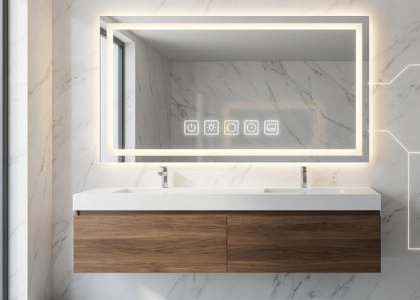
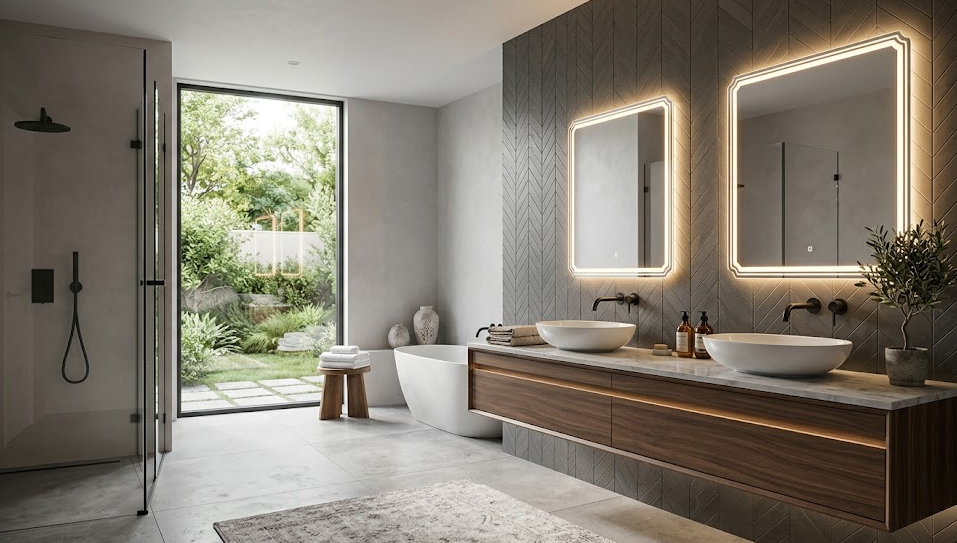
A decorative LED mirror is a mirror with built-in light-emitting diodes, usually hidden along the edge, behind the glass, or around a frame, so the mirror produces its own illumination. Instead of relying only on a ceiling fitting or a pair of wall lights, the mirror itself becomes a light source. Because LEDs are slim, efficient and cool-running, designers can place them almost anywhere, which is why these mirrors come in such a wide range of shapes and styles. The word “decorative” matters. A basic lit mirror exists to help you see your face. A decorative LED mirror is designed to be looked at as well as looked into. It might have a soft halo of light around its outline, a slim glowing band along one side, a sculpted frame, or an unusual silhouette such as a full circle, an arch or an organic curve. In many bathrooms it becomes the first thing your eye lands on when you enter, in the same way a statement painting does in a living room. Under the surface, the construction is fairly simple. A quality mirror starts with a silvered glass panel, often with a protective backing to resist humidity. LED strips are fitted either behind the glass, where light shines through carefully etched or cleared sections, or along the perimeter, where it bounces off the wall to create a gentle glow. A small driver converts household power to the low voltage the LEDs need, and a touch sensor or switch controls brightness. That is really all there is to it, and the simplicity is part of the appeal.Why the Bathroom Mirror Deserves a Second Look
Most bathrooms are lit badly, and most people have simply learned to live with it. A single ceiling light directly overhead casts shadows under the eyes and nose, flattens colour, and makes the face look tired. Anyone who has tried to shave, apply make-up or check a shirt collar under a harsh overhead bulb knows the frustration. The mirror reflects whatever light the room provides, so if the light is poor, the reflection is poor too. An LED mirror tackles this problem at its root. Because the light comes from around or behind the mirror, it falls across your face from the front and sides, which is the direction that flatters and reveals the most detail. Shadows soften. Skin tones look closer to their natural colour. Fine tasks become easier. This is the same principle that photographers and make-up artists have used for decades with ring lights and vanity bulbs, now built neatly into a piece of bathroom furniture. There is also a design reason. Bathrooms are full of hard, reflective, practical materials tile, ceramic, chrome and glass. They can easily feel cold or clinical. A glowing mirror adds warmth and visual interest without clutter, and it does so on a wall that is already there. You do not need extra floor space, extra furniture or a major rebuild. For small bathrooms in particular, where every centimetre counts, this is a meaningful advantage.The Main Styles of LED Mirrors
Once you start looking, you will notice that decorative LED mirrors fall into a handful of broad families. Understanding them makes it much easier to picture what might suit a particular room. Backlit mirrors have LEDs mounted behind the glass, so light spills out from behind the mirror’s edge and onto the wall. The effect is a soft halo that makes the mirror appear to float. Because the light is indirect, it is gentle on the eyes and ideal for creating an ambient, spa-like mood, especially in the evening. Front-lit mirrors have light that shines through clear or frosted strips on the face of the mirror and toward you. This is the practical champion. It lights the face directly and evenly, which makes it excellent for grooming, shaving and make-up. Many modern designs combine front-lit and backlit LEDs so one mirror can serve both functions. Round and oval mirrors soften a room full of straight lines. Bathrooms tend to be geometric, with rectangular tiles, square basins and straight cabinets, and a circular glowing mirror breaks that rhythm in a pleasing way. A single round mirror above a basin is one of the simplest ways to make a plain bathroom look considered. Arched and sculpted mirrors borrow from classical architecture and bring a sense of elegance. A tall arch with a thin line of light around its curve feels both timeless and contemporary, and it suits bathrooms with warm colour palettes, natural stone or brass fittings. Rectangular and full-width mirrors remain the most popular choice because they suit nearly every layout. A wide mirror above a double vanity, edge-lit and clean, makes a bathroom feel larger and brighter. Slim vertical versions work well beside a basin or in a narrow powder room. Smart LED mirrors add extra functions such as touch dimming, adjustable colour temperature, built-in clocks, anti-fog heating and sometimes even speakers or displays. These sit at the more technical end of the range and are covered in more detail in the features section below. If you are curious about how these work in practice, you can read about an LED smart mirror to see what the category includes.How Light Changes the Way a Bathroom Feels
The real magic of an LED mirror is not the mirror. It is the light. And light has a bigger effect on how a space feels than almost any other design element, which is why it is worth understanding a few simple ideas. Colour temperature describes how warm or cool a light appears and is measured in kelvins. Lower numbers, around 2700K to 3000K, give a warm, golden glow similar to candlelight or an old-fashioned bulb. Middle numbers, around 4000K, give a neutral white that looks clean and natural. Higher numbers, 5000K and above, give a cool, bluish daylight tone. Warm light feels relaxing and flattering, which suits evenings and bathing. Cooler light feels alert and precise, which suits early mornings and detailed grooming. Many decorative LED mirrors let you switch between these tones so the room can match the moment. Colour rendering, often shown as CRI, describes how accurately a light shows true colours. A low rating can make skin look grey or make a red shirt look brown. A high rating, generally 90 or above, shows colours the way daylight would. This matters more than most people expect, because the bathroom mirror is where we judge our appearance before we leave the house. Brightness and dimming are equally important. A mirror that is too bright at night is jarring, and one that is too dim in the morning is useless. Dimmable LEDs solve this by letting you set a soft glow for a midnight trip to the bathroom and a brighter, crisper level for getting ready. Some people use the lowest setting as a gentle night light, which is both comfortable and practical. Glare and diffusion complete the picture. Good decorative mirrors hide the actual LED points behind frosted or diffused channels so you see a smooth band of light rather than a row of tiny bright dots. That small detail separates a thoughtful design from a cheap one, and it is easy to spot once you know to look for it.Five Ways an LED Mirror Transforms a Bathroom
1. It makes the room look larger. Mirrors already double the visual depth of a space, and adding light amplifies the effect. A softly glowing mirror pushes the eye toward the wall, lifts the brightness of the whole room, and reduces the shadowy corners that make small bathrooms feel cramped. Many designers use a large LED mirror as the simplest tool for opening up a narrow or windowless bathroom. 2. It creates a mood. A bathroom can be a place to rush through or a place to unwind, and light usually decides which. With a warm, dimmed LED mirror and perhaps a candle or two, an ordinary evening bath starts to feel like a small retreat. Because the light comes from the mirror rather than the ceiling, it avoids the overhead glare that breaks the calm. 3. It improves everyday tasks. Shaving, skincare, make-up, hair styling and even brushing your teeth become easier with even, shadow-free light on the face. People who struggle with the dim, patchy lighting in older bathrooms often find this to be the benefit they notice first and appreciate most. 4. It adds a sense of luxury. There is a reason glowing mirrors are standard in upscale hotels and spas. Soft light, clean lines and a floating appearance signal quality at a glance. Installing one can make a modest bathroom feel more expensive without changing the tiles, the fittings or the layout. 5. It works as a focal point. Every well-designed room has somewhere the eye naturally goes. In many bathrooms there is no such place, so everything blends into a blur of white and grey. A decorative LED mirror gives the room a clear centre of attention, and the rest of the design can be arranged around it with confidence.Worth Noting None of these benefits depend on a mirror being expensive or elaborate. A simple, well-proportioned mirror with good, even light often does more for a bathroom than a complicated one with every feature switched on. In design, restraint usually looks better than excess.
Matching a Mirror to Your Bathroom Style
A decorative mirror should feel as if it belongs in the room, not as if it was added afterward. A few simple pairings can help you picture how different styles work together. Modern and minimalist bathrooms suit slim, frameless rectangles or perfect circles with a thin line of backlighting. Think white walls, large format tiles, matte black or brushed steel fittings. The mirror should almost disappear, leaving the glow as the only decoration. Warm contemporary bathrooms with beige stone, timber textures and brass or gold accents look beautiful with arched or oval mirrors and a warmer light tone around 3000K. The soft curve and golden glow echo the natural materials. Classic and traditional bathrooms can carry a mirror with a more sculpted frame or a decorative outline, as long as the lighting is discreet. The idea is to bring in the benefits of modern LED light while respecting the older character of the room. Boutique and statement bathrooms, such as those in restaurants, salons and guest powder rooms, are where bolder shapes shine. Oversized circles, layered shapes, or mirrors with coloured or patterned light can turn a small room into something guests remember and photograph. Scale matters as much as style. As a general guide, a mirror above a basin should be a little narrower than the vanity so it looks anchored rather than crowded, while a mirror over a double vanity can run nearly the full width for a calm, continuous look. Height is also worth thinking about, because the mirror should work for the tallest and shortest people who use it.
Curious how a glowing mirror might look in your own bathroom?