Most people who search for the cost of glass railings for stairs have already made one decision they like the look of glass railings. They’ve seen the clear, uninterrupted lines in a friend’s villa or a hotel lobby, and they’ve moved past the question of whether glass suits their staircase. What’s left is the harder, more practical question
what will this actually cost me, and how do I know I’m paying a fair price?
That’s the question this cost guide to glass railings for stairs is built around. Not “should you choose glass,” but how to evaluate the options, understand why two quotes for the same staircase can differ by 40 or 50 percent, and walk into a conversation with a supplier knowing exactly what to ask. If you’re comparing suppliers, systems and budgets right now, you’re in the right place.
A quick note before we start the guidance in this guide reflects how Green Glass Designer prices its
staircase glass railing installation across Pakistan. Pricing is calculated per running foot, and the final figure always depends on your staircase, your site, and the specification you choose, so treat this guide as a way to understand and compare, not as a fixed price list.
The Short Answer: What Glass Railings for Stairs Cost
Glass railings for stairs are priced per running foot, meaning the total length of railing along the stairs, including any landing or balcony return. Most projects fall into one of three bands, determined mainly by how the glass is held in place and how thick and protected the glass is.
| Tier |
Typical system |
Relative cost |
Best suited to |
| Essential |
Tempered glass, semi-frameless, stainless steel posts and clamps |
Lowest |
Family homes, budget-conscious upgrades, straight stairs |
| Mid-range |
Thicker tempered glass, standoff or spigot fixings, steel handrail |
Moderate |
Modern villas, offices, mezzanines |
| Premium |
Frameless laminated glass, base channel, concealed fixings |
Highest |
Luxury homes, hotels, atriums, public buildings |
These bands overlap on purpose. A complex staircase in the “Essential” system can cost more than a simple one in the “Mid-range” system. That’s why the rest of this guide focuses on the factors beneath the headline number.
Worth Noting A price per foot is only comparable between suppliers when the specification behind it is identical same glass type, thickness, hardware grade, and handrail. A lower figure often means a lower specification, not a better deal.
What Actually Drives the Price
Seven factors account for nearly all the variation between one glass railing quote and another. Understanding each gives you something concrete to compare, rather than just a total at the bottom of a page.
1. Glass type for glass railings: tempered vs. laminated
Tempered glass is heat-treated to be several times stronger than ordinary glass, and when it fails it breaks into small, blunt granules rather than sharp shards. It’s the standard choice for glass railings on residential stairs and the most economical safe option.
Laminated glass bonds two or more glass layers around a tough interlayer. If one layer cracks, the interlayer holds the pieces in place, so the panel stays standing rather than collapsing. That’s why laminated glass is preferred for frameless systems, public buildings, and any railing where a fall would be serious. It costs more, often adding a noticeable share to the glass component, but the added safety margin is the main thing you’re buying. You can read more about it on our
laminated glass installation page.
For a ground-floor stair in a family home, tempered is usually enough. For a double-height void, a mezzanine edge, or a commercial lobby, laminated is worth serious consideration, and in some project types it’s effectively expected.
2. Glass thickness
Thickness moves price in a fairly predictable way. Common thicknesses for glass railings for stairs run from 10 mm to 12 mm for tempered panels, and from roughly 17.5 mm to 21.5 mm for laminated assemblies. Thicker glass costs more per square foot, weighs more (which affects handling and fixing), and may need stronger hardware. Thicker is not automatically better, though. The correct thickness depends on panel height, span between supports, and how the glass is fixed. A supplier who recommends a thickness without asking about those details isn’t doing the engineering.
3. The fixing system
This is often the biggest single swing factor, and the one buyers understand least.
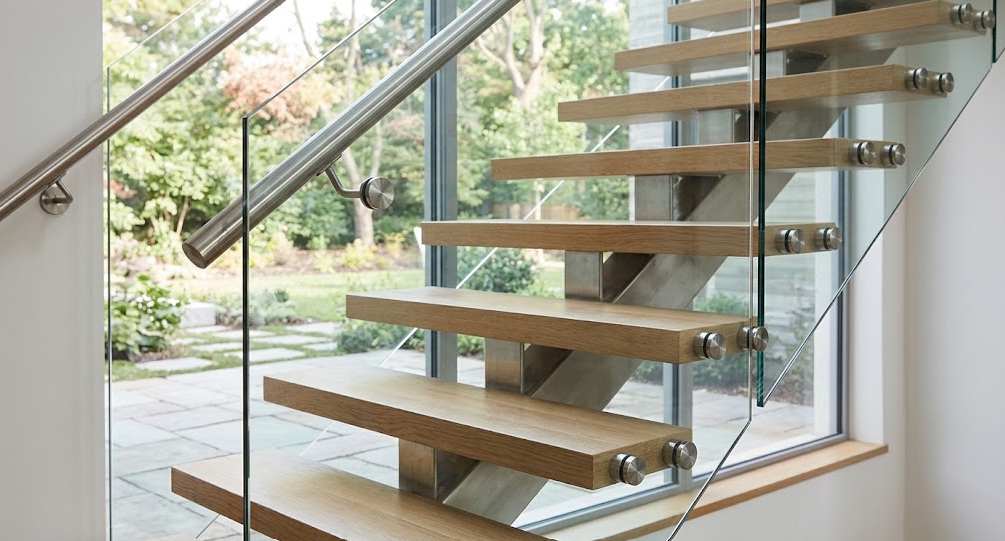
Semi-frameless (post and clamp): Glass panels sit between stainless steel posts and are held by clamps. It’s the most economical and visually clean, though posts break up the glass line.
Standoff or spigot systems: Glass is held by round metal fittings bolted through or clamped to the panel, or by spigots at the base. They create a lighter look with fewer visible supports, at a higher hardware cost.
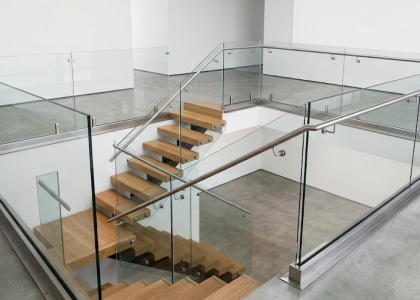
Frameless with base channel: Panels sit in a continuous aluminium or steel channel at the floor or stair edge, grouted or wedged in place. There are no posts at all, so the glass reads as one uninterrupted surface. This is the premium look, and it carries the premium fabrication and installation cost, partly because the channel needs a structurally sound edge to fix into.
Our range of
glass railings for stairs covers all three approaches, so the choice can follow your design rather than the other way around.
4. Handrail: yes, no, or built-in
Many building codes and safety standards require a graspable handrail on stairs, and in some cases glass alone doesn’t satisfy that. Adding a stainless steel or timber handrail adds cost per foot, but it also adds a structural tie between panels, which helps overall stability and provides a safeguard if one panel is damaged. Handrail material, profile, and finish (brushed, polished, powder-coated, wood) all shift the price. A slim brushed stainless handrail is an economical choice a custom timber handrail with concealed joints sits at the other end.
Frameless systems sometimes omit a handrail for the cleanest look, but this should always be a deliberate, safety-checked decision, not an afterthought to save money.
5. Staircase geometry
A straight, single-flight stair is the simplest and cheapest geometry. Costs rise with every added complication.
Angles and turns: L-shaped, U-shaped, and winder stairs require panels cut to multiple angles, more precise measurement, and more careful fitting.
Raked panels: Because the stair slopes, each panel on a flight is typically a parallelogram or trapezoid, cut to follow the pitch. Fabrication is more involved than for a flat balustrade panel.
Curved or spiral stairs: Bent glass is a specialist product with a long lead time and a substantially higher price. If you’re tempted by a curved stair but working to a tight budget, this is the area to think hardest about.
Landings, mezzanines, and balconies: These add straight, flat runs of glass. They’re usually cheaper per foot than raked stair panels, but they add to total running footage.
6. Glass finish and customization
Clear glass is the baseline. Moving beyond it adds cost low-iron (ultra-clear) glass removes the faint green tint of standard glass tinted and reflective glass changes the mood frosted, etched, or printed glass adds privacy or a design element. Our
decorative glass range offers these options, and for stairs they can be as simple as a frosted band at the base of the panel, or as expressive as a patterned panel set into an otherwise clear run.
7. Site conditions and installation
The same railing costs differently to install depending on the building. Factors include the structural material of the stair edge (concrete is easy to fix into hollow block or thin slabs may need reinforcement), the height and access of the staircase, whether the floors are already finished (tiled floors need careful core drilling), and how far the project is from the fabrication facility. These are why a reliable quote always follows a site visit rather than a phone call.
Not sure which system fits your staircase?
Three Common Staircase Scenarios
Costs become easier to judge when they’re attached to real layouts. These three scenarios show how running footage, system choice, and glass type combine to place a project in a lower, middle, or higher cost bracket. Your own quote will be confirmed after a site visit.
Scenario 1: Straight single-flight stair in a family home
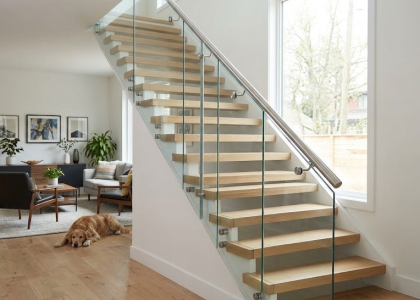
A 12-foot straight staircase with a 4-foot upper landing return gives roughly 16 running feet. With a tempered, semi-frameless system, this sits in the lowest cost bracket. Adding a handrail or thicker glass moves it toward the middle.
Scenario 2: L-shaped stair with landing in a villa
An L-shaped stair with two flights and a landing, totalling about 30 running feet, in a mid-range standoff system, sits in the middle bracket. The corner and landing mean more angled cuts and careful alignment, which is why it costs more per foot than a straight flight.
Scenario 3: Premium frameless laminated stair and mezzanine
A double-height lobby with a 24-foot stair and a 16-foot mezzanine edge (40 running feet) in frameless laminated glass with a base channel sits in the highest bracket. At this level, glass quality, edge finish, and installation precision matter as much as price, and the structural edge must be checked before ordering.
Worth Noting Notice how total cost depends far more on running footage and system choice than on any single feature. That’s why measuring accurately, and deciding your system early, saves more money than haggling over a final figure.
Why Choose Glass Railings for Stairs? A Quick Cost-Benefit View
Before going deeper into budgets, it helps to be clear about what you get for the money. Glass railings for stairs keep the staircase open, so daylight passes through the stairwell instead of being blocked by solid balusters. Glass railings also suit almost any interior style, from a modern villa to a corporate lobby, and they’re easy to keep clean. Because tempered and laminated glass railings are engineered safety products, you’re paying for strength and durability as well as appearance.
The trade-off is that glass railings cost more upfront than basic metal. The question to ask is not “are glass railings expensive?” but “which glass railing specification gives my staircase the right balance of safety, look, and budget?” The sections below answer exactly that.
Costs People Forget to Budget For
An estimate for glass railings for stairs that only counts glass and hardware can leave you surprised halfway through the project. Ask specifically about the following.
Structural preparation. If the stair edge isn’t strong enough to anchor a base channel or standoffs, it may need reinforcement before installation. This is far cheaper to discover during a site visit than on installation day.
Floor and wall repair. Drilling into finished tile, marble, or plaster can leave marks. Confirm whether making good is included, or whether you need your own tiler or painter afterwards.
Handrail and end fittings. Some quotes list the handrail separately, or leave out wall brackets and end caps. Check what “complete” means in practice.
Transport and access. Large glass panels need careful handling. Narrow staircases, upper floors without a lift, or remote locations can raise delivery and labour costs.
Re-measurement and remakes. Tempered glass can’t be cut or altered after it’s made. If measurements are off by even a few millimetres, the panel must be remade. A supplier who measures on site, rather than working from your drawings, protects you from paying for this mistake.
Future maintenance. Stainless steel fittings on glass railings in humid or coastal areas like Karachi benefits from the right grade (304 or 316) and periodic cleaning. Cheaper grades can show surface rust within a couple of years, which is a recurring cost the original quote never mentioned.
Glass Railings vs. Other Railing Materials: Where Does the Cost Sit?
If you’re still weighing materials, it helps to see where glass sits in relation to the alternatives. We cover this in depth in our comparison of
glass railings vs. steel railings, but here’s the cost-focused summary.
| Material |
Upfront cost |
Maintenance |
Look and light |
| Mild steel / iron |
Lowest |
Needs repainting, prone to rust |
Solid, blocks views |
| Stainless steel rods |
Low to medium |
Low |
Industrial, slim, partial views |
| Timber |
Medium |
Periodic polishing |
Warm, traditional |
| Glass (tempered, post-supported) |
Medium |
Low, wipe-clean |
Open, bright |
| Glass (frameless laminated) |
Highest |
Low |
Seamless, premium |
Glass railings usually cost more upfront than basic steel, but it tends to cost less to keep looking good. There’s no repainting, no rust treatment, and no re-polishing. Over the life of a staircase, that can narrow the gap. And unlike steel or timber, glass lets light travel through a stairwell, which can make a narrow or windowless staircase feel noticeably larger. That benefit doesn’t show up on a quote, but many owners count it among the most valuable.
How to Lower the Cost of Glass Railings for Stairs Without Lowering Safety
If your first estimate is above your budget, there are sensible ways to bring it down that don’t involve cutting the things that keep the railing safe.
Choose a semi-frameless system. Post and clamp systems give most of the visual benefit of glass railings at a significantly lower cost than a frameless channel.
Keep the glass clear. Standard clear tempered glass is the most economical. Save low-iron, tinted, or decorative finishes for a feature area rather than the entire run.
Mix systems. Some projects use frameless glass only on the most visible flight, such as the one seen from the entrance, and a simpler system elsewhere.
Standardize panel sizes. Repeating identical panel widths where the staircase allows it simplifies fabrication and reduces waste.
Install at the right time. Installing before final floor finishing, or coordinating with other trades, avoids damage and repair costs later.
Don’t compromise on these. Glass type appropriate for the location, correct thickness for the span, and quality fixings are the parts that matter if something goes wrong. A railing that’s cheaper because it uses thinner glass, lighter hardware, or no engineering check isn’t a saving, it’s a risk.
What a Good Quote for Glass Railings Should Include
When you collect quotes for glass railings for stairs from two or three suppliers, use the checklist below to compare them fairly. If a quote leaves out several of these, ask before you commit.
The specification: Glass type (tempered or laminated), thickness in mm, and whether it’s clear, low-iron, tinted, or frosted.
The system: Semi-frameless, standoff, spigot, or base channel, with the hardware grade (for example, stainless steel 304 or 316).
The handrail: Material, profile, finish, and whether it’s included in the per-foot rate.
Measurements: Total running feet, and confirmation that these were taken on site.
Inclusions and exclusions: Delivery, installation, core drilling, making good, and any structural work.
Timeline: Fabrication time and installation days, stated in writing.
Warranty and after-sales: What is covered, for how long, and who to call if a fitting loosens or a panel needs replacing.
Safety compliance: Confirmation that the glass and fixings meet recognised safety and load standards.
Green Glass Designer’s approach is built around this kind of transparency quotes with no hidden charges, and a specification you can check line by line. It’s also worth asking any supplier for completed project references. You can browse ours on the
Project References page.
Timeline: From Site Visit to Handover
Understanding the process helps you plan around your own project schedule, and it shows how cost is linked to each stage.
1. Site visit and consultation. We measure the staircase, check the structural edge, and discuss your design preferences and budget.
2. Design and material selection. You choose the railing style, glass type, and support system, with a written quote based on that specification.
3. Fabrication. Panels are cut, edge-finished, and tempered or laminated to the measured sizes.
4. Delivery. Protected transport to your site, anywhere in Pakistan.
5. Installation. Anchors, supports, and glass are fitted and safety-checked.
6. Final inspection and handover. We review the finished railing with you, and the warranty starts.
Most installations of glass railings for stairs are completed within 7 to 12 working days, depending on size and customization. Curved glass and unusual finishes can take longer.
Frequently Asked Questions
1. How much do glass railings for stairs cost per foot in Pakistan?
At
Green Glass Designer, staircase glass railing installation is priced per running foot. The final price depends on glass type, thickness, fixing system, handrail, and the complexity of your staircase.
2. Is laminated glass worth the extra cost for glass railings for stairs?
For many residential stairs, tempered glass is perfectly adequate. Laminated glass is worth the extra investment where the fall height is significant, where the railing is frameless, or in public and commercial spaces, because the interlayer keeps the panel in place if the glass cracks.
3. Why do two quotes for the same staircase differ so much?
Usually because the specifications differ glass thickness, glass type, hardware grade, handrail inclusion, or installation scope. Compare quotes line by line using the checklist above rather than comparing totals.
4. Can I add glass railings to an existing staircase?
Yes, in most cases. The key question is whether the existing stair edge or structure can securely anchor the fixings. A site visit will confirm whether reinforcement is needed.
5. Are glass railings safe for homes with children?
Properly specified glass railings, using tempered or laminated safety glass, correct thickness, and quality fixings, are safe and widely used in family homes. Fully frameless systems and horizontal gaps should be discussed with your installer if you have small children, so the design suits their needs.
6. How do I maintain glass railings for stairs?
Wipe the glass with a soft cloth and a non-abrasive glass cleaner, and clean stainless steel with a mild solution. Avoid harsh chemicals on handrails and fittings, and check that clamps and fixings remain tight during annual cleaning.
7. Does the price include installation?
Our per-foot pricing covers supply and installation, but you should always confirm inclusions in writing, including any structural work, floor repair, or handrail extras, as these vary between suppliers.
Choosing Glass Railings for Stairs With Confidence
Glass railings for stairs are one of the few upgrades that change how a whole space feels, bringing light into a stairwell and replacing a bulky barrier with something that almost disappears. They’re also structural, safety-critical elements, which is why the cheapest quote is rarely the best one, and why understanding what you’re paying for matters more than the headline number.
If you’ve read this far, you probably have a staircase in mind and a rough sense of your budget. The most useful next step is to get the numbers attached to your specific stair an accurate measurement, a clear specification, and a written quote that shows exactly what’s included.
To book a site visit or get a quote tailored to your staircase, reach out for a free consultation or message us directly on WhatsApp. You can also explore more of what we do on our Staircase Glass Railing Installation page.