Table of Contents
You are standing in front of a half-finished staircase, a bare balcony edge, or a terrace that needs something between you and a long drop. The contractor asks a simple question “Glass or steel?” It sounds like a small decision. It is not. A railing is one of the few parts of a building that you touch every day, look at every day, and rely on for safety every day, often without thinking about it.
Most people start this search with a vague feeling rather than a clear comparison. Glass looks modern and bright. Steel looks strong and familiar. Beyond that, the details blur Is glass really safe? Does steel rust? Which one costs more over ten years, not just on day one? Which one will still look good after a few monsoons and a few dusty summers?
This guide is meant to answer those questions plainly. It is not a sales pitch for one material. It is a practical, beginner-friendly comparison that walks through appearance, safety, durability, maintenance, cost, and everyday comfort, so you can decide with confidence. By the end, you should know which option suits your home, your budget, and your lifestyle, and what to ask before you commit.
Why This Choice Matters More Than It Seems
A railing is not decoration alone. It is a safety barrier, a visual feature, and a long-term investment that shapes how a space feels. A heavy, closed-in staircase can make a hallway feel narrow. A light, open one can make the same hallway feel generous. A balcony railing can frame a view or block it. A terrace railing can invite you to sit outside or quietly discourage it. Because railings are installed once and expected to last for decades, a poor choice is expensive to undo. Replacing a railing means removing fixings, repairing surrounding surfaces, and living with disruption. That is why it pays to understand the trade-offs before the first measurement is taken, rather than after the final installation. It also helps to know that “glass versus steel” is slightly misleading. Many modern railings use both glass panels held by stainless steel posts, handrails, or clamps. So the real question is usually about which material takes the lead role in the design, and which plays support.What Each Railing Actually Is
Glass railings
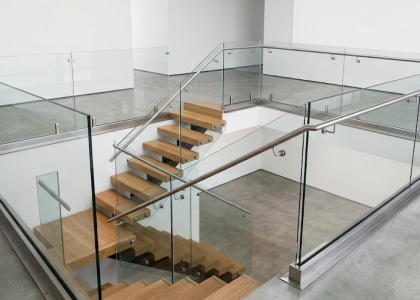
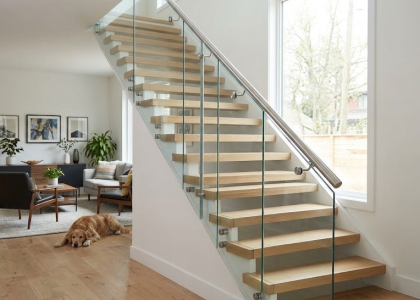
A glass railing uses panels of toughened (tempered) or laminated safety glass as the main barrier. The panels can be held in several ways a channel set into the floor edge, discreet metal spigots, standoff fittings fixed to the side of a slab, or clamps attached to slim posts. Some designs have a handrail along the top, while others are completely frameless, so the glass itself forms the entire barrier. Glass for railings is not ordinary window glass. Safety-rated panels are typically much thicker, often in the range of 10 to 21 mm depending on the system and application, and they are treated or layered to resist impact and to break in a safer way. Our guide on why glass railings are the modern choice for staircases goes deeper into how these systems are built.Steel railings
Steel railings use metal posts, rails, and infill such as vertical balusters, horizontal bars, cables, mesh, or decorative panels. In practice, the word “steel” covers a few different materials. Mild steel (often painted or powder coated) is the most economical, but it needs protective coating to resist rust. Stainless steel contains chromium, which gives it much better resistance to corrosion, and it is the usual choice for premium and outdoor work. Wrought iron and ornamental metalwork are also common, especially in traditional designs. This matters because comparing “glass” with “steel” is only fair if you specify which grade of steel you mean. A powder-coated mild steel railing and a polished stainless steel railing behave very differently over time, even though both are called steel.Looks and Light: The First Thing Everyone Notices
Appearance is usually what starts the debate, so it deserves honest treatment. Glass is defined by transparency. It lets light pass through, keeps sightlines open, and makes spaces feel larger. On a staircase, glass panels allow the stairs to look like they are floating, because there is no heavy visual mass beside them. On a balcony, glass keeps the view uninterrupted. In a double-height living room, glass lets light from one level reach the other. It also pairs well with almost any material, including timber, marble, concrete, and tile, because it does not compete with them. Steel brings structure and character. Slim black steel balusters create a crisp, industrial, or contemporary look. Brushed stainless steel feels clean and modern. Ornamental iron suits classic and heritage-style homes. Steel does not disappear the way glass does it draws lines, adds rhythm, and can become a deliberate design feature. For people who like a defined, graphic look, that is a strength rather than a drawback. In simple terms choose glass if you want the railing to fade into the background, and choose steel if you want it to be part of the visual story. Neither is “better looking” in absolute terms. It depends on the architecture around it and on your own taste. One practical point glass shows fingerprints, water spots, and dust more visibly than most people expect. Steel hides some marks but can show scratches, especially polished finishes. We will return to this in the maintenance section.Safety and Strength: What You Need to Know
Safety is the question people worry about most, and it is where myths are most common.Is glass safe for railings?
Yes, when the right type, thickness, and fixing system are used. Tempered glass is heat-treated to be several times stronger than ordinary glass of the same thickness, and when it breaks it crumbles into small, blunt pieces instead of sharp shards. Laminated glass sandwiches a tough interlayer between two or more sheets, so even if the glass cracks, the pieces stay bonded in place and the barrier remains standing. For many balcony, stair, and terrace applications, laminated safety glass is a sensible choice because it keeps protecting people even after damage. You can read more about this on our laminated glass installation page. Where glass railings go wrong is not the material itself but poor specification glass that is too thin, panels that are not properly supported, or fixings that are undersized. A well-engineered system is designed for the loads a railing is expected to take, including people leaning on it, children pushing against it, and crowds on a busy balcony.Is steel safe for railings?
Steel is inherently strong and ductile, meaning it tends to bend before it breaks. That gives it a reassuring, predictable behavior under heavy load. A properly fixed steel railing resists impact well and does not shatter. Its safety weaknesses are mostly design-related wide gaps between balusters can allow small children to slip through, horizontal bars can act as a ladder for climbing, and poorly anchored posts can loosen over time.The honest comparison
Both materials can be very safe, and both can be unsafe if installed badly. Steel’s advantage is its forgiving behavior under heavy load. Glass’s advantage is that it has no gaps to climb or slip through, which many families with small children find reassuring. In homes with toddlers, solid glass panels remove two of the most common railing worries at once footholds and gaps.Worth Noting
Safety depends far more on the installation than on the material. Whether you choose glass or steel, ask who will design the fixing system, what loads it is designed for, and how the anchoring into the slab or wall is done. A great material fixed badly is still a bad railing.
Durability in Pakistan’s Climate
Pakistan’s climate is demanding on exterior materials. Coastal cities such as Karachi deal with salt-laden humid air. Lahore and Islamabad see intense summer heat, heavy monsoon rain, and dust. Northern regions experience cold winters. A railing that looks great on installation day has to survive all of this.How glass holds up
Glass itself does not rust, rot, or fade. It shrugs off humidity, salt air, and sun without changing color. That makes it an excellent long-term material from a pure durability standpoint. The parts that need attention are the metal fittings, clamps, and channels that hold the glass. These should be stainless steel or properly protected metal, especially near the coast. Rubber or gasket components should also be checked occasionally, as they can age in strong sun.How steel holds up
Here the type of steel matters enormously. Mild steel, even when painted, can develop rust where coatings chip or where water collects at joints and base plates. In humid coastal conditions, this can happen faster. Stainless steel resists corrosion much better, though lower grades can still show surface staining in salty air. Higher grades, often referred to as marine grade, perform better near the sea but cost more. Powder coating and galvanizing can extend the life of mild steel significantly, but chips and scratches must be touched up promptly.Temperature and movement
Both materials expand and contract with temperature. Good systems allow for this movement, using appropriate gaps, gaskets, and fixings. Poorly designed systems may squeak, rattle, or develop stress at joints over time. This is another reason experienced installation matters. In general, for outdoor use in humid or coastal conditions, glass with quality stainless fittings tends to age gracefully, while mild steel demands the most vigilance. For indoor staircases, both materials last essentially indefinitely.Maintenance: What Daily Life Actually Looks Like
Many buyers focus on purchase price and forget the effort of upkeep. Over a decade, this matters. Glass maintenance is simple but regular. Panels need wiping with a soft cloth and a glass cleaner or mild soapy water to remove fingerprints, dust, and water marks. Outdoors, hard water can leave white mineral spots, so drying panels after cleaning helps. Avoid abrasive pads and harsh chemicals that can scratch the surface or damage coatings. A balcony in a dusty area may need cleaning weekly to keep that crystal-clear look. If you do not mind a slightly lived-in finish, monthly is fine. Steel maintenance varies by type. Stainless steel needs occasional wiping to remove fingerprints and stains, and a periodic polish if you want it to stay bright. Painted or powder-coated mild steel needs inspection for chips and rust spots, with touch-up paint applied promptly. Outdoor steel in humid conditions may need repainting every few years. Ornamental iron with intricate patterns can be tedious to clean and repaint because dust collects in the details. The trade-off is this glass needs more frequent cleaning but rarely needs repair. Steel needs less frequent cleaning (in some finishes) but may need protective maintenance over time. If you dislike wiping surfaces, a steel railing with a dark powder-coated finish may feel easier day to day. If you dislike repainting and rust treatment, glass will suit you better.Cost: Upfront Price vs. Long-Term Value
Cost is rarely as simple as “glass is expensive” or “steel is cheap.” Prices depend on thickness, type of glass, grade of steel, design complexity, site conditions, and installation method. Broadly speaking, basic mild steel railings are usually the most economical option upfront. Stainless steel railings cost more, and the price rises with grade and finish. Glass railings typically cost more than basic steel, particularly frameless systems, thick laminated panels, or custom shapes. Curved glass and large, heavy panels sit at the higher end because of the specialist fabrication, handling, and installation involved. But upfront price is only part of the picture. Consider:- Lifetime upkeep: Repainting, rust treatment, and replacement of corroded parts add cost to steel over time. Glass mainly needs cleaning.
- Property value: Glass railings often make interiors look more modern and spacious, which can influence how buyers or tenants perceive a property.
- Replacement risk: Cheaper materials that fail early cost more than a quality installation done once.
- Installation quality: A cheaper railing installed poorly may need rework. A properly engineered system avoids hidden costs.
Privacy, Views and Everyday Comfort
How a railing feels to live with matters as much as how it is built. Views: If your balcony overlooks a garden, skyline, or street scene you enjoy, glass lets you keep it. Steel balusters, even slim ones, create a visual grid you look through rather than past. For some homes, that is perfectly fine for others, it quietly shrinks the view. Privacy: Clear glass offers no privacy, which may be a concern for ground-floor terraces or balconies facing neighbors. In those cases, frosted, tinted, or patterned glass can provide privacy while still letting light through. See our frosted glass options for ideas. Steel with solid infill panels also blocks sightlines, but it blocks light too. Wind and noise: On high-rise balconies, solid glass panels reduce wind, which can make a balcony usable on blustery days. Open steel designs let wind through. Glass can also reduce some street noise, though it is not a soundproofing solution on its own. Touch and temperature: Metal handrails can feel hot after hours in direct summer sun and cool in winter. Glass edges, when fitted with a handrail or properly finished, feel smooth. Timber or capped handrails are a comfortable alternative on either system. Children and pets: Glass panels have no horizontal footholds, which makes climbing harder. Steel with vertical balusters is similarly safe if spacing is tight. Horizontal bar designs are the ones to be cautious about with young children.Side-by-Side Comparison
| Factor | Glass Railings | Steel Railings |
|---|---|---|
| Appearance | Open, light, modern keeps views clear | Defined lines industrial, classic, or contemporary |
| Light & space feel | Excellent spaces feel larger | Good with slim designs heavier designs feel more enclosed |
| Strength | Strong when correctly specified laminated glass adds safety | Very strong and ductile forgiving under heavy load |
| Gaps / climbing | No gaps or footholds in panel designs | Depends on baluster spacing and design |
| Weather durability | Excellent fittings need quality metal | Depends on grade mild steel needs coating care |
| Maintenance | Frequent wiping rarely repaired | Less cleaning may need repainting or rust treatment |
| Upfront cost | Usually moderate to high | Low (mild steel) to high (premium stainless) |
| Privacy | Clear = none frosted/tinted options available | Solid infill gives privacy but blocks light |
| Best for | Staircases, balconies with views, modern interiors | Budget projects, industrial or traditional styles, high-wear areas |