Table of Contents
Most people who reach the point of comparing glass stair railings have already settled the “do I like the look” question. The clear, open lines are the reason glass railings are on the shortlist at all. What usually remains is a quieter, more important worry will this hold up, and is it actually safe for the people who use this staircase every day? It is a fair worry. A staircase is one of the few places in a building where a failure means a fall, and a railing made of glass asks you to trust a material that most of us instinctively think of as fragile.
This guide is written for that stage of the decision. We will not repeat why glass railings look good. Instead we walk through what makes them strong, which features genuinely matter for safety, how the common options differ, and what separates a railing that stays solid for decades from one that causes problems within a few years. By the end you should be able to compare quotes sensibly and ask an installer the right questions, rather than choosing on price alone.
Why Durability and Safety Decide Everything
With most building finishes, a poor choice shows up as a cosmetic problem. A badly chosen paint fades a cheap tile chips. A staircase railing is different, because its job is structural. It must resist the push of a person leaning on it, a child running into it, a heavy bag swinging against it, or a crowd moving down a mall stairwell. Those loads are small most days and suddenly large on the one day they matter. Glass railings are safe when four things line up the right type of glass, the right thickness, a support system sized for the load, and installation done to a proper standard. Weakness in any one of those undermines the other three. A thick laminated panel held by undersized fixings is not a strong railing, and neither is a perfectly engineered fixing carrying thin, ordinary glass. Keep that “chain” idea in mind, because it is the lens we will use through the rest of this article. If you are still at the stage of comparing styles first, our guide to the types of glass railings for staircases is a good companion read. Here we concentrate on performance.Tempered vs Laminated: How Each Behaves Under Stress
Ordinary float glass has no place in a stair railing. It breaks into long, sharp shards and has modest strength. Reputable railings use one of two safety glass types, or a combination of them.Tempered (toughened) glass
Tempered glass is heated and then cooled rapidly, which locks compressive stress into the surface. The result is glass that is commonly rated at roughly four to five times the strength of regular glass of the same thickness. It resists everyday impact and bending far better, and it handles temperature swings well, which matters for terraces and sun-facing staircases. When it does break, it crumbles into small, blunt, granular pieces rather than dangerous shards, which greatly reduces injury risk. The trade-off is what happens next. A broken tempered panel loses its integrity almost completely. It does not stay in place as a barrier the whole panel can fall out of its fixing. For a low interior staircase, that risk may be acceptable. For a tall open stairwell or a balcony edge, it is a real consideration. You can see our tempered glass range for the available options.Laminated glass
Laminated glass is made of two or more glass layers bonded with a tough interlayer, commonly PVB or a stiffer ionoplast type. If one layer cracks, the interlayer holds the fragments together. The panel may look badly cracked, but it generally stays in the frame and continues to act as a barrier until it can be replaced. That “fail-safe” behavior is why laminated glass is widely preferred for railings where a fall would be serious, and often required for balustrades above a certain height. Laminated panels are usually built from tempered or heat-strengthened sheets, so you get the strength of tempered glass plus the retention of the interlayer. Cost is higher, but for railings it is often the more sensible place to spend. Learn more about our laminated glass installation work.| Feature | Tempered | Laminated (tempered layers) |
|---|---|---|
| Relative strength | High, about 4–5x regular glass | High, depends on layers and interlayer |
| When it breaks | Crumbles into small blunt pieces | Cracks but fragments stay bonded |
| Stays in place after breakage | Usually no | Usually yes, for a time |
| Best suited to | Low interior stairs, protected spaces | Open stairwells, balconies, public buildings, homes with children |
| Sound and UV | Standard | Better sound dampening, blocks most UV |
| Cost | Lower | Higher |
Worth Noting “Safety glass” is a category, not a guarantee. Two panels sold under the same name can differ widely in thickness, interlayer quality and edge finishing. Always ask for the exact build, such as 10 mm tempered or 8+8 mm laminated, and not just the label.
Thickness and Load Resistance
Thickness is the most visible durability feature, and the easiest to cut corners on. A thicker panel resists bending more, which means it flexes less under a person’s weight and feels more solid in the hand. It also improves safety margins against impact. As a general guide, many frameless systems that hold glass in a base channel use panels in the range of 12 mm tempered or an equivalent laminated build, while post-supported or standoff systems may use slightly thinner glass because the hardware shares the load. The right figure depends on panel width, the height of the railing, the type of fixing, and the loads the railing must resist. That is why a reliable supplier calculates it for your staircase rather than quoting one thickness for everything. Loads in building codes are expressed as horizontal force along the top edge of the barrier, and the required level rises with the type of building. A private home is assessed at a lower level than a shopping mall, school or airport, where crowds can press against a railing. Local requirements and the engineer’s judgment apply, but the principle is simple the busier the building, the stronger the system must be. If your project is commercial, say so at the start, because it changes both the glass and the fixings. Green Glass Designer’s systems are specified to meet international safety and load standards, and we will explain the basis for the thickness we recommend.Height matters too
Railing height is a safety feature in its own right. Residential staircases commonly use heights around 900 to 1000 mm, while balconies, landings with a drop, and commercial spaces typically need more. An otherwise strong railing that is too low defeats its purpose. Confirm the height against local regulations and the way the space will be used.Fixings and Support Systems: Where Durability Is Really Decided
When a glass railing disappoints, the glass is rarely the part that fails. It is usually the fixing, the base, or the surface it is anchored into. This is the single most overlooked area in quotes, so it deserves attention.Base channel (frameless) systems
Here, the glass sits in a continuous aluminium or stainless-steel channel fixed to the floor or stair edge, and is locked in with wedges or a structural compound. This gives the cleanest look and distributes load along the full bottom edge, which is why it feels so solid. It does require a sound concrete or structural edge to anchor into, and the channel must be correctly sized for the glass thickness.Spigot and clamp systems
Individual stainless-steel spigots or clamps hold each panel at points near the base. They are slimmer in appearance and easier to adapt to unusual layouts, but because the load is carried at fewer points, the hardware and glass thickness must be chosen carefully. Quality varies enormously in this category.Standoff and post-supported systems
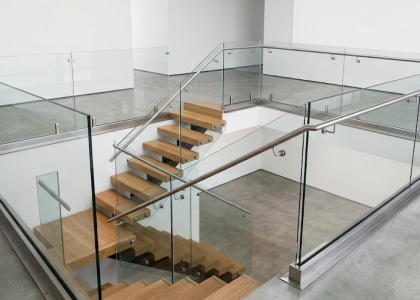
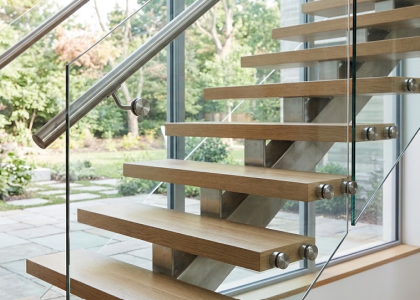
Glass is fixed to the side of the stair or to stainless-steel posts using standoff buttons or clamps. These are well suited to semi-frameless designs and offer a good balance of openness and rigidity, particularly where a handrail runs along the top, which also gives the railing added stiffness. Across all three, three material details separate a durable railing from a short-lived one:- Steel grade. Stainless steel is not one material. Grade 304 performs well in most indoor and moderate outdoor conditions. Grade 316 contains molybdenum and resists corrosion much better, which matters for coastal cities such as Karachi, humid terraces and swimming-pool areas.
- Anchor quality. Chemical or heavy-duty mechanical anchors must be rated for the base material. Cheap anchors in weak concrete are a hidden failure point.
- Gaskets and glazing packers. Glass should never touch metal directly. Proper setting blocks and gaskets prevent stress cracks and absorb vibration.
Not sure which system suits your staircase?
What Happens When Glass Is Hit or Breaks
It helps to think about glass failure honestly rather than pretending it cannot happen. Properly specified safety glass is very difficult to break in normal use, but there are situations where it can a sharp blow to an unprotected edge, a heavy object striking the glass, or, rarely, internal defects.Edge damage
The edges of tempered glass are its weak point. A chip or hit on a bare edge can trigger breakage hours or days later, because the stored stress is released from the damaged spot. This is why good railings use polished, protected edges and why installers must handle panels carefully. Glass edges should be seamed or polished, and ideally sit inside a channel or behind a handrail where they are unlikely to be struck.Nickel sulfide inclusions
Occasionally, microscopic nickel sulfide particles inside tempered glass can cause spontaneous breakage long after installation. It is rare, but it is the reason premium suppliers may offer heat-soak testing for high-risk or high-level installations, and another reason laminated glass is favored where falling glass would be dangerous.Thermal stress
Strong sun on part of a panel while another part sits in shade can create thermal stress. Tempered glass is far more tolerant of this than regular glass, but it is worth mentioning if your railing is on an exposed rooftop or terrace in a hot climate.Worth Noting If you want the safest possible behavior after an accident, choose laminated glass. If budget leads you to tempered, keep the edges protected and the panel size sensible. The question to ask yourself is simple if this panel cracked tomorrow, would it matter that it stayed in place?
Installation Quality: The Invisible Safety Feature
You can buy the best glass and hardware available and still end up with a poor railing if the installation is rushed. Good installation is partly craftsmanship and partly process, and it is the easiest thing to evaluate before you sign. Start with measurement. Staircases are rarely perfect. Angles, slopes and wall tolerances differ from the drawings, so accurate site measurement is the foundation. Toughened glass cannot be cut or drilled after treatment, which means any error becomes an expensive remake rather than a simple adjustment. Installers who measure carefully before fabrication save you time and money. Next comes the substrate. A frameless channel fixed into poorly finished or cracked concrete is a risk, no matter how strong the channel is. A professional team checks the base, tells you if it needs reinforcement, and does not install into surfaces that cannot take the load. Finally, there is handling and inspection. Panels should travel with protective packaging, be installed with proper lifting tools, and be checked for alignment, gaps and movement afterward. At Green Glass Designer, the process runs from a site visit and consultation, through design and material selection, precision fabrication, protected delivery and expert installation with anchors, supports and safety checks, ending in a final inspection and handover with warranty and client approval. Most projects are completed within about 7 to 12 working days, depending on size and customization.Durability Over the Years
A railing that is safe on handover day should still be safe in ten years. Durability depends on how the system deals with time, weather and use.Resistance to environment
Glass itself is chemically stable. It does not rust, rot, warp or fade like timber and painted metal. The weak links over time are the metals and the seals. In humid or coastal climates, corrosion-resistant steel and good drainage in base channels prevent trapped water from slowly attacking the hardware. On exposed terraces, UV-stable gaskets and sealants keep their elasticity instead of cracking.Scratch and surface wear
Glass is hard and resists everyday scratching, but grit dragged across the surface can leave marks. Regular, gentle cleaning with a soft cloth and a non-abrasive cleaner is all that is required. Avoid harsh chemicals near rubber seals, and never use metal scrapers.Routine checks
Once or twice a year, look for loose fixings, movement in a panel when you push it gently, rust or staining around steel, and chips on exposed edges. These checks take a few minutes and catch small problems before they become large ones. A supplier who is confident in the system will tell you exactly what to look for and offer follow-up support if something needs tightening. Low maintenance is one of the main benefits of glass over timber or painted steel, but “low” is not “none.” Treating the railing as a safety component, not just a decorative feature, keeps it dependable.Safety for Homes, Children and Public Spaces
Homes with children and elderly family members
Families often worry first about children climbing or hitting glass, and about older relatives who may lean on a railing for balance. Laminated glass and a continuous handrail address both concerns. The handrail gives a firm grip and also braces the glass. For young children, pay attention to gaps at the bottom of the railing and between panels, which should be small enough that a child cannot slip through or trap a limb.Slip and visibility
Fully clear glass is excellent for light, but it can be hard to see in bright conditions. Light etching, frosting or a visible handrail makes the barrier easier to notice. This is also useful if you want a little privacy our frosted glass options and tinted or etched finishes can be combined with railings without losing their strength.Commercial and public buildings
Offices, hotels, malls, hospitals and universities place heavier and less predictable loads on stairs. They also have a higher duty of care. Laminated glass, higher-rated fixings, and documented installation are standard expectations here. If you are planning a commercial project, review our project references to see the type of work we have delivered for corporate and public clients.Where Glass Railings Can Disappoint
A balanced view helps you make a better choice. Glass railings are not the right answer for every staircase, and there are situations where expectations need adjusting. Fingerprints and cleaning. Clear glass shows marks, especially in homes with children. Expect to wipe panels more often than you would a solid balustrade. Etched or lightly frosted finishes hide marks better. Cost. Laminated, thick and frameless systems cost more than steel or timber. As a reference point, our staircase glass railing installation typically ranges from PKR 3,500 to PKR 8,500 per running foot, depending on the glass type, railing system and complexity. Our glass staircase railing cost guide explains the factors in detail. Poor substrates. Some staircases, such as older structures with weak or irregular edges, may need reinforcement before a frameless system can be fitted. This adds cost, but ignoring it would add risk. Cheap shortcuts. The biggest disappointments come from quotes that look attractive because they quietly lower thickness, use lower-grade steel, or skip proper anchoring. Glass railings fail the reputation of the whole category when this happens.Checklist Before You Shortlist an Installer
Use these questions when you compare quotes. A trustworthy supplier will answer them clearly and in writing.- What exact glass is being supplied? Type, thickness and, for laminated, the interlayer.
- Are the edges polished and protected? Ask how they will be finished and where they sit.
- What steel grade is used in the fixings? Ask whether 304 or 316 is proposed, and why.
- How was the thickness decided? The answer should refer to height, panel width, load and system type.
- What load standard does the system follow? Ask for the standard, not just “safe.”
- What will it be anchored into? Make sure the base has been checked.
- Who installs it? Ask whether it is the company’s own trained team.
- What does the warranty cover? Glass, hardware and workmanship should each be clear.
- Are there similar completed projects? Look for examples at your type of property and in your city.
- Is the quote itemized? Transparent pricing with no hidden charges makes comparison fair.
Frequently Asked Questions
1. Are glass railings safe for residential staircases?
Yes, when they use tempered or laminated safety glass of the correct thickness, a suitable support system and professional installation. Safety glass is designed to meet international safety standards and is several times stronger than regular glass.
2. Which is safer for stairs, tempered or laminated glass?
Both are safe in normal use, but laminated glass is the stronger choice where a failure would be serious, because the interlayer keeps a cracked panel in place. Tempered glass is a sensible option for low, protected interior staircases with a limited budget.
3. How thick should the glass be?
It depends on the railing system, panel width, height and building type. Frameless systems typically use thicker glass than post-supported ones. A reliable installer will calculate the figure for your staircase and explain it.
4. Will a glass railing last outdoors or in coastal areas?
Yes, provided the hardware is corrosion-resistant. For coastal or humid areas, higher-grade stainless steel and UV-stable seals are recommended, and drainage in base channels should be considered.
5. Can a glass railing be repaired if it cracks?
Individual panels cannot be repaired they are replaced. Because tempered and laminated glass are made to size, replacement is straightforward if the supplier keeps the specifications on record. This is a good reason to choose a company that documents each project.
6. How long does installation take?
Most projects are completed in about 7 to 12 working days, which includes measurement, fabrication and installation, though larger or highly customized staircases can take longer.