Table of Contents
If you’re on this page, there’s a decent chance you’re part of a mosque committee, a trustee, an architect, or a contractor trying to figure out whether stained glass is actually achievable for your project and whether it’s worth the investment, the disruption to an active place of worship, and the risk of trusting a vendor with something this visible and this permanent.
That’s exactly the position the committee was in before they approached Green Glass Designer. This case study walks through that project from first consultation to final handover the brief, the design challenges specific to a religious space, the material decisions that mattered most, and the results so you can see exactly what a properly managed mosque stained glass installation looks like before you commit to one of your own.
Project Overview
Location: Lahore, Pakistan
Space: Central dome interior and clerestory windows, main prayer hall
Scope: Custom geometric and calligraphic stained glass panels, laminated and UV-protected
Timeline: Consultation to handover in X weeks
Category: Religious architectural glass
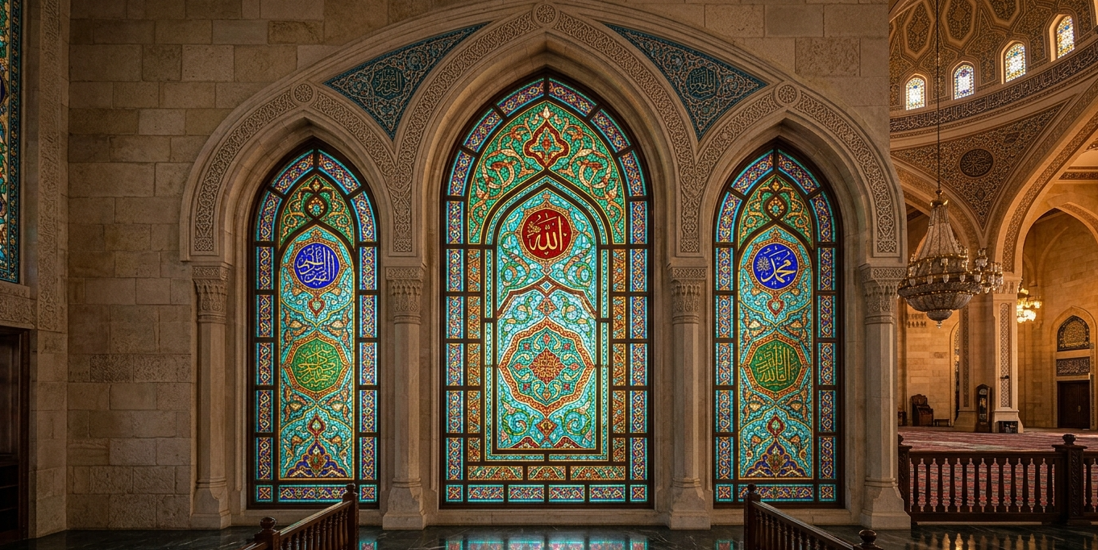
The mosque’s main prayer hall had been completed structurally for some time, but the dome interior and the clerestory band of windows around the hall remained finished in plain glazing functional, but flat. The committee wanted the space to feel the way a mosque interior is supposed to feel when sunlight moves through it during the day colored light shifting across the mihrab wall and prayer floor as the sun changes position, without anything that competed with the calligraphy already planned for the walls below.
This is a genuinely common starting point for mosque projects that come to Green Glass Designer. The structure is finished, the community has a clear feeling they’re trying to create, but nobody on the committee has been through a stained glass procurement process before which is exactly where a lot of projects stall out or go wrong with the wrong vendor.
The Brief: What the Mosque Committee Actually Asked For
In the first consultation, three things came up repeatedly, and they shaped everything that followed:
“It has to feel Islamic, not decorative.” The committee was clear early on that they didn’t want a generic colored-glass pattern that could belong in a hotel lobby. They wanted geometric Islamic motifs and calligraphic elements that reflected the mosque’s own architectural language pointing specifically to existing tilework and mihrab detailing already in the space as visual references.
“It has to survive our summers.” Direct concern about fading, given the dome’s south-facing exposure and the intensity of sun during peak summer months.
“We can’t shut the mosque down for weeks.” The prayer hall remains in active use for five daily prayers, and Friday Jummah draws significantly larger attendance. Any installation plan needed to work around that schedule, not against it.
Those three requirements cultural accuracy, long-term durability, and minimal disruption to an active place of worship became the three things every design and material decision in this project had to satisfy simultaneously.
The Challenge: Why Mosque Glasswork Isn’t Like Any Other Project
It’s worth being direct about why religious glasswork is a different category of project entirely, not just a stylistic variation on a residential or commercial job.
The design has to be theologically and culturally correct, not just visually pleasing. Geometric Islamic patterns follow mathematical and symbolic conventions that have been refined over centuries. Getting the proportions, symmetry, or motif selection wrong isn’t a minor design miss in a mosque it’s immediately noticeable to a community that has grown up around this visual language, and it can’t be quietly revised after installation the way a corporate lobby panel might be.
The physical installation environment is unusual. A dome interior isn’t a flat wall. Curved surfaces, elevated access, and structural considerations specific to religious architecture (load distribution around a mihrab, integration with existing tilework, sightlines from the prayer floor) all affect both the design and the installation method.
The space can’t simply close. Unlike a corporate office or private home, a mosque can’t be vacated for a multi-week installation window. Work has to be sequenced around prayer times, and on Fridays specifically, scheduled around Jummah attendance.
The stakes of getting durability wrong are higher. A mosque installation is meant to last generations, not just survive a warranty period. A community expects a completed dome or window feature to still look the way it did on day one, decades later which puts direct pressure on material choice, not just craftsmanship.
Any vendor who approaches a mosque project with the same generic process used for a retail storefront panel is going to run into at least one of these four issues, usually more than one.
Inside the Design Process, Step by Step
Step 1: Consultation and Cultural Design Brief
Beyond standard measurements, this stage focused on understanding the mosque’s existing visual identity the tilework patterns already present, the calligraphy style planned for interior walls, and the community’s own sense of what the space should feel like. This is also where the earlier prayer-schedule and durability requirements were formally logged as design constraints, not just preferences.
Step 2: Artistic Design Creation
Hand-drawn concept sketches translated the geometric motifs pulled from the mosque’s existing tilework into a scaled pattern suitable for the dome’s curvature and the clerestory window proportions. Multiple color palette options were prepared variations that leaned warmer (golds, ambers, deep reds) versus cooler (blues, greens) since color temperature changes dramatically how a space feels under direct sun versus overcast light. The committee reviewed full-scale mockups before a single piece of glass was cut, which is a step some vendors skip or shorten to save time.
Step 3: Glass Selection and Fabrication
Individual glass pieces were selected not just for color accuracy but for how they’d transmit light at different times of day a consideration that matters more in a mosque than almost any other building type, since the dome is meant to visibly shift in character across the five daily prayer times. Cathedral and hand-textured glass were used selectively in the calligraphic elements to give those sections more visual depth than flat opalescent glass would provide.
Step 4: Delivery
Panels were fabricated off-site and delivered in stages matched to the installation sequence below, with protective packaging designed for the curved panel sections specifically flat-panel packaging methods aren’t adequate for dome-curved glasswork, and mishandling at this stage is a common source of damage on religious glass projects.
Step 5: Installation
Covered in detail in the next section, since this is where the “can’t shut the mosque down” requirement had the most direct impact on how the project was actually executed.
Step 6: Final Handover
The project closed with a walkthrough alongside the mosque committee, formal warranty documentation, and a maintenance briefing specifically covering how the panels should be cleaned without damaging the lead came or copper foil joins a detail that matters for the long-term life of the piece and one that’s easy for a maintenance team to get wrong without guidance.
Material Selection: Why Lamination Wasn’t Optional
Given the committee’s explicit concern about summer sun exposure on a south-facing dome, laminated, UV-protected stained glass construction was the only material approach that made sense for this project and it’s worth explaining why in plain terms, since this is the single technical decision that determines whether a mosque installation still looks vibrant in twenty years or starts fading within a handful of summers.
Laminated stained glass sandwiches the decorative glass layer between protective layers, which addresses three risks directly relevant to this dome:
- UV exposure the dome’s south-facing orientation means direct, intense sun for a significant portion of the day, year-round. Unlaminated colored glass is far more vulnerable to progressive color fading under this kind of exposure.
- Weather stress temperature swings between summer heat and cooler mornings put mechanical stress on any glass assembly over time, and lamination adds resistance to that stress.
- Impact resistance a dome position is elevated but not inaccessible, and lamination reduces breakage risk compared to unlaminated leaded panels, which matters both for safety and for long-term maintenance cost.
This is also the question we’d encourage any mosque committee evaluating a vendor to ask directly, regardless of who they end up working with is the glass being proposed laminated and UV-protected, or is it decorative float glass that looks similar in a sample but performs very differently after five summers of direct sun?
Installation Day: Working Around Prayer Schedules and a Live Dome
This is the part of the project that gets the least attention in most stained glass marketing, and it’s often the part that determines whether a religious institution has a good experience with a vendor or a frustrating one.
Installation was sequenced in stages, scheduled around the five daily prayers rather than around a standard contractor’s working hours. Work on any given day paused before each prayer time and resumed afterward, with the dome and clerestory areas cleared and made safe before each congregation entered. Friday installation work was avoided entirely given Jummah attendance, and the schedule was communicated to the committee in advance so mosque staff could plan around it rather than being surprised by it.
Scaffolding and access equipment for the dome interior were selected specifically to allow full removal or repositioning within the window between prayers, rather than equipment that would need to remain in place overnight blocking sightlines or access.
This kind of sequencing takes longer than a standard commercial installation timeline and any vendor who quotes a mosque project on the same timeline as an office lobby either hasn’t accounted for this, or is planning to install in a way that will disrupt the mosque’s actual operating schedule.
The Result
The completed dome and clerestory installation now shifts noticeably across the day warmer tones dominating during Fajr and Maghrib light, and a fuller, richer spread of color across the prayer floor during midday sun. The geometric patterns read clearly from the prayer floor at the proportions they were designed for, and the calligraphic elements in the clerestory band remain legible without competing with the dome’s central geometry.
What This Project Taught Us About Buying Stained Glass for a Religious Space
A few things came out of this project that are worth passing on to any committee, architect, or contractor starting a similar process elsewhere:
Bring your existing visual references early. The tilework and planned calligraphy style the committee brought to the first consultation shaped the entire design direction. Committees that wait to share this until after initial concepts are drawn often end up needing a full redesign.
Ask about light behavior, not just color. A swatch under a showroom light looks different from the same glass under direct dome sun at 1pm in July. Ask any vendor how they account for that difference during design.
Get the installation schedule in writing before you approve the design. A beautiful design that assumes a two-week uninterrupted install window is a design that’s going to cause real friction with your congregation if the vendor hasn’t actually planned around prayer times.
Lamination is not a premium upsell for a south-facing dome, it’s the baseline requirement. Any quote that doesn’t specify laminated, UV-protected construction for a high-sun-exposure religious installation is a quote for a shorter-lived installation, whether or not that’s stated outright.
What a Project Like This Costs
Mosque stained glass projects in Pakistan generally fall within the same general pricing structure as other custom installations PKR 3,500 to PKR 9,000 per square foot but tend to sit toward the higher end of that range for a few specific reasons relevant to religious architecture:
- Curved dome fabrication requires more specialized cutting and assembly than flat rectangular panels
- Calligraphic and detailed geometric motifs are more labor-intensive than simple repeat patterns
- Elevated, staged installation around prayer schedules takes longer than a standard commercial install timeline
- Laminated, UV-protected construction effectively non-negotiable for most mosque orientations costs more than unlaminated decorative glass
As with any custom project, a vendor quoting a fixed rate without seeing the dome’s dimensions, the committee’s design brief, and the mosque’s actual sun exposure is guessing. A legitimate quote follows a site visit and design consultation.
Vendor Checklist for Mosque and Religious Glasswork
| What to Confirm | Why It Matters for a Religious Space |
|---|---|
| Portfolio of completed religious/mosque projects | Confirms real experience with cultural and theological design accuracy, not just general decorative glasswork |
| Design process includes a mockup approved before fabrication | Prevents pattern or motif errors from being discovered only after installation |
| Laminated, UV-protected glass as standard | Determines whether the installation still looks vibrant after years of direct sun exposure |
| Installation plan built around prayer schedule, not standard business hours | Avoids disrupting an active place of worship during a multi-stage install |
| Experience with curved/dome fabrication, if relevant | Domes require different cutting, assembly, and reinforcement than flat panels |
| Registration and certification (PEC, ISO, etc.) | Indicates the vendor meets recognized construction and quality standards for a permanent installation |
| Warranty and maintenance guidance provided at handover | Protects the community’s investment for decades, not just through the installation date |
Why Mosques and Religious Institutions Choose Green Glass Designer
Green Glass Designer has completed stained glass work across mosque domes, minaret windows, and mihrab surrounds throughout Pakistan, and religious glasswork sits at the core of the stained glass installation service offered alongside decorative glass and laminated glass work more broadly. A few things specific to religious projects:
- PEC-registered and ISO-certified, meeting recognized standards for construction quality and reliability on permanent religious installations
- Custom design rooted in each mosque’s own visual identity patterns are drawn from existing tilework, calligraphy style, and architectural detailing already present in the space, not selected from a generic catalog
- Laminated, UV-protected construction as standard for religious installations, built to withstand Pakistan’s climate rather than fade within a few seasons
- Installation scheduling built around prayer times, so active mosques don’t have to close or restrict congregation access during the work
- Nationwide coverage, with completed religious and cultural projects across Lahore, Karachi, Islamabad, and beyond
- Warranty-backed installation with maintenance guidance, so the committee has clear instructions for preserving the panels for decades to come
FAQ
How long does a mosque stained glass installation typically take?
Timelines vary based on scope and dome complexity, but a project of this type typically runs from initial consultation to final handover across several weeks, with the installation phase itself sequenced around prayer schedules rather than compressed into a single continuous block.
Can the design incorporate our mosque’s existing calligraphy or tilework style?
Yes this is standard practice for religious commissions. Bringing photos or references of existing patterns and calligraphy in the mosque during the first consultation significantly improves design accuracy and reduces revision cycles.
Does the mosque need to close during installation?
No. Installation is staged around the five daily prayers, with equipment cleared before each prayer time and Friday Jummah avoided entirely, so the mosque remains in active use throughout the project.
Is laminated glass required for mosque installations, or is it optional?
For most mosque orientations, particularly south or west-facing domes and windows with significant direct sun exposure, laminated and UV-protected construction is effectively the baseline requirement for a durable long-term result, not an optional upgrade.
What is the typical cost range for a mosque stained glass project?
Mosque projects generally fall within PKR 3,500 to PKR 9,000 per square foot, often toward the higher end of that range due to dome curvature, calligraphic detail, and laminated construction requirements.
Planning a Similar Project for Your Mosque or Religious Space?
Every mosque committee that starts this process has the same underlying question will this actually look and feel the way we’re picturing it, and will it hold up for the community over decades, not just years. The honest answer is that it depends almost entirely on the design process and materials behind it which is exactly why a proper mockup, a laminated glass specification, and an installation plan built around your prayer schedule aren’t optional extras. They’re the difference between a dome your community is proud of for generations and one that needs to be redone within a decade.
Schedule a free consultation with Green Glass Designer to discuss your mosque or religious space project, or get an instant quote via WhatsApp if you already have dimensions and a vision in mind. Either way, you’ll leave with a clear design direction and an honest cost estimate before committing to anything.