Table of Contents
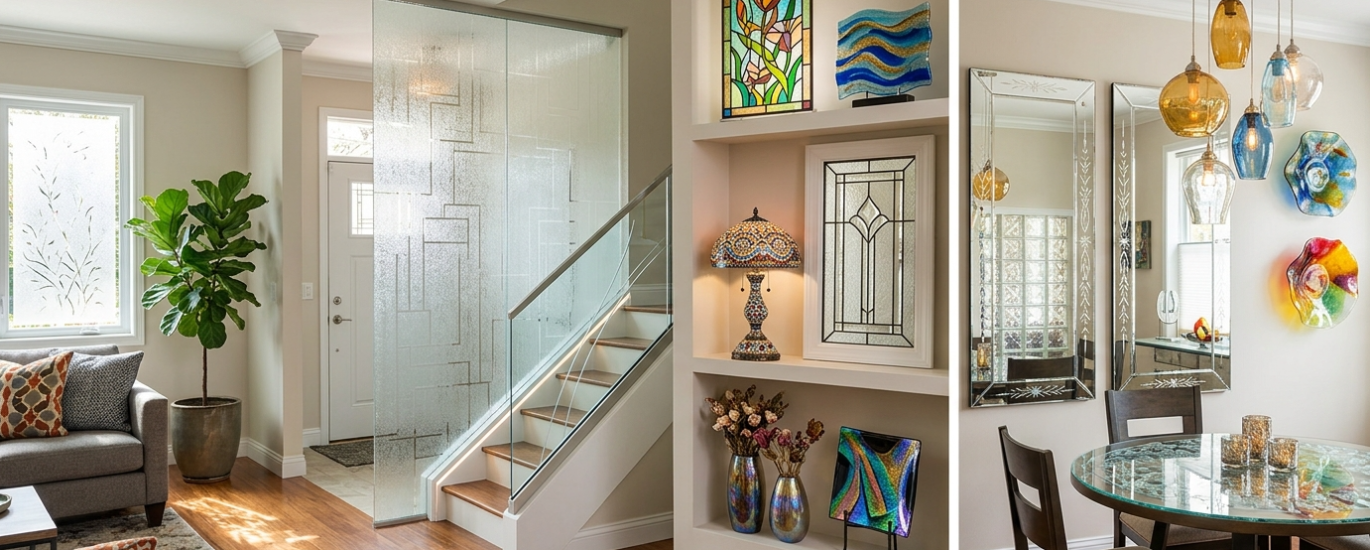
Glass is one of the most versatile materials available for transforming a space, and yet most people only ever think of it in its plainest form, a clear window, a basic mirror, a shower door. Once you start looking at the full range of what decorative glass can actually do, colored, patterned, backlit, textured, structurally dramatic, it becomes clear just how much design potential gets left on the table by defaulting to plain glass out of habit rather than genuine choice.
This guide walks through fifteen distinct decorative glass applications spanning homes, offices, restaurants, and retail spaces, so you can see the real breadth of what’s possible before deciding what fits your own project. Every idea here is something we’ve actually designed and installed, not aspirational inspiration with no practical path to having it in your own space.
15 Applications
Spanning residential, commercial, and hospitality projects
Custom Design
Every application here can be tailored in pattern, color, and scale to your specific space
Nationwide
Green Glass Designer designs and installs decorative glass across Pakistan
Why Decorative Glass Has Such Broad Design Potential
Before getting into the specific applications, it’s worth understanding why glass, more than almost any other material, lends itself to such a wide range of decorative treatments. Glass can be colored throughout its structure, coated on its surface, patterned through ceramic firing, textured through etching or sandblasting, backlit for a completely different effect after dark, and shaped into curves or custom forms, all while remaining a genuinely durable, long-lasting material once properly specified and installed. Few other materials offer this combination of visual flexibility and structural performance in a single medium.
This is exactly why decorative glass shows up across such a wide range of applications, a stained glass window and an LED smart mirror seem like completely different products, but they share the same underlying material flexibility that makes glass such a rewarding design material to work with.
A Useful Way to Approach This List
Rather than trying to find “the” decorative glass idea for your space, think about which two or three of these fifteen ideas solve a specific need or opportunity you actually have, a plain wall that needs visual interest, a window that needs privacy without losing light, an entryway that needs a memorable first impression, and start your planning from there.
1. Stained Glass Windows and Panels
The most immediately recognizable decorative glass application, stained glass brings genuine color and craftsmanship to entryways, staircases, domes, and feature windows. Modern copper foil construction techniques make custom stained glass considerably more achievable than the elaborate leaded glass work of centuries past, ranging from fully abstract geometric designs to traditional Mughal-inspired motifs. For a deeper look at exactly how this material works and where it fits best, our beginner-friendly comparison of stained glass and frit glass is a genuinely useful starting point.
2. Ceramic Frit Glass Partitions
Frit glass uses a permanently fired ceramic pattern to create privacy and light control without color, making it the go-to choice for office partitions, shopfronts, and any application needing a clean, contemporary, and highly durable decorative effect at scale. Our complete beginner’s guide to frit glass covers exactly how this material is made and where it works best.
3. Beveled Mirror Walls
A beveled mirror wall arranges individual mirror panels, each with a subtly angled, polished edge, into a larger installation, creating a genuinely luxurious, dimensional effect as light catches each bevel differently across the wall. This is a popular choice for formal dining rooms, hotel lobbies, and entryway feature walls where a plain mirror would feel flat by comparison, and the beveled edges add a texture and visual richness that a single large mirror simply can’t replicate.
Best For
Formal dining rooms, hotel and restaurant lobbies, and entryway feature walls wanting a genuinely elevated, dimensional mirror treatment.
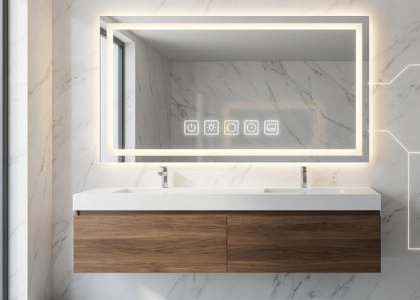
4. LED Smart Mirrors
Beyond their practical lighting benefits, LED smart mirrors function as a genuine decorative statement in a bathroom, bedroom vanity, or salon styling station, their soft, integrated edge lighting creating a distinctly modern glow that a plain mirror simply can’t offer. Our detailed look at why LED smart mirrors have become a must-have feature covers the full range of benefits this application brings beyond decoration alone.
5. Digital Glass Media Walls
For spaces wanting to combine glass with digital display technology, a digital glass media wall integrates screens or projection capability behind or within a glass surface, creating a striking feature for retail environments, corporate lobbies, and hospitality spaces wanting to display branding, artwork, or dynamic content within an architecturally sophisticated glass installation rather than a standalone screen mounted on a wall.
Best For
Corporate lobbies, retail flagship stores, and hospitality spaces wanting a dynamic, technology-integrated feature wall.
6. Digital Glass Niche Designs
A digital glass niche uses backlit or illuminated glass within a recessed wall niche, traditionally used for displaying decorative objects or artwork, to create a genuinely eye-catching focal point in an entryway, living room, or retail display area. Combining a niche’s natural architectural framing with glass’s ability to diffuse and transmit light creates a considerably more polished and intentional display feature than a plain shelf or open recess.
7. Kitchen Splashback Glass
A glass splashback behind a stove or sink area offers a clean, easy-to-maintain alternative to tile, and decorative options, colored glass, subtly textured surfaces, or even a printed pattern, turn a purely functional kitchen element into a genuine design feature. This is one of the more practical entries on this list, splashback glass needs to handle heat and moisture reliably, but it’s also one of the most visually impactful, since a kitchen’s splashback area typically sits at eye level and draws attention throughout daily use.
A Practical Advantage Worth Knowing
Glass splashbacks are considerably easier to clean than tile, since there’s no grout to collect grease and stains, a genuine everyday practical benefit alongside the decorative upgrade.
8. Color Coated Glass Panels
Color coated glass applies a durable colored finish to the back surface of clear glass, creating a bold, uniform color statement well suited to accent walls, cabinet fronts, and feature panels in both residential and commercial interiors. Unlike tinted glass, which colors the glass throughout its body, color coated glass allows for a wider, more vivid range of color options and can be paired with back-painted or reflective finishes for additional visual depth.
9. Textured and Cutwork Glass Windows
Textured glass, featuring a raised or embossed surface pattern, and cutwork glass, where a design is carved or ground into the glass surface, both offer a tactile, dimensional decorative quality that goes beyond flat color or printed pattern. These work particularly well in front doors, sidelights, and interior windows where you want visual interest and some degree of privacy while still allowing meaningful light transmission.
Best For
Front door sidelights, interior windows between rooms, and any application wanting a tactile, dimensional decorative quality rather than a flat pattern.
10. Frosted and Sandblasted Glass
Frosted and sandblasted glass treatments create a soft, translucent surface through chemical etching or physical abrasion, offering privacy while still allowing light through, without the pattern or color of frit or stained glass. This remains one of the most versatile and widely used decorative glass treatments precisely because of its understated simplicity, working equally well in bathroom windows, office partitions, and front door panels without competing visually with a room’s other design elements.
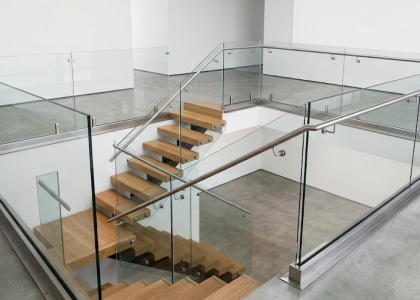
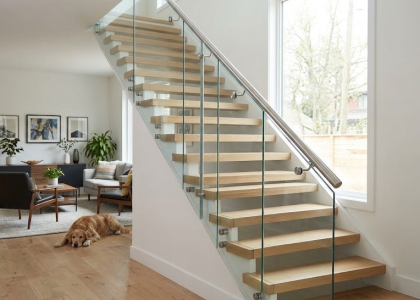
11. Staircase Glass Railings
A glass railing transforms one of the most-used features in a home into a genuine design statement, whether through minimalist frameless panels, a stained glass accent, or a gradient frit pattern. Our detailed guide to ten elegant staircase glass railing designs walks through the full range of what’s achievable for a staircase specifically, if this is the application that interests you most.
12. Terrace and Balcony Glass Railings
Similar in concept to staircase railings but built for exterior use, terrace and balcony glass railings preserve unobstructed views while meeting the same safety requirements a solid railing would, making them especially popular for rooftop terraces, balconies, and outdoor seating areas where the whole point is enjoying an open view rather than looking through a series of vertical bars or posts. Weather-appropriate tempered or laminated glass specifications matter more here than for interior applications, given direct sun and weather exposure.
A Consideration Specific to Outdoor Installations
Exterior glass railings need glass and hardware specifications suited to sustained weather exposure, not simply the same specification used for an equivalent interior staircase railing. This is worth confirming directly with your installer if you’re considering this application for a terrace or balcony.
13. Ceiling Glass Features
From dramatic stained glass domes to subtle backlit frit panels, ceiling glass remains one of the most transformative and underused decorative applications available, precisely because so few people think to look up when planning a room’s design. Our complete guide to ten ceiling glass designs covers this application in much greater depth, from formal domes to functional sunroom solutions.
14. Bent and Curved Glass
For spaces with curved architectural features, a rounded reception desk, a spiral staircase, a curved storefront corner, bent glass is fabricated to follow that exact curvature rather than approximating it with flat panel segments. This is a more specialized fabrication process than standard flat glasswork, but the visual payoff for the right application, a seamless, continuous curved surface, is considerably more elegant than a series of small straight panels attempting to fake a curve.
Best For
Curved reception desks, spiral staircases, rounded storefront corners, and any architectural feature with a genuine curve rather than a straight run.
15. Spider Fitting Glass Systems
Spider fitting glass uses minimal, discreet stainless steel point fittings, resembling a spider’s splayed legs, rather than a continuous frame, to support large glass panels for entryways, facades, and canopy structures. This creates a genuinely dramatic, almost frameless architectural glass installation, popular for commercial entryways, atriums, and any application wanting maximum transparency and a striking, engineered aesthetic rather than a conventional framed glass wall.
Why This Design Reads as So Architecturally Impressive
Because spider fitting systems minimize visible hardware to just the point fittings themselves, they create some of the most dramatically transparent large-scale glass installations achievable, making them a favorite for commercial entryways and atriums wanting to make a genuine architectural statement.
Fifteen Decorative Glass Ideas at a Glance
| Idea | Best Setting | Visual Character |
|---|---|---|
| Stained Glass Windows | Entryways, domes, staircases | Colorful, traditional or modern |
| Ceramic Frit Partitions | Offices, shopfronts | Clean, geometric, contemporary |
| Beveled Mirror Walls | Dining rooms, lobbies | Luxurious, dimensional |
| LED Smart Mirrors | Bathrooms, vanities, salons | Modern, softly glowing |
| Digital Glass Media Walls | Corporate lobbies, retail | Dynamic, technology-integrated |
| Digital Glass Niches | Entryways, living rooms | Focused, illuminated |
| Kitchen Splashback Glass | Kitchens | Clean, easy-maintenance, bold |
| Color Coated Glass Panels | Accent walls, cabinetry | Vivid, uniform color |
| Textured/Cutwork Glass | Front doors, interior windows | Tactile, dimensional |
| Frosted/Sandblasted Glass | Bathrooms, partitions | Soft, understated, private |
| Staircase Glass Railings | Staircases | Open, light-preserving |
| Terrace Glass Railings | Balconies, rooftops | Unobstructed, view-preserving |
| Ceiling Glass Features | Entryways, sunrooms, domes | Dramatic or subtly glowing |
| Bent and Curved Glass | Curved architectural features | Seamless, elegant |
| Spider Fitting Glass | Entryways, atriums, facades | Dramatically transparent |
How to Narrow Down Fifteen Ideas Into the Right One (or Two) for You
With this many options, it helps to work through a few practical questions rather than trying to evaluate all fifteen ideas with equal weight against your specific project.
What problem are you actually trying to solve?
Privacy without losing light points toward frit, frosted glass, or textured glass. A plain, uninteresting wall or ceiling points toward stained glass, color coated panels, or a digital niche. A staircase or railing that feels visually heavy points toward a glass railing replacement. Starting from the actual problem, rather than a general desire for “something decorative,” narrows the list quickly.
What’s the scale of the space involved?
A single accent feature, a niche, a splashback, a mirror, is a very different project than covering an entire wall, ceiling, or facade, and it’s worth being realistic about scale before falling in love with an idea that doesn’t match your actual space or budget.
Is this indoors or exposed to weather?
Terrace railings, exterior facades, and any outdoor application need weather-appropriate glass specifications that differ from interior equivalents, worth flagging early in your planning.
Does your home or business already have an established design language?
A traditional, heritage-influenced home generally pairs better with stained glass and beveled mirror work, while a sleek, modern commercial space often suits frit glass, spider fitting systems, and color coated panels more naturally, though these aren’t hard rules, and combining traditional and modern elements thoughtfully is entirely possible with the right guidance.
You Don’t Need to Have This Fully Figured Out
If you’re still not sure which of these fifteen ideas fits best, that’s genuinely normal, and exactly what a consultation is built to help you work through with an actual look at your space rather than guessing from a list alone.
Frequently Asked Questions
Can I combine multiple decorative glass ideas from this list in a single renovation or build?
Yes, and many of our most successful projects do exactly this, a stained glass entryway feature paired with frit glass office partitions, or a beveled mirror wall alongside an LED smart mirror in the same bathroom suite. Combining complementary ideas is genuinely common and often produces a more cohesive, considered result than treating each room in complete isolation.
Which of these ideas is the most budget-friendly starting point?
Frosted and sandblasted glass, kitchen splashback glass, and smaller-scale applications like a digital glass niche or a ceiling medallion generally represent more accessible entry points than large-scale installations like a full stained glass dome, a spider fitting facade system, or an extensive suspended panel ceiling.
Do any of these ideas work well for a small apartment rather than a large home?
Yes, several of these ideas are particularly well suited to smaller spaces specifically. Beveled mirror walls, frosted glass partitions, and kitchen splashback glass all work beautifully at a smaller scale and can make a compact space feel considerably more finished and intentional without requiring the square footage a larger installation would need.
How do I know if my existing structure can support something like a stained glass dome or a spider fitting system?
This depends heavily on your specific structure and requires an actual assessment rather than a general answer, which is exactly the kind of question a site visit and consultation is designed to address, particularly for structurally involved applications like domes, spider fitting systems, and bent glass installations.
Is decorative glass difficult to maintain compared to standard glass or other wall and ceiling materials?
Most decorative glass treatments require no more maintenance than standard glass, cleaning with appropriate glass cleaning products. Frit and stained glass in particular are genuinely low-maintenance since their patterns are fused or leaded into the material rather than sitting as a removable surface coating.
Can these decorative glass ideas be used in commercial spaces, or are they primarily residential?
The majority of ideas on this list work well in both residential and commercial contexts, with several, frit partitions, digital media walls, spider fitting systems, color coated panels, being especially common in commercial and hospitality applications specifically. It’s worth discussing your specific commercial goals, branding, foot traffic, durability needs, during a consultation to identify the best fit.
Where should I start if I’m genuinely undecided between several of these ideas?
Start with the practical questions covered in the section above, what problem you’re solving, the scale involved, indoor versus outdoor, and your existing design language, and bring whatever ideas from this list still feel appealing to a consultation. Talking through real photos of your space with someone who can assess feasibility directly is considerably more productive than trying to fully decide from a list alone.
Your Next Step
Fifteen ideas is a lot to take in, but the underlying takeaway is simple glass is one of the most flexible, design-rich materials available for transforming almost any space in a home or business, far beyond the plain windows and mirrors most people default to without a second thought. Whether you’re drawn to a dramatic stained glass dome, a clean frit partition, or something as understated as a well-chosen kitchen splashback, the right next step is a direct conversation about your specific space and goals.