Table of Contents
A homeowner in DHA Lahore recently messaged us on WhatsApp with a photo of a stained glass window she’d seen at a friend’s farmhouse in Bedian. Her question was simple “How much would something like this cost for my staircase landing?” It’s the single most common question we get at Green Glass Designer, and it’s also one of the hardest to answer with a single number, because stained glass pricing in Pakistan depends on far more than just window size.
If you’ve been searching for a straight answer on what stained glass windows actually cost here, whether for a home in Lahore, a mosque in Karachi, or a boutique café in Islamabad, this guide breaks it down properly. No vague “contact us for pricing” dodge. We’ll walk through what actually drives the cost, by technique, by design complexity, by city, and by the hidden factors that quietly push a quote up or down, so you understand exactly what you’re paying for before you ever request a formal estimate.
Why Stained Glass Pricing Isn’t a Fixed Number
Unlike tempered glass or plain float glass, where cost is largely a function of thickness and square footage, stained glass is closer to commissioned artwork than a standard building material. Two windows of identical size can carry very different price tags depending on the glass technique used, how many individual pieces of colored glass go into the design, whether the pattern is a simple repeating geometric motif or a custom floral scene, and whether the glass is imported or locally sourced.
This is exactly why a generic “how much does stained glass cost” answer, without context, tends to either scare people off with assumptions that are too high or set unrealistic expectations with a figure that doesn’t hold up once the design is finalized. The honest answer depends on where your project lands across the factors below, and getting a firm number requires seeing your actual design and space.
Design complexity, not size
The single biggest driver of stained glass cost in most Pakistani projects
3–6 weeks
Typical turnaround for a custom-designed stained glass window, from approval to installation
4 techniques
Main stained glass methods used in Pakistan, each with a meaningfully different price position
The Four Main Types of Stained Glass and How They’re Priced
Before you can budget for a stained glass window, you need to know which technique you actually want, since the cost difference between them is significant and often misunderstood by first-time buyers.
1. Traditional Leaded Stained Glass
This is what most people picture when they hear “stained glass” individual pieces of colored glass cut to shape and joined together with strips of lead or zinc came, the way it’s been done for centuries in churches, havelis, and heritage buildings across the subcontinent. It’s the most labor-intensive method and, correspondingly, sits at the higher end of the pricing spectrum.
Cost position: Premium tier, priced primarily by piece count and glass quality
Leaded stained glass is priced heavily by the number of individual glass pieces (called “cames” once assembled) in the design. A simple geometric border with large glass panels costs meaningfully less than a detailed floral or figurative scene with fifty or more small, individually cut pieces, even at the exact same window size.
2. Faux (Overlay) Stained Glass
Faux stained glass achieves a similar visual effect using colored film, paint, or leading applied over a single sheet of glass rather than assembling individual pieces. It’s a popular middle-ground option for homeowners who want the aesthetic without the full cost of traditional leaded work.
Cost position: Budget-friendly tier, the most accessible entry point into the stained glass look
This option has become increasingly common for residential projects in Lahore and Islamabad where clients want a stained glass look on a partition, transom window, or entry door sidelight without committing to the higher budget of authentic leaded construction.
3. Painted and Fired Stained Glass
This technique involves hand-painting detail directly onto glass and firing it in a kiln to permanently bond the pigment, often combined with leaded construction for the most detailed figurative or pictorial work. It’s typically reserved for feature pieces, religious installations, or statement windows where fine detail matters more than budget.
Cost position: Highest tier, due to specialized kiln work and painting skill layered on top of standard leading
Because this method requires kiln access and specialized painting skill on top of the standard leading process, it sits at the premium end of stained glass pricing in Pakistan, and lead times run longer than the other three categories.
4. Mosaic-Style Stained Glass
Mosaic stained glass uses smaller, irregularly shaped glass pieces arranged in a more abstract or textured pattern rather than a defined pictorial design. It’s a strong option for accent panels, skylights, or decorative niches where texture and color variation matter more than a specific image.
Cost position: Mid-tier, generally more affordable than detailed leaded pictorial work but above faux glass
✓ Quick Reference: Which Technique Fits Your Budget
If budget is the primary constraint, faux stained glass delivers the closest visual impression for the lowest relative cost. If you want authentic construction and heirloom-quality durability, traditional leaded glass is worth the premium. Painted and fired work makes sense only when a specific pictorial or religious design genuinely requires it.
What Actually Drives the Cost
Square footage matters, but it’s usually the second or third biggest factor in a final quote, not the first. Here’s what typically has a bigger impact.
Design Complexity and Piece Count
This is the single biggest cost driver in traditional and painted stained glass. A window with a repeating geometric pattern using large glass sections might use a modest number of pieces per square meter. A detailed floral, landscape, or figurative design can use several times that many pieces in the same area. Every additional piece means additional cutting, grinding, fitting, and leading time, and that labor is where most of the cost lives, not the raw glass itself.
Glass Source Imported vs. Locally Available
Premium colored art glass particularly specialty textures like cathedral glass, opalescent glass, or streaky glass is largely imported, and that import cost, along with currency fluctuation, directly affects final pricing. Locally available colored glass keeps costs down but offers a narrower color and texture palette. Projects that mix a few imported feature colors with locally sourced base glass are a common way to control budget without sacrificing visual impact entirely.
Window Size and Shape
Larger windows cost more in absolute terms, obviously, but unusually shaped windows arched tops, circular rosettes, irregular custom cuts add cost beyond what size alone would suggest, because irregular shapes require more precise templating and glass wastage tends to be higher during cutting.
Framing and Structural Requirements
Stained glass panels need a supporting frame, and whether that frame is a simple timber or aluminum surround versus a custom-fabricated frame integrated into an existing window opening changes the total project cost. Retrofit installations into an existing structure, particularly older buildings, sometimes require additional structural work that isn’t part of the glass cost itself but does affect the overall budget.
Installation Access and Location
A ground-floor window in a straightforward residential setting installs differently than a stairwell window three storeys up or a dome-shaped skylight requiring scaffolding. Installation complexity and site accessibility are factored into most formal quotes separately from the glass and fabrication cost.
The Most Common Budgeting Mistake
Assuming stained glass pricing scales purely with square footage the way plain glass or mirror does. A small, highly detailed floral panel can cost more than a much larger simple geometric window, because complexity and piece count, not area, are doing most of the pricing work.
Relative Cost by Project Type
To make this more concrete without pinning down exact figures that vary project to project, here’s how common applications typically compare against each other in relative cost terms.
| Application | Typical Size Range | Relative Cost Level | Common Technique |
|---|---|---|---|
| Entry door sidelight panel | 2–4 sq. ft. | Lower | Faux or simple leaded |
| Staircase landing window | 6–12 sq. ft. | Low-to-moderate | Leaded or mosaic |
| Living room feature window | 10–20 sq. ft. | Moderate | Leaded, moderate detail |
| Mosque or religious building window | 15–40 sq. ft. | High | Painted and fired, leaded |
| Restaurant or hotel decorative panel | 20–50 sq. ft. | Moderate-to-high | Leaded or mosaic |
| Custom dome or skylight installation | Project-specific | Highest | Leaded, structural framing |
These comparisons are meant to help with relative budgeting between project types. Every one of these categories still varies significantly based on design complexity, glass sourcing, and site conditions, which is exactly why a proper quote requires seeing the actual design and space rather than relying on a general comparison alone.
City-Wise Cost Considerations Across Pakistan
Pricing shifts somewhat depending on where in Pakistan the project is located, largely due to transport, labor availability, and local demand for decorative glass work.
Lahore has the most mature decorative and architectural glass market in the country, with strong demand from DHA, Gulberg, Bahria Town, and the city’s growing café and boutique hotel scene. Competitive supplier density here tends to keep pricing reasonably consistent, and turnaround times are typically faster since fabrication facilities are concentrated in and around the city.
Karachi sees strong demand from both residential high-rises and commercial hospitality projects, but transport costs for imported specialty glass and larger project logistics in a bigger, more spread-out city can add modestly to overall project cost compared to Lahore.
Islamabad and Rawalpindi have a growing market driven largely by newer housing societies and corporate offices seeking a premium aesthetic. Because much of the decorative glass fabrication capacity is based in Lahore, projects here sometimes carry a modest transport and logistics premium, though this gap has been narrowing as demand grows.
Smaller cities and rural projects including farmhouses and private residences outside major urban centers, generally see the largest logistics-related cost addition, simply due to distance from fabrication hubs, though this is usually a smaller proportion of total project cost on larger installations.
Hidden Costs to Budget For
A quote that only reflects the glass panel itself can leave out real costs that show up later if they aren’t discussed upfront.
Framing and hardware: Unless you already have a compatible existing frame, budget separately for framing material and hardware, which can range from a modest addition on a small residential panel to a significant line item on a large architectural installation.
Removal of existing glass: If you’re replacing an existing window rather than installing into new construction, factor in removal and disposal of the old glass, along with any repair needed to the surrounding frame or wall.
Protective glazing: For exterior-facing stained glass exposed to weather, a protective outer layer of clear tempered or laminated glass is often recommended to shield the decorative glass from impact and weathering, which adds to material cost but significantly extends the life of the installation.
Design and consultation fees: Highly custom pictorial or figurative designs sometimes involve a separate design development phase, particularly for large commercial or religious commissions, which some studios bill separately from fabrication.
Delivery and installation for out-of-city projects: As covered above, projects outside major fabrication hubs should budget for transport and installation team travel as a distinct cost.
A Note on Getting an Accurate Quote
The fastest way to get a real number instead of a rough estimate is to share your window dimensions, a reference image or design concept, and your location directly with a supplier. Most stained glass studios, including Green Glass Designer, can turn around a working estimate within a day or two once they see the actual design rather than a verbal description alone.
Stained Glass vs. Other Decorative Glass Options: A Cost Comparison
For buyers weighing stained glass against other decorative glass finishes, here’s how it generally compares in relative cost.
| Decorative Glass Type | Relative Cost Level | Best For |
|---|---|---|
| Frosted glass | Most affordable | Privacy partitions, bathroom windows, budget-conscious projects |
| Etched/sandblasted glass | Affordable | Logo panels, subtle pattern work, office partitions |
| Faux stained glass | Budget-friendly | Budget-conscious decorative windows, faster turnaround |
| Digital printed glass | Moderate | Custom imagery, media walls, photographic designs |
| Traditional leaded stained glass | Premium | Heirloom-quality windows, heritage-style projects, feature pieces |
| Painted and fired stained glass | Highest | Religious installations, detailed pictorial commissions |
If your priority is closest visual match to authentic stained glass at the lowest possible cost, faux stained glass consistently offers the best value. If durability, authenticity, and long-term investment value matter more, traditional leaded construction remains worth the higher entry cost a well-made leaded stained glass window can last for decades with minimal maintenance, which meaningfully changes the cost-per-year calculation compared to a cheaper alternative that needs replacement sooner.
How to Get Real Value Without Overspending
Cost control on a stained glass project doesn’t have to mean settling for a plain design. A few practical approaches consistently help clients get the look they want within a realistic budget.
Simplify the pattern without simplifying the impact. A well-composed geometric or Art Deco-inspired pattern with fewer, larger glass pieces can look just as striking as a highly detailed floral scene, at a fraction of the labor cost. Good design, not maximum complexity, is what actually makes a window look expensive.
Mix imported feature colors with local base glass. Reserve imported specialty glass for the two or three accent colors that define the design, and use locally available glass for the surrounding fill areas. This keeps the visual richness of imported glass in the areas where it matters most while controlling overall material cost.
Prioritize placement over panel count. One well-placed statement window, in a stairwell, above an entry door, or as a focal point in a living space, delivers more visual return than multiple smaller stained glass elements scattered across a home. If budget is limited, concentrate it in a single high-impact location rather than spreading it thin.
Consider faux stained glass for secondary spaces. Reserve traditional leaded work for the primary feature window and use faux stained glass for secondary or less prominent openings where the visual difference is less noticeable but the cost difference is significant.
Get a firm quote before finalizing the design. Design revisions after fabrication has started are far more expensive than adjustments made on paper. Confirming piece count, glass sourcing, and final size before work begins avoids costly mid-project changes.
What a Real Project Timeline Looks Like
For a typical residential stained glass commission say, a 10 to 15 square foot staircase landing window with moderate detail the process generally follows a predictable sequence that also maps to when costs are committed.
Consultation and concept design (Week 1): Initial discussion of budget, size, and design direction, often supported by reference images the client provides. At this stage, cost is still a general range, not a firm number.
Design finalization and formal quote (Week 1–2): Once a specific pattern and glass palette are agreed, a firm quote is issued based on actual piece count and glass sourcing requirements. This is the number that should be treated as your real budget figure.
Glass sourcing and cutting (Week 2–3): Colored glass, particularly imported specialty pieces, is sourced and cut to the confirmed pattern. This is where lead time can extend if a specific imported color needs to be ordered rather than pulled from existing stock.
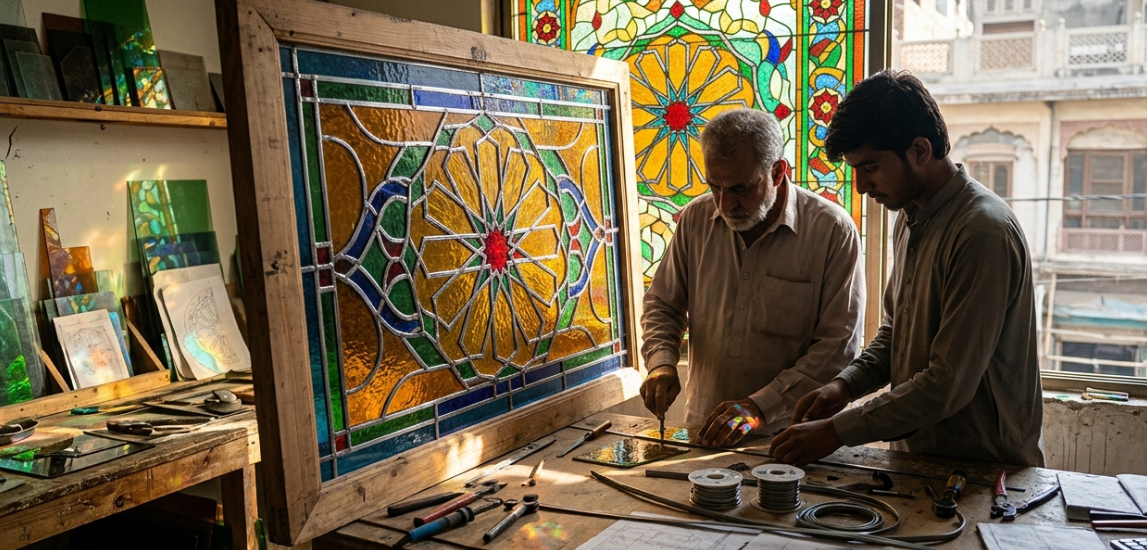
Assembly and leading (Week 3–5): Individual pieces are fitted, leaded or filmed, and soldered or finished depending on technique. This is the most labor-intensive phase and where most of the fabrication cost is realized.
Framing and installation (Week 5–6): The finished panel is framed and installed on site, with any protective glazing added at this stage if specified.
Rush timelines are sometimes possible for simpler designs using in-stock glass, but heavily detailed or fully custom commissions using imported colors should be budgeted with a realistic six-week-plus timeline to avoid last-minute cost premiums for expedited sourcing.
“Stained glass isn’t priced like a commodity because it isn’t manufactured like one. Every window we build is closer to a commissioned piece of art than a standard building product, and helping clients understand where their budget is actually going, design complexity, glass sourcing, skilled labor, is what leads to a result they’re genuinely happy with rather than a number that surprised them halfway through the project.”
Green Glass Designer, Decorative Glass Studio
Frequently Asked Questions
What determines the cost of a stained glass window in Pakistan more than anything else?
Design complexity and piece count matter more than raw size in most cases. A small, highly detailed panel with dozens of individually cut glass pieces can cost more than a much larger window using a simple repeating pattern with fewer, bigger glass sections. Glass sourcing, imported versus locally available, is the second biggest factor.
Is faux stained glass a good alternative to traditional stained glass?
For many residential and commercial applications, yes. Faux stained glass delivers a very similar visual effect at a noticeably lower cost than traditional leaded construction, and modern film and paint techniques have improved significantly in recent years. The main trade-off is long-term durability and authenticity, traditional leaded glass tends to last longer and carries more value as an architectural feature, particularly in heritage-style or high-end projects.
Why does stained glass cost so much more than regular decorative glass?
The cost reflects labor intensity, not just material. A detailed stained glass window can involve dozens or even hundreds of individually cut, ground, fitted, and leaded glass pieces, each requiring skilled hand work that simply doesn’t apply to frosted, etched, or printed glass, which are produced through faster, more mechanized processes. Imported specialty glass colors add further cost on top of the labor factor.
Can I get an accurate stained glass quote without a finalized design?
A rough sense of budget is possible based on size and general style preference, but an accurate, firm quote requires a finalized design, since piece count and glass sourcing, the two biggest cost drivers, aren’t determinable until the pattern is set. Most studios, including Green Glass Designer, offer a free consultation to develop a concept design before issuing a formal quote.
Does stained glass cost more in Karachi or Islamabad compared to Lahore?
Generally, yes, modestly. Lahore has the most concentrated decorative glass fabrication capacity in Pakistan, which keeps pricing competitive and turnaround times shorter. Projects in Karachi, Islamabad, or smaller cities typically carry a modest additional cost for transport and logistics, though this is usually a small proportion of total project cost rather than a major budget factor.
How long does a well-made stained glass window last, and does that affect the cost-value comparison?
A properly constructed traditional leaded stained glass window, protected from direct weather exposure or paired with protective outer glazing, can last several decades with minimal maintenance beyond occasional cleaning and lead came inspection. When comparing cost against a cheaper alternative like faux stained glass, which typically has a shorter practical lifespan before film or paint begins to show wear, the long-term value of traditional stained glass often narrows or even reverses the apparent price gap.
Do I need planning approval or building code clearance to install stained glass windows in Pakistan?
For most residential retrofit projects, no special approval is required beyond standard renovation permissions your housing society or building management may already require. Larger commercial installations, structural window replacements, or work on heritage-listed buildings may require additional approval depending on the project and location, and it’s worth confirming with your architect or relevant authority before finalizing a large-scale installation.
Ready to Get an Accurate Quote for Your Stained Glass Project?
Talk to Green Glass Designer
Green Glass Designer works with homeowners, architects, and commercial clients across Lahore, Karachi, and Islamabad to design and install custom stained glass windows, from single feature panels to full architectural installations. Share your space, your reference images, and your budget, and we’ll walk you through exactly what your project will cost before you commit to anything.