Table of Contents
You’ve made the decision or you’re seriously considering it. Stained glass in your home, office, mosque, or commercial space. The colours, the craft, the way morning light pours through a hand-painted panel and spills across the room in shifting, jewelled tones. It’s one of the most beautiful design choices anyone can make.
But the questions that follow are almost always the same How long will it actually last? What happens when it gets dirty? What if a panel cracks can it be repaired? Is stained glass practical for Pakistan’s climate? These are not vanity questions they are smart, practical concerns that anyone evaluating a significant interior investment has every right to have answered clearly.
This guide exists to answer them fully. Whether you’ve already installed stained glass and want to care for it properly, or you’re comparing options before buying, what follows is a complete picture of stained glass durability and maintenance grounded in Pakistan’s climate realities and the craftsmanship standards Green Glass Designer has applied across hundreds of residential, commercial, and hospitality projects.
Understanding What Stained Glass Is Made Of
Before discussing how durable stained glass is, it helps to understand what it’s actually made of because “stained glass” is not a single material, and different construction methods have significantly different durability profiles.
Traditional stained glass panels consist of individual pieces of coloured glass cut to shape and joined together using lead came thin strips of H-profile lead that grip the edges of each glass piece and are soldered at every junction point. The completed panel is then reinforced with a cement or putty compound that is worked into the gaps between the lead and glass, adding rigidity and weather resistance. In older European cathedral windows, this was the standard construction method, and many of those panels have survived for centuries.
Modern stained glass, particularly for residential and commercial applications, often uses a slightly different approach. The copper foil method popularised by Louis Comfort Tiffany in the late 19th century wraps each glass piece in adhesive copper foil before soldering, creating finer, more intricate detail than lead came allows. This technique is well-suited to decorative panels, lampshades, and smaller art pieces, though lead came remains preferred for larger architectural installations.
At Green Glass Designer, our stained glass panels use a combination of authentic hand-coloured and painted glass with either tempered or leaded segments, depending on the application. For installation in windows, doors, skylights, and partition panels, tempered glass backing or protective glazing is often added a modern engineering enhancement that dramatically extends the lifespan of the panel while protecting it from impact and weather exposure.
Understanding this construction is essential because it tells you where the vulnerabilities lie and where the strength comes from. The glass itself is extremely durable. The lead came, solder joints, and framing require periodic attention. And the protective measures applied during installation determine how much maintenance the panel will need over its lifetime.
How Durable Is Stained Glass? The Honest Answer
The honest answer to “how durable is stained glass?” is extremely, when properly made and properly installed and considerably less so when shortcuts are taken in either process.
The coloured glass itself does not fade, deteriorate, or degrade under normal conditions. The colour in quality stained glass is not painted on the surface it is fused into the glass during manufacture using metallic oxides and mineral pigments that become part of the glass structure at temperatures above 1,000 degrees Celsius. This is fundamentally different from surface-applied paint or film, which fades with UV exposure over time. Properly manufactured stained glass retains its colour for generations. The windows installed in European cathedrals 500 to 800 years ago are still essentially the same colour today as when they were made.
In Pakistan’s specific climate context, stained glass faces a few real challenges that should be understood:
UV Exposure: Pakistan receives some of the highest levels of solar radiation in the world, particularly in Punjab and Sindh during summer months. For stained glass where colour is embedded in the glass itself, UV has negligible effect on colour. However, if surface-painted details or enamelled accents have been applied as they often are for fine detailing UV exposure over many years can cause some fading in lower-quality painted elements. At Green Glass Designer, we use professional-grade kiln-fired enamels and silver stain that bond permanently to the glass surface, significantly reducing this risk.
Thermal Stress: Pakistan’s temperature swings from intense summer heat to cold winter mornings in cities like Islamabad and Lahore create thermal expansion and contraction in glass panels. Traditional lead came construction accommodates this movement naturally because lead is a flexible material. Problems arise when panels are installed in rigid frames with no expansion allowance, or when inferior solder work creates stress points that crack under repeated thermal cycling. Correct installation practice, which always includes adequate expansion gaps in the framing, addresses this entirely.
Humidity and Moisture: In coastal cities like Karachi, high humidity and salt-laden air can accelerate oxidation of lead came if panels are not properly sealed and maintained. A well-cemented, sealed panel in good condition resists this effectively. Neglected panels with cracked putty or failing solder joints are vulnerable.
Seismic Activity: Pakistan sits in a seismically active zone, and this is a genuine consideration for architectural glass of any kind. Stained glass panels installed with proper structural support, flexible framing, and adequate cushioning within their frames respond to tremors without cracking. Panels installed rigidly into fixed frames without flexibility are far more vulnerable.
When proper materials, proper construction, and proper installation practices are all in place, stained glass installed today in a Pakistani home or commercial space should realistically last 50 to 100 years or more with only routine maintenance. This is not an exaggeration it is the track record of well-made stained glass across centuries of architectural history.
The 5 Most Common Durability Problems and How to Prevent Them
Understanding the failure modes of stained glass is the most practical knowledge a buyer can have. Here are the five most common issues, what causes them, and how to prevent each one.
1. Lead Came Deterioration
Lead is a remarkably long-lived metal, but it is not immune to deterioration. Over decades, lead came can become brittle, buckle, or pull away from glass edges particularly in panels exposed to moisture, temperature extremes, or physical stress. Panels that were originally installed with thin or low-quality lead are especially susceptible.
Prevention starts at the fabrication stage using appropriately heavy-gauge lead came for the panel size and application, and ensuring the cementing process is done thoroughly so every section of lead is fully supported. On the maintenance side, visual inspection every few years allows early detection of sagging or buckling before it progresses to cracking.
2. Failed Solder Joints
Solder joints are the points where lead cames intersect and are bonded together. Poorly executed solder work insufficient heat, contaminated surfaces, incorrect solder composition creates joints that look acceptable initially but fail under stress over time. A failed solder joint leaves a section of panel unsupported, which places additional load on adjacent joints and can trigger cascading damage.
Prevention work only with experienced glass artisans who use correct soldering technique and appropriate flux and solder composition. Green Glass Designer’s fabrication team follows professional standards for solder work on every panel, with quality checks at each stage of production.
3. Putty and Cement Failure
The putty or cement compound that fills the gaps between lead and glass does two things it stiffens the panel, and it seals out moisture. When putty hardens, cracks, and falls out which happens naturally over years, especially in temperature-variable climates the panel loses rigidity and becomes vulnerable to moisture infiltration and wind pressure.
This is one of the most common maintenance needs of older stained glass panels and is entirely addressable. Re-cementing a panel is a specialist task, but it restores the panel’s structural integrity and weather resistance effectively. If you’re purchasing a property with existing older stained glass, inspect the putty condition as a priority.
4. Frame and Support Failure
Stained glass panels do not stand independently they depend entirely on their frames for structural support. When frames rot, rust, warp, or loosen from surrounding masonry, the stresses are transferred directly to the glass panel. This is one of the leading causes of stained glass damage in older Pakistani buildings, where wooden window frames have been allowed to deteriorate around otherwise sound glass panels.
Prevention always use appropriate framing materials powder-coated aluminium, stainless steel, or treated hardwood and inspect frame condition as part of any maintenance assessment. At Green Glass Designer, we design the framing as an integral part of every stained glass installation, specifying materials appropriate to the exposure conditions and aesthetic requirements of each project.
5. Impact Damage
Unlike architectural tempered glass, which must withstand wind loads and accidental impacts, traditional stained glass panels are not engineered for high impact resistance. A ball, a heavy object, or a falling branch can crack or shatter a panel. This is why, for installations in high-traffic or high-exposure locations, protective glazing a clear tempered glass pane installed on the exterior side of the stained glass is strongly recommended.
Protective glazing serves a dual function it absorbs impact loads that would otherwise reach the decorative glass, and it provides an additional weather barrier that reduces the maintenance demands on the lead, solder, and putty. For Pakistani homes with children, for commercial shopfronts, and for any exterior-facing installation, protective glazing is not optional it is essential.
Maintenance: What Stained Glass Actually Needs
One of the most reassuring things about stained glass maintenance is that most of it is simple and straightforward. The bulk of what a stained glass panel needs is regular, gentle cleaning and that’s something any owner can do without specialist help.
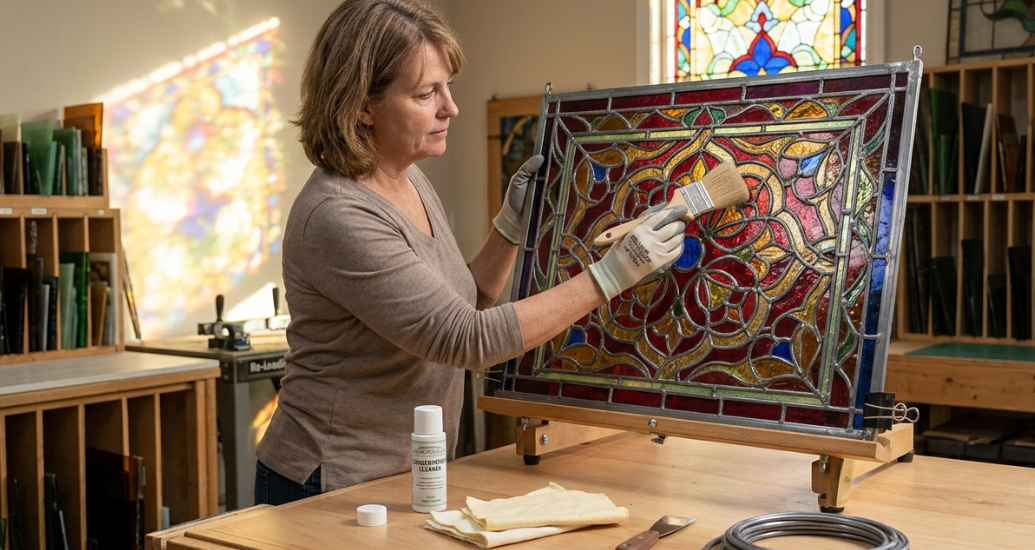
Routine Cleaning: How to Do It Right
The goal of cleaning stained glass is to remove dust, airborne grease, and surface deposits without damaging the lead, solder, or any surface-painted details. The rules are simple:
Use a soft, lint-free cloth microfibre is ideal dampened with clean water or a mild, pH-neutral glass cleaner. Wipe gently in sections, working from top to bottom so any drips fall onto uncleaned sections. Dry immediately with a separate clean cloth do not allow water to pool along lead joints, as standing moisture accelerates oxidation.
What to avoid is equally important. Never use abrasive scrubbers, scouring pads, or rough cloths. Never use acid-based cleaners, vinegar solutions, or harsh chemical solvents these can strip surface treatments from lead came, damage solder joints, and in some cases affect surface-applied enamels. Never use pressure washing or hosing, even on exterior-facing panels.
For panels in cooking areas a kitchen backsplash accent, for example grease deposits may require a slightly stronger approach. A small amount of diluted mild dishwashing liquid on a soft cloth, applied gently and rinsed immediately, is acceptable. Do not allow soapy residue to sit on lead or solder surfaces.
How often? For interior panels in living rooms, offices, or mosques, a gentle wipe-down every four to six weeks is usually sufficient. Panels in kitchens or other high-deposit environments may need monthly attention. Exterior-facing panels in dusty urban environments common in Lahore and Karachi benefit from cleaning every two to three weeks.
Periodic Inspection: What to Look For
Beyond routine cleaning, a more thorough inspection every one to two years is advisable. This does not need to be a specialist visit it’s something a careful owner can do with their own eyes and a flashlight.
Look for any lead came that appears to be pulling away from glass edges, sagging, or cracking. Run your fingers lightly along the surface to feel for sections of putty that have become loose, powdery, or absent. Inspect solder joints for white oxidation patches (normal and treatable) or dark grey powdering (a sign of more serious corrosion). Check the framing for any signs of moisture penetration, rot, or movement that could be transferring stress to the glass.
If anything concerns you, the correct response is to contact your glass supplier or installer for a professional assessment. Most issues, caught early, are straightforward and inexpensive to address. Issues allowed to progress compound in complexity and cost.
When to Call a Professional
Certain conditions require professional intervention rather than DIY attention:
A cracked or broken glass piece requires specialist repair the affected piece must be carefully removed from its lead came setting, a replacement cut and colour-matched, and the new piece re-leaded and soldered in. This is skilled work that should not be attempted without proper training and tools.
A panel that is visibly bowing or bulging has lost structural integrity and needs re-leading a complete restoration process in which the panel is disassembled, the lead came replaced, and the panel rebuilt. This is a significant undertaking but entirely achievable, and a properly re-leaded panel is essentially as good as new.
Extensive solder joint failure across a panel indicates that the panel has reached the end of its natural service life for its existing metalwork. Full restoration is the appropriate response.
At Green Glass Designer, we offer after-sales support and maintenance services for all panels we install, as well as assessment and restoration services for panels originally installed by other providers. If you’re unsure about the condition of an existing stained glass installation, a professional assessment is always the right first step.
Maintenance Schedule: A Practical Reference
| Task | Frequency | Who Does It |
|---|---|---|
| Gentle surface cleaning | Every 4–6 weeks | Owner |
| Kitchen/high-deposit area cleaning | Every 2–4 weeks | Owner |
| Lead, solder & putty visual inspection | Every 12–24 months | Owner |
| Professional condition assessment | Every 3–5 years | Specialist |
| Lead oxidation treatment | As needed (every 5–10 years) | Specialist |
| Re-cementing/re-puttying | Every 20–30 years | Specialist |
| Full re-leading | Every 50–100 years (if needed) | Specialist |
Stained Glass in Pakistan’s Climate: Special Considerations
Pakistan’s diverse climate from Karachi’s coastal heat and humidity to Islamabad’s cold winters and Lahore’s dust-heavy monsoon season creates conditions that affect stained glass in ways worth addressing specifically.
In Karachi, the salt-laden sea air is the primary concern. Salt deposits on glass and metalwork accelerate corrosion of lead and solder if panels are not sealed and cleaned regularly. Monthly cleaning is advisable for any exterior-facing or near-exterior panel in coastal environments. Panel installation in Karachi should always specify fully sealed perimeters and, for any external-facing application, protective glazing as standard.
In Lahore, the dual challenge of summer dust storms and monsoon humidity requires panels to be well-sealed against moisture infiltration during rain, while also being cleaned of dust deposits that accumulate rapidly during dry months. The thermal swings between hot summers and cooler winters make expansion-gap-conscious installation particularly important.
In Islamabad, the cooler climate with significant winter cold creates temperature differentials that can stress poorly installed panels. Condensation along lead came accelerates deterioration more quickly than in drier climates. Good ventilation around interior panels and proper exterior sealing are the main countermeasures.
For all Pakistani locations, interior installation is less demanding from a maintenance perspective than exterior installation. For exterior-facing positions front door sidelights, exterior windows, or shop entrances a dual-glazing approach (stained glass on the interior side, protective tempered glass on the exterior) is strongly recommended and is standard practice in all Green Glass Designer commercial installations.
Why Professional Installation Determines Long-Term Performance
Everything discussed in this guide the durability potential, the maintenance simplicity, the longevity is contingent on one foundational factor the quality of the original installation.
A stained glass panel fabricated with appropriate materials, installed with correct framing, properly cemented and sealed, and fitted with the right protective measures will deliver decades of beautiful, low-maintenance performance. The same panel, installed carelessly into an ill-fitting frame, without adequate sealing, without expansion allowance, and without protective glazing where required will develop problems within years.
This is not an abstract warning. It reflects what Green Glass Designer sees regularly when clients come to us for assessment of panels installed by less experienced providers. The glass itself is often fine. The installation is the problem.
At Green Glass Designer, every stained glass installation begins with a site survey and design consultation, proceeds through custom fabrication by our master artisans, and is completed by trained teams who follow professional standards for framing, sealing, and protective glazing. Our installations are backed by a service warranty, and we remain available for assessment and maintenance support throughout the life of every panel we install. Our project portfolio spans residential homes across Lahore’s DHA and Gulberg, boutique hotels in Karachi, mosques across Punjab, and commercial premises in Islamabad’s Blue Area.
Comparing Stained Glass to Other Decorative Glass Options
If you’re in the evaluation stage comparing stained glass against frosted glass, decorative etched glass, or digital glass solutions durability and maintenance are legitimate decision factors.
Frosted glass is extremely low-maintenance. It has no lead, no solder, no putty just glass with a surface treatment. It does not carry the artistic depth or light-play of stained glass, but its maintenance demands are minimal. For practical spaces where decoration is secondary to function, frosted glass is an excellent choice.
Decorative etched glass is similarly low-maintenance and can achieve intricate patterns, but does not produce the colour and luminosity that define stained glass’s unique character.
Digital glass media walls and LED-backlit decorative glass offer dynamic visual content but serve a fundamentally different purpose from handcrafted stained glass art.
The value of stained glass lies precisely in what these alternatives cannot replicate genuine handcrafted artistry, the play of coloured light through space, the heritage and cultural resonance of the medium, and the entirely unique character of each individually made panel. No two stained glass panels from our workshop are identical, and that individuality is central to what owners are investing in.
Questions to Ask Before You Buy Stained Glass
If you are currently evaluating a stained glass purchase and speaking with potential suppliers, these are the questions that will help you separate quality providers from those cutting corners:
What type of glass is used is it genuine coloured-through glass or surface-painted?
Surface-painted glass fades coloured-through glass does not.
Are painted or enamelled details kiln-fired onto the glass?
Kiln-fired details bond permanently cold-applied paints do not.
What gauge lead came is used, and how is the panel cemented?
Light-gauge came and skipped cementing are shortcuts with real long-term consequences.
Is protective glazing recommended for my specific installation?
Any reputable supplier assesses this based on your actual site conditions, not a blanket answer.
What is the warranty, and what does it cover?
Understand exactly what the supplier stands behind, and whether they offer maintenance and restoration services after installation.
At Green Glass Designer, we address all of these questions directly, with specifics based on your project’s actual requirements.
Get a Professional Assessment or Consultation
Whether you are planning a new stained glass installation, managing an existing panel that needs attention, or simply researching your options, Green Glass Designer is here to help with expert guidance grounded in 15 years of experience and hundreds of completed projects across Pakistan.
We offer free consultations in person or via WhatsApp where we assess your space, discuss your design vision, explain your material and construction options, and provide a transparent, detailed quotation. We are PEC-registered, ISO-certified, and committed to delivering stained glass that earns its place in your space not just at the moment of installation, but for decades to come.
Contact Green Glass Designer:
- 📞 03008445214
- 📧 greenglasspk@gmail.com
- 🌐 greenglassdesigner.com
- 💬 Chat on WhatsApp for an instant quote
Our stained glass services cover Lahore, Karachi, Islamabad, Rawalpindi, and all major cities across Pakistan.
Frequently Asked Questions
How long does stained glass last?
Properly made and installed stained glass can last 50 to 100 years or more. The glass itself does not degrade the lead came and solder require periodic maintenance and, eventually, replacement a process called re-leading that restores a panel to essentially new condition.
Does stained glass fade in Pakistan’s strong sunlight?
No quality stained glass colour is embedded in the glass during manufacture using mineral oxides, not applied to the surface. UV light cannot fade it. Surface-applied enamel details in lower-quality work can fade over time kiln-fired enamels used by professional studios do not.
Can a cracked stained glass panel be repaired?
Yes, in most cases. A cracked or broken individual piece of glass can be removed from its lead came setting and replaced with a colour-matched piece by a trained artisan. The result is virtually invisible in finished work.
Is stained glass safe for homes with children?
Traditional stained glass panels are not impact-resistant. For installations in homes with children, we strongly recommend protective tempered glazing on the exterior or traffic-facing side of any decorative stained glass panel standard practice in all Green Glass Designer residential installations.
What is the cost of stained glass maintenance?
Routine cleaning costs nothing beyond your time and mild cleaning products. Periodic professional maintenance re-cementing, treating oxidised lead is modest in cost compared to the value of the panel. Full restoration (re-leading) is a more significant investment but extends the panel’s life by another 50-plus years.
Conclusion
Stained glass is one of the oldest and most enduring decorative art forms in human architecture and for good reason. When made well and installed correctly, it is genuinely durable, genuinely beautiful, and far less demanding to maintain than most people assume before they learn the facts.
For homeowners, hotel operators, mosque committees, office designers, and commercial property owners across Pakistan, the key question is not whether stained glass can last it can but whether the craftsmanship, materials, and installation meet the standards required to realise that potential. At Green Glass Designer, those standards are not aspirational. They are the baseline of everything we make and install, from the coloured glass we source to the protective glazing specifications we recommend.
If you are ready to bring the beauty of stained glass into your space or to restore and protect stained glass you already own we are ready to help.