Table of Contents
By the time most homeowners and architects reach out to us, they’ve already decided plain glass isn’t going to do the job. Maybe it’s a street-facing window that needs privacy without turning into a dark, frosted slab. Maybe it’s a feature wall in a new café that needs to say something about the brand before a single menu is read. Maybe it’s a staircase that’s felt flat and forgettable since the day construction finished. Whatever the starting point, the decision has usually already been made that the glass itself needs to do more work than just letting light through.
What hasn’t been decided yet and what we get asked about more than almost anything else is which material actually gets you there stained glass or frit glass. Both are decorative both work with light in a way ordinary glass doesn’t and both show up constantly in the same Pinterest boards and Instagram reels that got someone excited about doing something more interesting with their glazing in the first place. But they’re genuinely different materials, suited to different rooms, budgets and design intention and picking the wrong one for your specific project is one of the more common regrets we hear about from clients who didn’t ask enough questions before committing.
This guide is built for exactly that decision point. If you already know you want more than plain glass and you’re now weighing stained glass against frit glass, here’s everything you need to make that call with confidence.
Quick Facts Before You Decide:
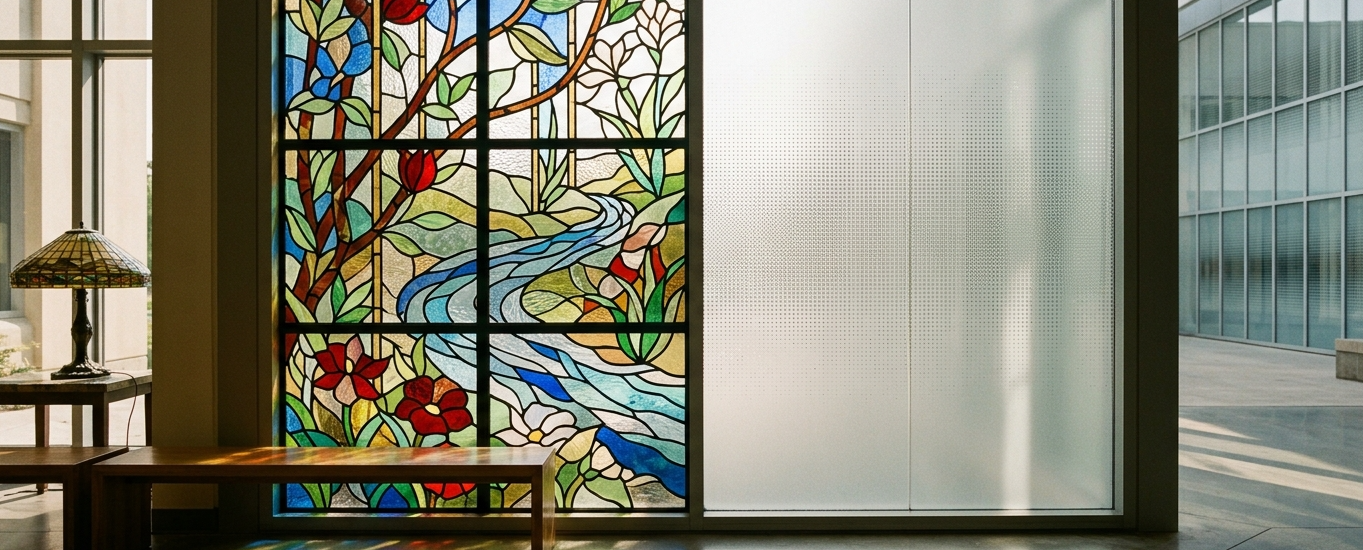
- Stained glass is defined by color and light transmission through colored panels frit glass is defined by pattern and privacy through an opaque or semi-opaque ceramic coating fired onto clear glass.
- Frit glass is generally the more budget-friendly option for large-scale privacy applications like office partitions and shopfronts.
- Stained glass is almost always the choice when color storytelling, or a strong decorative statement is the primary goal.
- Both materials can be paired with tempered or laminated safety glass for structural applications.
- Many of our most successful residential and commercial projects in Lahore, Karachi and Islamabad actually combine both materials in the same space, rather than choosing one exclusively.
What Stained Glass Actually Is
Stained glass is glass that has been colored throughout its structure, either during manufacturing by adding metallic salts to molten glass or through modern techniques like copper foil construction, where individually cut pieces of colored glass are joined together with soldered metal came. The defining characteristic is that light passes through the color itself, not through a coating applied on top of clear glass. That’s what gives stained glass its distinctive quality of glowing rather than simply being tinted.
Traditional stained glass work is associated with cathedral windows and religious storytelling, but the techniques used today, particularly copper foil construction, have made the craft far more flexible and considerably more achievable for residential and commercial projects than the leaded glass work of centuries past. A modern stained glass panel can range from a fully abstract, geometric color-block design that would sit comfortably in a minimalist villa to a Mughal-inspired jharoka-style window with colored glass set behind traditional latticework all the way to fully custom calligraphic or motif-driven pieces.
The most important thing to understand about stained glass is that its entire visual effect depends on light transmission. A stained glass panel installed somewhere with strong, direct natural light will glow and shift throughout the day in a way that’s genuinely difficult to replicate with any other material. The same panel installed in a dim, north-facing corner with limited daylight will look considerably flatter and won’t deliver nearly the same impact.
What Frit Glass Actually Is
Frit glass sometimes called ceramic frit or fritted glass is clear glass that has had a ceramic paint or enamel pattern fired permanently onto its surface at high temperature, fusing the pattern into the glass itself rather than sitting on top as a removable coating. The result is a durable, opaque or semi-opaque pattern, dots, lines, gradients, custom motifs that controls light transmission and visibility without relying on color the way stained glass does.
Frit glass is fundamentally a functional material that happens to also be decorative, rather than the other way around. It was originally developed and remains widely used for solar control in commercial architecture since a frit pattern can meaningfully reduce heat gain and glare through a large glazed façade a function that has nothing to do with aesthetics at all. That functional origin still shows in how frit glass gets specified today office partitions, shopfront glazing, large curtain walls and any application where privacy or solar performance needs to be balanced against natural light at scale.
Because the frit pattern is fired directly into the glass rather than built from separate colored pieces, frit glass can be produced in much larger continuous panels than stained glass typically allows and it can be manufactured with a level of pattern consistency, dot gradients, precise line spacing, that’s difficult to achieve with hand-assembled colored glass work.
The Core Difference in Plain Terms
If you only remember one distinction between these two materials, make it this one stained glass is primarily about color and storytelling through light frit glass is primarily about pattern, privacy and solar control. Everything else two materials’ cost, scale, application and maintenance differences flows from that core difference in what each one is actually designed to do.
That doesn’t mean the two can’t overlap. A frit pattern can be visually striking and can absolutely serve as a design statement in its own right and a stained glass panel can provide meaningful privacy in the right location. But if you’re trying to figure out which material fits your specific project starting from what you actually need, color and glow, or pattern and light control, will get you to the right answer faster than comparing the two materials in the abstract.
✓ A Useful Gut Check
Ask yourself one question before reading further are you trying to add color and personality to a space or are you trying to solve a privacy or glare problem while keeping things visually clean and neutral? If it’s the first, lean toward stained glass. If it’s the second, lean toward frit glass. The rest of this guide will help you refine that instinct, but it’s a genuinely reliable starting point.
Stained Glass vs. Frit Glass: Side by Side
| Factor | Stained Glass | Frit Glass |
|---|---|---|
| Primary Effect | Color and glowing light transmission | Opaque or semi-opaque pattern, privacy, glare control |
| Best For | Feature windows, entryways, statement walls, room dividers | Office partitions, shopfronts, large façades, bathroom privacy |
| Typical Scale | Smaller to medium panels, custom-fit | Large continuous panels, highly scalable |
| Customization | Fully custom colors, motifs and imagery | Custom patterns, dot density and gradients |
| Light Transmission | High, with strong color shift throughout the day | Moderate, generally more consistent across the day |
| Relative Cost | Higher per square foot for custom color work | Generally more economical for large-scale applications |
| Production Time | Longer for fully custom or intricate designs | Typically faster for standard pattern runs |
| Maintenance | Low, though soldered joints in traditional work benefit from occasional inspection | Very low, since the pattern is fused into the glass surface |
| Heritage or Modern Feel | Can flex from fully modern to strongly heritage-influenced | Reads as distinctly modern and architectural |
| Solar/Heat Performance | Secondary consideration, not a primary function | Genuine functional benefit for large glazed areas |
Where Stained Glass Wins
When color and mood are the point. If the goal is a space that genuinely feels different because of how light interacts with it throughout the day, an amber and smoke-grey entryway transom that shifts in character from morning to evening, there’s no substitute for stained glass. Frit glass simply doesn’t produce that same quality of glowing, shifting color because it isn’t working with color transmission in the same way.
Entryways, feature windows, and staircases. These are the applications where stained glass has made its biggest comeback in modern Pakistani interiors, and for good reason. A colored glass transom above a front door or a skylight above a central staircase is meant to be a focal point, something a guest notices and remembers not a background architectural element. Stained glass is built for exactly that kind of visual statement in a way frit glass, by design isn’t trying to be.
Projects with a heritage or storytelling angle. If a project wants to draw on Mughal-inspired jharoka windows, calligraphic detail or a commemorative custom design, stained glass is really the only material of the two that can carry that kind of narrative or motif-driven work convincingly. Frit glass patterns tend to read as geometric and contemporary almost by nature of how the technique works, which makes it a poor fit for a client specifically chasing a heritage aesthetic.
Smaller, high-impact areas. Because custom stained glass work is priced per square foot for the colored, hand-assembled glass and often involves more intensive fabrication, it tends to deliver the strongest value in smaller, carefully chosen locations, an entryway sidelight, a powder room window, a single statement panel, rather than being spread across very large glazed areas where the cost scales up quickly.
Where Frit Glass Wins
Large-scale office and commercial partitions. When a business needs to divide an open floor plan into private offices and meeting rooms without losing the sense of an open, light-filled workspace, frit glass is almost always the more practical and economical choice. Its ability to be produced in large, consistent panels makes it far better suited to covering significant square footage than custom stained glass would be.
Shopfronts and curtain wall façades. Retail and commercial shopfronts frequently use frit glass both for its clean, modern aesthetic and for its genuine solar control benefits, reducing glare and heat gain on a large glazed storefront in a way that matters for both comfort and energy costs. This is a case where frit glass’s functional origins as a solar-control material genuinely pay off not just its appearance.
Bathroom and shower privacy where a neutral aesthetic is wanted. For clients who want privacy without introducing strong color into a bathroom’s design scheme, frit glass delivers that in a clean, contemporary way that sits comfortably alongside neutral tile and fixtures without competing for visual attention the way a colored stained glass panel would.
Projects on a tighter timeline or budget for large areas. Standard frit patterns can typically be produced and installed faster than fully custom stained glass work, particularly for larger installations, which makes it a better fit for commercial projects working against a fit-out deadline or a defined per-square-foot glazing budget.
A Common Misstep to Avoid
We regularly see clients fall in love with a stained glass image from a small feature window and then try to scale that same approach across an entire large office partition wall, or the reverse, choosing a frit pattern for a single small statement window where a bit of color would have delivered far more visual impact. Matching the material to the actual scale and function of the space, not just the aesthetic you saw online, is the single biggest factor in whether a project feels right once it’s installed.
Cost Considerations, Honestly
Cost is one of the most common questions we get on this comparison and the honest answer is that it depends heavily on scale and customization rather than one material simply being cheaper than the other in every situation.
For a single, custom-designed statement panel, an entryway transom or a small feature window, stained glass and a comparably sized custom frit panel can end up in a similar cost range, since both involve meaningful design and fabrication work at that scale. Where the cost gap widens is at larger scale covering a significant wall or an entire office partition system in fully custom, hand-assembled stained glass gets expensive quickly, while frit glass’s production process scales more efficiently across large continuous areas, which is exactly why it dominates commercial applications at that size.
The more useful way to think about cost isn’t “which material is cheaper” in the abstract, but “which material is being asked to do the right amount of work for its price.” A small stained glass feature costs what it costs because it’s doing a concentrated, high-impact design job in one location. A large frit glass partition costs what it costs because it’s efficiently covering a lot of square footage with a consistent, functional pattern. Comparing the two head-to-head only makes sense once you’ve settled on the scale and function you actually need.
Can You Combine Both in One Project?
Yes, and some of our most successful projects across Lahore, Karachi, and Islamabad do exactly this rather than treating it as an either-or decision. A common and effective pairing is a stained glass feature element, an entryway sidelight or a small statement window, combined with frit glass used functionally elsewhere in the same project, such as an adjoining office partition or a bathroom privacy panel.
This combination lets a project get the color and storytelling impact of stained glass exactly where it matters most for first impressions and focal points, while relying on frit glass’s efficiency and neutral aesthetic for the larger, more functional glazing needs elsewhere in the same space. If your project has both a clear “statement” location and a larger, more functional glazing need, it’s worth discussing this combined approach rather than assuming you need to pick a single material for everything.
Questions to Ask Yourself Before Deciding
Is the primary goal color and visual impact, or privacy and light control?
This is the single most useful question and it tends to sort most projects clearly toward one material or the other before any other factor even comes into play.
How much natural light does the space actually get?
Stained glass depends on strong light transmission to deliver its full effect a space with limited or indirect daylight will get more consistent value from frit glass, which doesn’t rely on the same degree of direct light to look intentional and well-finished.
What’s the scale of the area being covered?
A single feature window has very different economics and design logic than an entire partition wall or shopfront. Matching the material to the actual scale, rather than defaulting to whichever material inspired the original idea, avoids both overspending and underwhelming results.
Does the project have a heritage or storytelling angle, or a clean, contemporary one?
Stained glass flexes across both ends of that spectrum more naturally than frit glass does if a strongly modern, minimal aesthetic is the goal throughout, frit glass will generally feel more architecturally consistent with the rest of the space.
Is solar heat gain or glare a genuine functional concern for this glazing?
If you’re dealing with a large west-facing façade or a shopfront that bakes in direct sun for much of the day, frit glass’s functional solar-control properties are a real, measurable benefit that stained glass isn’t designed to provide in the same way.
A Simple Decision Framework
Small, high-impact, colorful, heritage-flexible, budget concentrated in one location → Stained Glass. Large-scale, neutral, privacy or glare-driven, budget spread across significant square footage → Frit Glass. Both needs present in the same project → Consider combining the two rather than forcing a single choice.
What This Looks Like in Real Pakistani Interiors Right Now
Walking through recent residential and commercial projects across Lahore, Karachi and Islamabad, the pattern holds up consistently. Villas and boutique homes leaning into the current stained glass revival tend to use it in exactly the places this guide points toward entryway transoms, staircase skylights and powder room windows, locations where a concentrated, high-impact design statement makes sense.
Meanwhile, corporate offices, retail shopfronts and larger commercial fit-outs across the same cities lean heavily on frit glass for partition walls and façade glazing, precisely because those projects are covering significant square footage and need a consistent, professional, light-controlling finish rather than a decorative focal point at every turn. The two materials aren’t competing for the same projects nearly as often as their shared popularity on design social media might suggest in practice, they tend to sort themselves cleanly by application once a project’s actual needs are clear.
A Decision Worth Getting Right the First Time
Both stained glass and frit glass are excellent materials capable of transforming a space and neither is objectively better than the other in isolation. The mistake worth avoiding isn’t choosing the “wrong” material in some absolute sense, it’s choosing a material that doesn’t match what a specific room or project actually needs, which is a far more common and far more avoidable problem than people expect going in.
If you’re still genuinely unsure which direction fits your space after reading through this comparison, that’s a completely normal place to be and it’s exactly the kind of question worth talking through before committing to a design, rather than after installation.
At Green Glass Designer, we walk homeowners, architects, and business owners across Lahore, Karachi, Islamabad and beyond through exactly this decision on a regular basis, looking at the actual light conditions, scale, and intent of a specific project rather than starting from a material preference. If you’re weighing stained glass against frit glass for your own space, our stained glass installation service and ceramic frit glass pages have more examples of what each material can look like in practice.
Get a Free Consultation or reach out on WhatsApp to talk through which option actually fits your space, no obligation, just a straightforward conversation about what’s possible.