Table of Contents
If you’ve ever admired a front door with a window full of small, sparkling geometric glass pieces, each one catching and refracting light slightly differently as you walk past, you’ve likely seen cluster beveled glass without knowing what it’s actually called. It’s one of those design details that people notice and love instinctively, without necessarily knowing there’s a specific name and craft technique behind it, or that it’s something you can actually specify for your own home or business rather than something you only find in older, established properties.
This guide is built to close that gap. Whether you spotted this style on a neighbor’s front door, saw it in a photo while researching entryway ideas, or just want to understand what makes this particular glass treatment look so distinctive, this is the plain-language starting point covering exactly what cluster beveled glass is, how it’s made, where it works best, and how to think about it for a project of your own.
Individual Pieces
Each bevel in a cluster panel is a separate, individually cut and polished piece of glass
Light Refraction
The angled edges bend and separate light like a small prism, creating sparkle and subtle color
Nationwide
Green Glass Designer designs and installs cluster beveled glass panels across Pakistan
What Cluster Beveled Glass Actually Is
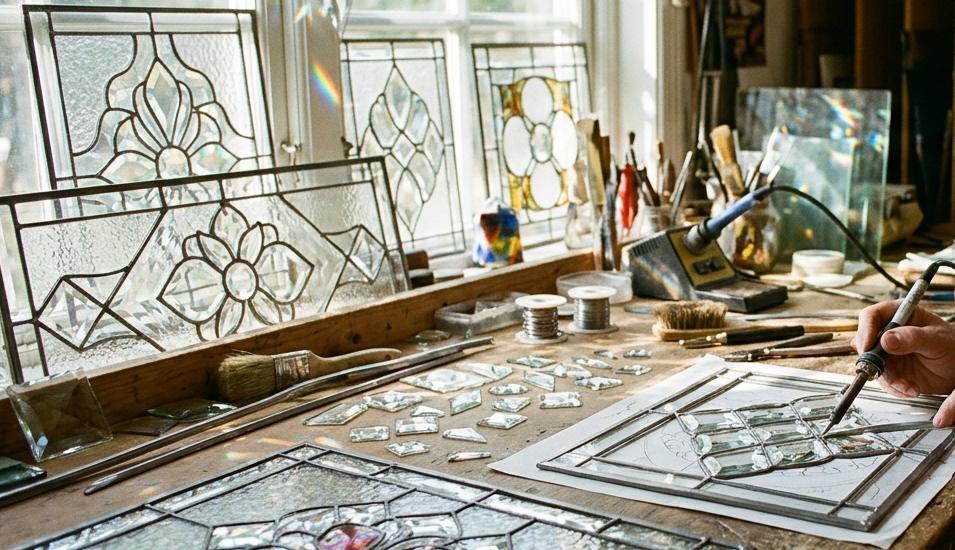
Cluster beveled glass is a decorative glass panel made up of multiple individual pieces of beveled glass, each cut into a specific shape, commonly diamonds, triangles, ovals, or other geometric forms, and assembled together into a single arrangement, typically joined using the same lead or zinc came construction technique used in traditional stained glass work. The word “bevel” refers to the angled, polished edge ground into each piece of glass, rather than leaving the edge flat and square.
The key word here is “cluster.” A single beveled mirror or window uses one large piece of glass with a beveled edge around its perimeter. Cluster beveled glass instead groups many smaller individual bevels together into one panel, and it’s the interaction between all of those individually angled pieces, each catching and refracting light slightly differently depending on its shape and position, that creates the sparkling, faceted, almost jewel-like visual effect this style is known for.
A Simple Way to Picture It
Think of a single beveled mirror as one polished gem with an angled edge, and a cluster beveled panel as a whole arrangement of smaller polished gems grouped together into a single composition. The individual bevel and the cluster panel share the same core beveling technique, they’re just applied at completely different scales and with a very different visual result.
What “Beveling” Actually Means at a Technical Level
Before getting further into how cluster panels are assembled, it’s worth understanding what beveling itself actually involves, since this grinding and polishing process is the foundation of the entire visual effect. A standard piece of flat glass has a plain, straight-cut edge. Beveling grinds that edge down at an angle, typically at a shallow slope rather than a steep one, then polishes it to a smooth, clear finish.
This angled edge does something a flat edge can’t it bends light differently than the flat face of the glass does, creating a visible line of refracted light and color along the beveled edge itself, the subtle rainbow or prism-like sparkle you notice when light catches a beveled mirror or window at the right angle. A wider, more pronounced bevel creates a more dramatic refraction effect, while a narrower bevel produces a more subtle sparkle, and this is one of the specifications worth discussing directly when planning a cluster panel, since bevel width genuinely changes the final visual character of the piece.
Why This Detail Matters for the Final Look
The width and angle of the bevel ground into each individual piece has a real, visible effect on how much sparkle and color refraction the finished panel produces. A cluster panel made with narrow, subtle bevels reads as more understated and elegant, while wider, more pronounced bevels create a bolder, more dramatic sparkling effect, both are valid choices depending on the look you’re going for.
How a Cluster Beveled Glass Panel Is Actually Made
Understanding the construction process helps explain both the visual result and why this style of glasswork is considered a genuine craft rather than a simple manufacturing process.
Individual bevels are cut and ground to their final shapes. Each piece in the cluster, whether it’s a diamond, triangle, oval, or another geometric shape, is cut from clear glass and then has its edges ground down and polished into a beveled finish, a separate, careful process for every single piece in the design.
The overall pattern is laid out. Before assembly, the full cluster design is planned as a pattern, determining how many individual bevel pieces will be used, their specific shapes and sizes, and how they’ll be arranged relative to each other within the final panel, radiating out from a center point, arranged in a grid, or following a more organic, asymmetric composition.
The pieces are joined using lead or zinc came. Following the same fundamental technique used in traditional stained glass construction, each individual beveled piece is wrapped with thin strips of lead or zinc came, a soft metal channel that holds adjacent pieces together at their edges, and the entire assembly is soldered at every joint where pieces meet, creating a single, structurally unified panel out of what started as many separate pieces of glass.
The finished panel is cleaned, sealed, and, if needed, framed. Once assembled and soldered, the panel is cleaned of any flux residue from the soldering process, and cement or a similar sealant is often worked into the joints between the came and the glass for additional structural stability and weather resistance, particularly important for exterior applications like front doors and sidelights.
Why This Is Considered a Genuine Craft, Not Just a Manufacturing Step
Every individual bevel in a cluster panel is cut, ground, and polished separately, and the overall composition needs to be planned so the finished arrangement reads as a cohesive design rather than a random assortment of shapes. This is why cluster beveled glass work is generally produced by craftspeople with genuine glasswork experience, rather than being a fully automated manufacturing process the way plain flat glass typically is.
Curious What a Cluster Beveled Design Could Look Like for Your Door or Window?
Message or Call with a photo of the space you’re considering, and we’ll help you picture what a custom cluster arrangement could look like there.
What Cluster Beveled Glass Actually Looks Like
Because the term covers a genuinely wide range of specific designs, it helps to understand the common visual variations you’re likely to encounter or want to choose between.
Radiating starburst patterns. One of the most classic and recognizable cluster arrangements, where beveled pieces radiate outward from a central point, often a round or oval central bevel, creating a sunburst or starburst effect that reads as formal and traditional, especially popular for front door transoms and sidelights.
Diamond grid clusters. Uniform diamond-shaped bevels arranged in a repeating grid pattern across the panel, creating a more contemporary, geometrically consistent look than a radiating starburst design, well suited to modern doors and room dividers wanting a cleaner, more structured aesthetic.
Asymmetric or organic clusters. Rather than a strict geometric pattern, some cluster designs arrange varying shapes and sizes of bevels in a more organic, seemingly random but carefully composed arrangement, creating a more artistic, less formally symmetrical final look.
Mixed clear and colored bevel combinations. While cluster beveled glass is most commonly seen in clear glass, some designs incorporate a small number of colored glass pieces within an otherwise clear cluster, adding a subtle color accent without moving fully into stained glass territory.
Bevel clusters combined with a stained glass border. For a more elaborate, layered design, a cluster of clear bevels can be set within a colored stained glass border or frame, combining both craft techniques into a single panel for a genuinely rich, detailed final piece.
How This Differs From What You Might Be Picturing
If you’re picturing something fully colorful with imagery or a scene depicted in the glass, you’re likely thinking of stained glass rather than cluster beveled work, which is almost always primarily clear glass, relying on the sparkle and refraction of the bevels themselves rather than color for its visual impact. If you’re not sure which effect you’re actually after, our guide on stained glass versus frit glass covers a related but different comparison worth understanding alongside this one.
Where Cluster Beveled Glass Is Actually Used
Front door windows and sidelights. This is by far the most common and recognizable application, a front door with a cluster beveled window, or matching sidelights flanking the door, creates a genuinely memorable, elegant first impression, catching and sparkling with both natural daylight and porch or entryway lighting in the evening.
Transom windows above doors. A cluster beveled transom, the window positioned directly above a door frame, brings the same sparkling effect to an entryway without requiring the door itself to include glass, a popular choice for homes wanting this decorative detail while keeping the door itself solid for security or privacy reasons.
Interior room dividers and cabinet doors. Smaller-scale cluster beveled panels work beautifully as inserts in cabinet doors, particularly in more formal dining rooms or living spaces, and as decorative panels within larger room divider screens, bringing sparkle and light play to interior spaces beyond just entryways.
Decorative window inserts. Rather than a full window, a cluster beveled panel can be set as a decorative insert within a larger window composition, adding a sparkling focal detail without covering the entire window opening.
Stair landing and hallway windows. Cluster beveled panels in stairwell or hallway windows catch changing light throughout the day as the sun moves, creating a genuinely dynamic decorative feature in spaces that often otherwise receive relatively little design attention.
A Quick Way to Know If This Fits Your Project
If you’re drawn to the idea of a sparkling, faceted, jewel-like glass detail with a more traditional or elegant character, particularly for an entryway, cluster beveled glass is very likely the right direction. If you’re picturing bold color and imagery instead, that’s a sign you’re actually thinking of stained glass, and if you’re picturing a clean, modern, geometric pattern for privacy at a larger scale, frit glass would likely serve you better.
Cluster Beveled Glass vs. Other Decorative Glass Styles
Since cluster beveled glass is often considered alongside a few related decorative glass techniques, it’s worth clarifying how it actually differs from the most common alternatives.
Cluster beveled glass vs. a single large beveled mirror or window. A single beveled piece uses one large piece of glass with a beveled edge around its perimeter, creating a subtle sparkle line only along that outer edge. A cluster panel groups many smaller individually beveled pieces together, multiplying that sparkle effect across the entire surface of the panel rather than confining it to a single perimeter edge.
Cluster beveled glass vs. stained glass. Stained glass uses colored glass throughout its structure to create imagery, patterns, or scenes through color and light transmission. Cluster beveled glass is almost always clear glass, relying on the physical, angled bevel cuts and resulting light refraction for its visual effect rather than color. The two techniques can be combined, a cluster of clear bevels within a stained glass border, but they’re fundamentally different visual approaches on their own.
Cluster beveled glass vs. frit glass. Frit glass uses a fired ceramic pattern on flat, unbeveled glass to create privacy and light control at a larger architectural scale, offices, shopfronts, facades. Cluster beveled glass is a smaller-scale, more traditionally crafted decorative technique focused on sparkle and light refraction rather than privacy or solar control, and the two serve genuinely different practical purposes even though both fall under the broader “decorative glass” category.
Cluster beveled glass vs. plain textured or frosted glass. Textured and frosted glass create a uniform, diffused visual effect across an entire surface through etching or embossing. Cluster beveled glass creates its effect through the specific, individual angled cuts of many small glass pieces assembled together, a considerably more detailed, labor-intensive, and visually intricate technique than a uniform surface texture treatment.
Cluster Beveled Glass Compared to Related Styles
| Style | Primary Visual Effect | Typical Scale | Relies On |
|---|---|---|---|
| Cluster Beveled Glass | Sparkle, light refraction, faceted texture | Doors, sidelights, cabinet inserts | Individually cut and polished bevel edges |
| Single Beveled Glass | Subtle sparkle along one perimeter edge | Mirrors, single windows | One large beveled edge |
| Stained Glass | Color and light transmission | Windows, domes, panels | Colored glass pieces joined with came |
| Frit Glass | Privacy, pattern, solar control | Partitions, facades, shopfronts | Fired ceramic pattern on flat glass |
| Frosted/Textured Glass | Uniform diffusion or texture | Windows, partitions | Etched or embossed surface treatment |
Practical Considerations Before Choosing Cluster Beveled Glass
A few practical factors are worth understanding before deciding this is the right direction for your project.
It’s generally best suited to smaller-scale applications. Given the individual craftsmanship required for each bevel piece and the overall composition, cluster beveled glass tends to work best, both visually and practically, at the scale of a door window, sidelight, transom, or cabinet insert, rather than being scaled up to cover an entire large wall or facade, which is where a technique like frit glass becomes more appropriate instead.
It requires genuine craftsmanship, which affects timeline. Because each bevel is individually cut, ground, and polished, and the full assembly is hand-soldered, cluster beveled panels generally take longer to produce than a simpler flat glass treatment, worth factoring into your project timeline if you’re working toward a specific completion date.
It can be designed to match an existing architectural style, or set a design tone for a new build. For renovations of homes with existing traditional or period architectural details, a custom cluster beveled design can be crafted to genuinely complement that existing character. For new builds, it can help establish an elegant, traditional design tone from the entryway inward.
Exterior applications need appropriate weatherproofing. For a front door or exterior sidelight application, the came joints and overall panel construction need proper weatherproofing and, in many cases, protection through an additional storm door or exterior glazing layer, a detail worth discussing directly with your installer for any exterior placement.
A Question Worth Asking Before You Commit
If you’re planning a cluster beveled panel for an exterior door or window, ask your supplier directly how the installation will be weatherproofed and protected from direct exposure, since this affects both the panel’s longevity and its ongoing structural integrity over years of outdoor exposure.
Frequently Asked Questions
Is cluster beveled glass the same as “beveled glass” in general, or something more specific?
“Beveled glass” broadly refers to any glass with a ground and polished angled edge, which can describe a single piece, like a large beveled mirror, just as accurately as a cluster panel. “Cluster beveled glass” specifically refers to an arrangement of many individual beveled pieces assembled together into one composition, a more specific and more visually elaborate application of the broader beveling technique.
How durable is cluster beveled glass, especially for a front door that gets used daily?
Properly constructed cluster beveled panels are genuinely durable for regular daily use, since the individual glass pieces themselves are as strong as standard glass and the lead or zinc came construction is a time-tested technique used in traditional glasswork for centuries. As with any glass installation, appropriate glass thickness and, for exterior applications, weatherproofing and protective glazing matter for long-term durability.
Can cluster beveled glass be custom designed, or is it limited to standard patterns like starbursts?
Fully custom cluster designs, specific shapes, arrangements, sizes, and even a mix of clear and colored bevels, are genuinely achievable, since each panel is assembled from individually cut pieces rather than manufactured as a single fixed unit. Standard patterns like radiating starbursts are popular because they work reliably well visually, but they’re a starting point rather than the only option available.
Is cluster beveled glass more expensive than plain glass or a single beveled panel?
Yes, given the individual craftsmanship required for each bevel piece and the hand assembly process, cluster beveled glass generally costs more than plain flat glass or a single beveled piece of comparable size. The specific cost depends on the number of individual bevels, the complexity of the pattern, and the overall panel size, which is exactly the kind of detail worth discussing directly for your specific project.
Does cluster beveled glass work well in a modern home, or is it only suited to traditional architecture?
While cluster beveled glass has strong traditional associations, particularly the classic radiating starburst pattern, more geometric arrangements like uniform diamond grids can read as considerably more contemporary, making this a genuinely flexible technique that isn’t strictly limited to traditional or period-style homes.
Can cluster beveled glass be installed as a retrofit into an existing door, or does it require a new door entirely?
In many cases, an existing door’s glass panel can be replaced with a custom cluster beveled panel without replacing the entire door, provided the existing opening and frame are suitable for the new glass panel’s dimensions and weight. This is worth assessing directly with your installer based on your specific existing door.
How do I clean and maintain a cluster beveled glass panel?
Standard glass cleaning products and methods work well for the glass surfaces themselves, and the lead or zinc came joints generally require little more than occasional gentle cleaning to keep them looking their best, without any special or unusual maintenance routine required beyond what you’d already do for a regular window or door glass panel.
Bringing This Detail Into Your Own Entryway
Cluster beveled glass is a genuinely distinctive, craft-driven decorative technique that turns an ordinary door, window, or cabinet detail into something considerably more memorable, relying on the interplay of many individually cut and polished glass pieces rather than color or pattern for its visual impact. If this is the kind of sparkling, elegant detail you’ve been picturing without quite knowing what to call it, the next step is a straightforward conversation about your specific door, window, or space.