Table of Contents
Imagine two buildings on the same commercial road in Lahore, both clad in aluminium composite panels the same year. Five years later, one still looks crisp, with clean lines, even color and tight joints. The other shows streaking under the window lines, a few chalky patches on the west face and sealant that has started to crack. Same material, very different outcome. The gap almost never comes down to the panels alone. It comes down to specification, installation quality and what happened, or didn’t happen, after handover.
If you’re reading this, you’ve probably already decided ACP is worth considering. You’ve seen the designs, you understand the look, and now the practical questions are showing up how long will it really last, how much work does it need, and will it still look good when the novelty wears off? This guide answers those questions honestly, including the parts that don’t flatter the material, so you can compare ACP against your other options and choose a contractor with open eyes.
We work with ACP façades across Pakistan’s major cities, so the examples below reflect local conditions intense summer sun, monsoon humidity, dust and urban pollution. Where we quote numbers, they’re typical ranges rather than promises, since every building behaves differently.
Buildings near busy roads or construction activity may need washing more often, while a sheltered interior lobby may need nothing more than an occasional wipe. The point is consistency. A light wash twice a year costs far less than restoring a façade that’s been neglected for a decade.
For high-rise or hard-to-reach elevations, plan access in advance. Cradles, rope access or scaffolding add cost, so many owners bundle cleaning with their sealant inspection to do both in a single visit.
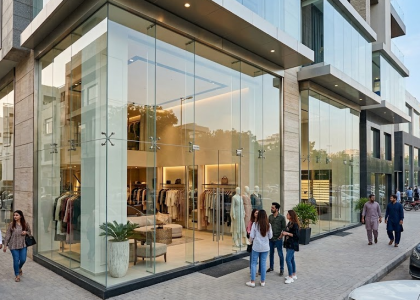
ACP sits in a practical middle ground lighter and quicker to install than stone, longer-lasting and cleaner-looking than paint over time, and often more affordable than large glazed systems. Many projects also combine them. A glass entrance or shopfront glass panels framed by ACP gives a façade both transparency and a durable, colour-controlled surround. If you’re weighing glazing against cladding for a particular elevation, our note on glass shop front durability is a useful companion read.
What Makes ACP Durable in the First Place
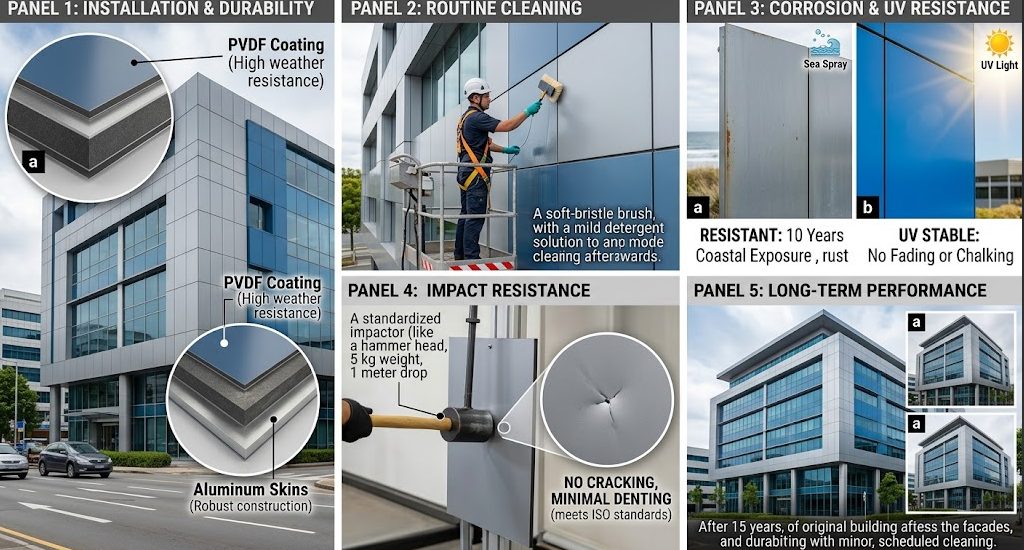
An aluminium composite panel is a sandwich two thin aluminium skins bonded to a core, usually polyethylene or a mineral-filled fire-retardant core. The skins carry a factory-applied coating, typically PVDF (polyvinylidene fluoride) for exteriors or polyester for interiors. Durability is really the sum of these layers working together.The aluminium skins
Aluminium doesn’t rust. It forms a thin oxide layer that protects the metal underneath, which is why ACP is described as corrosion-free. That matters in humid or coastal-adjacent conditions where steel cladding would demand constant attention. The skins are also light, which reduces load on the structure and on the fixing system.The coating
The coating is where most of the long-term appearance is won or lost. PVDF coatings resist ultraviolet degradation, chalking and color fade far better than basic polyester. On a west-facing façade in a Pakistani summer, that difference is visible within a few years. Interior panels away from sunlight can do perfectly well with polyester.The core
The core keeps the panel flat and rigid while staying light. A good-quality core bonds evenly to both skins. Poor bonding shows up later as bubbling, waviness or delamination, which is a defect no amount of cleaning will fix.The fixing system
Panels are only as durable as what holds them up. A properly engineered aluminium sub-frame, correct fasteners and designed expansion gaps let the panels move with temperature without stressing the joints. Most durability complaints we’re called to assess trace back to the frame or the sealant, not the panel face.Worth Noting Two panels that look identical on a sample board can behave very differently after five summers. Thickness of the aluminium skin, coating type and core quality are invisible from a few steps away, which is why asking for specifications in writing matters more than judging a sample by eye.
Realistic Lifespan in Pakistan’s Climate
Well-specified, properly installed exterior ACP with a PVDF coating can reasonably perform for fifteen to twenty-five years, and interior applications often last longer because they avoid UV and rain. Lower-grade panels with thin skins and basic coatings may start showing problems within five to eight years on exposed elevations. Our own panels carry a 10-year warranty on durability with a 2-year warranty on installation workmanship. That split is informative. Panel defects are rare when material is sourced properly, while workmanship issues such as sealant failure or misaligned joints tend to surface early, which is why the shorter workmanship window still matters. Local conditions shape the curve:- Sun: Summer heat in Punjab and Sindh pushes surface temperatures high. Coating quality and expansion allowances do the heavy lifting here.
- Monsoon and humidity: Water isn’t a threat to aluminium, but it finds weaknesses in sealant lines and drainage details.
- Dust and pollution: Particulates settle on surfaces and, combined with rain, create streaks. This is a cosmetic maintenance issue rather than a structural one.
- Wind: Tall buildings and open plots expose panels to uplift. Fixing design and panel thickness must account for it.
What Actually Causes ACP to Fail Early
When ACP disappoints, it’s rarely a mystery. The same handful of causes show up again and again. Thin or uncertified material. Price differences between panels often reflect skin thickness and coating grade. A cheaper panel may look identical on day one and age noticeably faster. Missing expansion gaps. Aluminium expands and contracts with temperature. Panels fixed too tightly can buckle or oil-can, and joints can open up. Poor sealant or wrong sealant. Sealant is the most maintenance-sensitive part of the system. Low-grade silicone yellows, shrinks and loses adhesion, allowing water behind the panels. Inadequate sub-frame. Corroded steel brackets, uneven framing or weak fixings cause waviness and, in severe cases, panel movement. Edge and cut damage. CNC cutting and grooving need to be done cleanly. Rough edges left exposed can allow moisture into the core, particularly on interior-grade material used outdoors. Aggressive cleaning. Abrasive pads and harsh chemicals strip coatings and leave permanent marks. This is the most avoidable failure of all. No maintenance at all. Even a robust façade benefits from a yearly look. Small sealant failures are cheap to fix early and expensive to fix after water has done damage.A Practical Maintenance Routine
Good news: ACP is a low-maintenance material, not a no-maintenance one. A sensible routine is short and inexpensive compared with repainting or re-rendering a concrete façade.| Frequency | Task | What you’re looking for |
|---|---|---|
| Every 3–6 months | Visual walk-around from ground level | Streaks, bird droppings, debris in joints, loose trims |
| Every 6–12 months | Wash with mild soap solution and soft cloth or sponge | Dust film, pollution staining, algae near damp zones |
| Yearly | Sealant and joint inspection | Cracking, shrinkage, gaps, discoloration |
| Yearly (before monsoon) | Check drainage paths, gutters and flashings | Blocked weep paths, water tracks behind trims |
| Every 3–5 years | Professional inspection of sub-frame and fixings | Corrosion at fixings, movement, panel bowing |
Cleaning Do’s and Don’ts
Do
- Use lukewarm water with a mild, non-abrasive detergent.
- Work from top to bottom so dirty runoff doesn’t streak clean areas.
- Rinse thoroughly with clean water so no detergent residue dries on the surface.
- Wash in the morning or evening rather than when the panels are hot, to avoid water spots.
- Test any cleaner on a small hidden area first.
Don’t
- Use steel wool, scouring pads or stiff brushes that scratch the coating.
- Apply strong acids, alkalis, bleach or solvent-based cleaners without manufacturer approval.
- Pressure-wash at close range. High pressure can force water into joints and damage edges.
- Scrape off stubborn marks with blades or metal tools.
- Let graffiti or paint sit for weeks. Early removal with appropriate mild solvents is easier and safer for the coating.
Worth Noting The best cleaning product is the gentlest one that works. If a mild soap solution leaves a stain behind, ask the installer or supplier for a coating-safe option instead of escalating to something harsher.
Repairs: What’s Fixable and What Isn’t
One of the quiet advantages of ACP is that it’s modular. A damaged panel can usually be removed and replaced without touching the rest of the façade, provided the same panel batch or a close match is available and the original fixing method allows access.Usually simple to fix
- Sealant failure: Old sealant is cut out, joints are cleaned and new sealant is applied. This is routine maintenance.
- Loose trims or flashings: Re-fixing or replacing small components.
- Minor scratches: Often improved with touch-up coatings, though a perfect color match isn’t always possible.
- Single damaged panels: Replacement after impact, vandalism or storm damage.
More involved
- Widespread coating fade or chalking: Points to a coating-grade problem. Recoating is possible in some cases, but replacement may be more sensible.
- Delamination across many panels: A material defect. Claim under warranty if applicable.
- Sub-frame corrosion: Requires opening up the façade to repair the structure behind it.
- Colour matching on older façades: Batch variation and aging make perfect matches difficult, so large repairs sometimes call for a whole elevation to be refreshed for visual consistency.
ACP vs Other Cladding Options Over Time
At the consideration stage, the honest question isn’t “is ACP good?” but “how does it age compared with what I’d otherwise choose?” Here’s a simplified comparison for exterior use.| Factor | ACP | Natural stone | Painted render | Glass façade |
|---|---|---|---|---|
| Weight on structure | Light | Heavy | Moderate | Moderate to heavy |
| Routine upkeep | Periodic washing, sealant checks | Sealing, stain and efflorescence care | Repainting every few years | Regular glass cleaning, seal checks |
| Weather behaviour | Corrosion-free, stable coating if PVDF | Durable but can stain or crack | Prone to fading, cracking, damp | Strong, depends on glazing system |
| Repair style | Panel-by-panel | Difficult to match stone | Patch and repaint, visible joins | Replace individual units |
| Upfront cost | Moderate | High | Low | Moderate to high |
Fire Performance and Durability
Durability isn’t only about weather. Fire behaviour is part of long-term performance, and it’s the subject where material choice matters most. Standard polyethylene-core panels and fire-retardant (FR) mineral-filled-core panels perform very differently in a fire. For façades on commercial buildings, hospitals, schools and high-rises, FR panels are the sensible specification and are available on request from us, meeting international safety expectations. Fire-rated and premium finishes cost more than standard panels, and that extra spend usually belongs in the budget for any building where people gather or sleep. Also confirm what your local building authority requires before you finalise the specification, because requirements can vary by building type and height.Lifetime Cost, Not Just Installation Cost
Comparing quotes by price per square foot can mislead. In our current ranges, standard ACP starts at roughly PKR 450–550 per sq ft, while fire-rated and premium finishes run about PKR 600–850 per sq ft, depending on thickness, design and installation scope. A cheaper quote may save money on day one and cost more by year six. A more useful approach is to think in three buckets:- Initial cost: Panels, fabrication, sub-frame, installation, access equipment.
- Running cost: Washing, sealant renewal, periodic inspections, all modest compared with repainting cycles.
- Risk cost: What it costs if something goes wrong, including early replacement, water damage behind the cladding, or a safety retrofit.
Questions to Ask Any ACP Contractor
Before you sign, these questions separate contractors who stand behind their work from those who only sell panels.- What panel thickness, skin thickness and coating type are you quoting? Ask for it in writing, and for PVDF versus polyester specifically.
- What core is used, and is FR available?
- What warranty do you offer, and what does it cover? Ours is 10 years on panel durability and 2 years on installation workmanship.
- How is the sub-frame designed, and what material is it?
- Which sealant do you use, and how do you handle expansion gaps?
- Who fabricates the panels? Precision cutting, grooving and finishing done in a controlled facility reduces on-site errors.
- Do you handle maintenance and repairs after handover?
- Can I see completed projects that are several years old? Aged projects tell you more than new ones. Our project references are a starting point.
- Are you registered and experienced? We’re registered with the Pakistan Engineering Council and have over 15 years in architectural cladding.
- What does the handover include? A proper process ends with inspection, durability checks and client sign-off.
Worth Noting A contractor who answers these questions comfortably, and who’s willing to visit your site first, is usually one who has fixed their own mistakes before. Hesitation or vague answers deserve a follow-up.