Table of Contents
A buyer who’s already decided their project needs laminated glass, a skylight, a balustrade, a storefront, a boardroom feature wall, usually runs into the same next question almost immediately: laminated glass isn’t one product, it’s a category, and the right specification within that category depends entirely on what the glass actually needs to do. A skylight needs different interlayer performance than a ground-floor storefront. A boardroom wall prioritizing acoustic privacy needs a different specification than a balustrade prioritizing structural load capacity. Understanding the range of laminated glass options available, and matching the right one to the right application, is exactly the decision this piece is written to support.
This guide walks through the range of laminated glass solutions we work with at Green Glass Designer, organized by what each specification is actually built to deliver, safety, security, acoustic performance, solar control, and structural capability, so that if you’re currently comparing options for a specific project, you can see clearly which part of our range actually fits your application, rather than treating “laminated glass” as a single undifferentiated product to be quoted on thickness alone.
What Ties the Entire Range Together
Every laminated glass product in our range shares the same underlying construction principle: two or more layers of glass bonded together with an interlayer, most commonly polyvinyl butyral, known as PVB, under controlled heat and pressure. That interlayer is what gives laminated glass its defining characteristic, if the glass breaks, the interlayer holds the fragments together rather than letting them fall away as separate, dangerous pieces, which is why laminated glass is specified so widely across architectural applications where safety in the event of breakage genuinely matters.
What differentiates one laminated glass product from another within that shared construction principle is the specific interlayer type, its thickness, the glass specification it’s paired with, and any additional performance characteristics engineered into that particular combination. Our range is built around exactly those variables, giving architects, contractors, and building owners the ability to specify precisely what a given application needs, rather than defaulting to a single generic laminated glass product across every use case on a project.
Worth Noting
The specific product names, certifications, and technical specifications referenced by any glass supplier, including our own range, should always be confirmed directly for your current project, since specifications and available options can be refined or updated over time. This guide is meant to help you understand the categories of laminated glass solutions available and how to match them to your application, as a foundation for a more detailed conversation with our team about your specific project’s requirements.
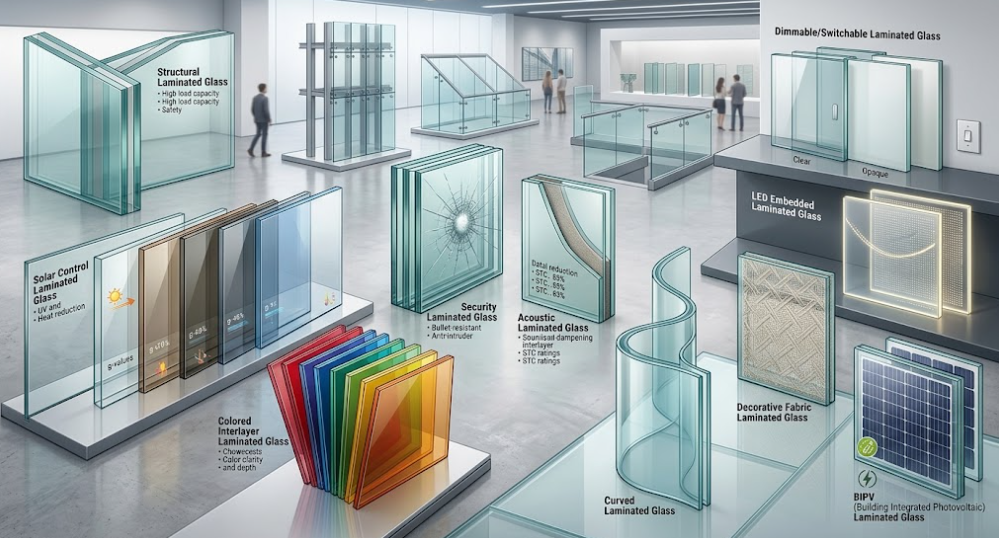
Standard Safety Laminated Glass
This is the foundational product within our laminated glass range, and it’s the right starting point for understanding everything else in the lineup, since most of our more specialized products build on this same core construction with an added performance characteristic layered on top.
Standard safety laminated glass uses a conventional PVB interlayer between two glass panels, providing the fundamental safety benefit that defines the entire laminated glass category: if the glass breaks, the interlayer holds the pieces in place rather than allowing them to shatter and fall. This is the specification most commonly appropriate for residential skylights, overhead glazing, general balustrades and railings, and interior applications like partitions and glass doors, where the primary requirement is reliable safety performance without a more specialized need like enhanced acoustic control or ballistic resistance.
Best suited for: Residential and light commercial skylights, standard balustrades and railings, interior partitions and doors, general overhead glazing where a specialized performance characteristic beyond standard safety isn’t required.
Acoustic Laminated Glass
For applications where sound transmission is a genuine functional concern, standard PVB interlayer laminated glass, while still offering some acoustic benefit over ordinary float glass, generally doesn’t deliver the level of sound dampening a demanding application requires. Our acoustic laminated glass range uses a specialized acoustic interlayer, engineered specifically to interrupt sound transmission more effectively than standard PVB, without requiring the added thickness and weight of a much heavier glass buildup to achieve a comparable result.
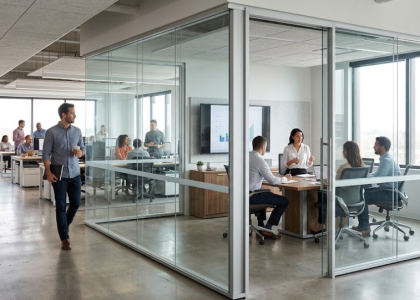
This specification is particularly relevant for buildings in high-noise environments, urban commercial buildings facing busy roads, buildings near airports or industrial noise sources, and for interior applications where privacy and sound isolation matter directly to a space’s function, boardrooms, private offices, and healthcare or professional consultation rooms among them. As covered in more detail in our framed versus frameless office partition guide, acoustic performance is one of the most consequential specification decisions in any interior glazing project involving confidential or noise-sensitive spaces, and choosing the right interlayer is central to getting that performance right.
Best suited for: Boardrooms and confidential meeting spaces, buildings in high-traffic or high-noise urban locations, healthcare and consultation rooms, any application where genuine acoustic privacy is a functional requirement rather than a nice-to-have.
Security and Impact-Resistant Laminated Glass
For applications where resistance to forced entry, impact, or intentional breakage is a genuine consideration, our range includes laminated glass specified with thicker interlayers, multiple interlayer plies, or higher-performance interlayer materials engineered specifically for enhanced resistance to penetration and impact. This category sits above standard safety laminated glass in both interlayer robustness and, correspondingly, in glass thickness and overall panel weight.
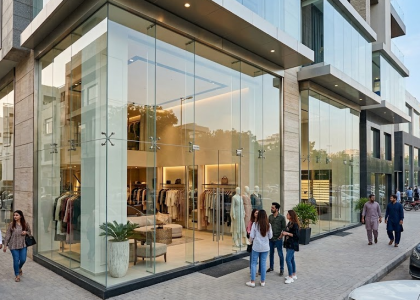
This specification is commonly relevant for ground-floor retail storefronts in higher-risk locations, as discussed in our glass shop front versus metal front comparison, for jewelry and high-value electronics retail specifically, and for any application where a building owner has identified a genuine security requirement that standard laminated glass wouldn’t adequately address. It’s worth noting that security-rated laminated glass exists on a genuine performance spectrum, from moderate impact resistance suitable for general retail security concerns, up to considerably more robust specifications appropriate for higher-risk applications, and the right point on that spectrum should be determined by an honest assessment of the specific security need, not selected reflexively at the highest available specification regardless of actual risk.
Best suited for: Retail storefronts carrying high-value inventory, ground-floor glazing in higher-risk locations, applications where forced-entry resistance is a documented, specific requirement rather than a general precaution.
Solar Control and Tinted Laminated Glass
Pakistan’s climate, with intense direct sun and a cooling-dominated energy cost profile for most commercial buildings, makes solar heat gain a genuinely significant consideration for any substantial glazed area, and our laminated glass range includes solar control options built to address it directly. These products combine the standard safety benefit of laminated construction with tinted glass, reflective coatings, or solar control interlayers designed to reduce the amount of solar heat transmitted through the glass while maintaining reasonable visible light transmission.
This category matters particularly for west and south-facing elevations receiving intense direct sun for extended periods during the day, and for any project where a facade’s overall energy performance and the building’s resulting cooling load are being weighed seriously against its visual and daylight goals, a trade-off discussed in more detail in our ACP cladding versus glass facades comparison. Solar control laminated glass allows a project to maintain meaningful glazing and daylight access on a demanding elevation without accepting the full solar heat gain that clear, untreated glass of the same area would bring into the building.
Best suited for: West and south-facing facade glazing, large glazed areas where cooling load is a genuine budget and design consideration, projects balancing daylight goals against Pakistan’s demanding solar exposure.
Structural Laminated Glass
For applications where the glass itself is carrying genuine structural load, glass flooring, structural balustrades, or overhead glazing spanning a significant distance, standard PVB interlayer laminated glass often isn’t sufficient on its own, and our range includes structural-grade laminated glass using higher-performance structural interlayers engineered specifically for these more demanding load-bearing applications.
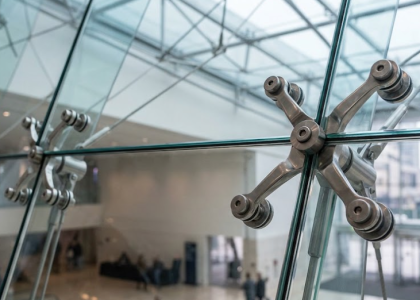
These structural interlayers offer significantly greater stiffness and load-bearing capacity than standard PVB, which allows a structural glazing application to be engineered with genuine confidence in its load performance, an essential consideration given the real safety stakes involved whenever glass is asked to do actual structural work rather than simply enclosing a space. This category is closely related to the structural considerations discussed in our point glass system versus curtain wall comparison, since point-fixed glazing applications frequently call for this same category of higher-performance structural laminated glass.
Best suited for: Glass flooring and stair treads, structural balustrades and railings carrying genuine load requirements, point-fixed glazing applications, overhead glazing spanning significant unsupported distances.
| Product Category | Core Performance Focus | Typical Applications |
|---|---|---|
| Standard safety laminated glass | Baseline safety, holding fragments in place upon breakage | Skylights, general balustrades, interior partitions and doors |
| Acoustic laminated glass | Enhanced sound transmission reduction | Boardrooms, urban buildings, healthcare and consultation rooms |
| Security and impact-resistant laminated glass | Resistance to forced entry and impact | High-value retail storefronts, security-sensitive ground-floor glazing |
| Solar control and tinted laminated glass | Reduced solar heat gain, managed light transmission | West and south-facing facades, large glazed elevations |
| Structural laminated glass | Load-bearing capacity for genuinely structural applications | Glass flooring, structural balustrades, point-fixed glazing |
How These Categories Combine in Real Projects
It’s worth being direct about something that’s easy to miss when reading through a product range presented as separate categories: a real project frequently needs more than one of these performance characteristics combined into a single specification, not just one category chosen in isolation.
A storefront on a busy, sun-exposed commercial road might reasonably combine security-rated interlayer performance with solar control tinting, addressing both the retail security concern and the practical reality of intense sun exposure on that specific elevation, in a single specified product rather than treating those two needs as separate, unrelated decisions.
A boardroom wall in a building with genuine security considerations, an executive floor, a financial services firm, might combine acoustic performance with a security-rated interlayer, addressing both the confidentiality requirement of the space and any documented security concern for that specific floor or building.
A structural glass floor in a design-forward retail or hospitality space might combine structural interlayer performance with a specific tint or solar control treatment, if that flooring sits beneath a skylight or large glazed roof area where solar heat gain through the floor itself is a genuine consideration.
This is exactly why a genuinely useful laminated glass conversation with a supplier goes well beyond picking a single category from a product range and instead starts with a specific, honest conversation about what a particular application actually needs to achieve, safety, acoustic performance, security, solar control, structural capacity, in what combination, before a final specification is settled.
A Question Worth Asking Before Finalizing Your Specification
Rather than asking a supplier “what laminated glass do you offer,” ask what combination of performance characteristics your specific application genuinely needs, and let that answer drive the specification. A supplier who asks detailed questions about your application before recommending a specific product is giving you a considerably more reliable answer than one who quotes a single standard product without first understanding what the glass actually needs to do.
Understanding Buildup and Thickness Within Each Category
It’s worth adding one further layer of nuance to this range: within each of the five categories described above, there’s still a genuine range of glass thickness and total buildup options, and getting this right matters as much as choosing the correct category in the first place. A thinner buildup within the acoustic laminated glass category, for instance, will still deliver a real improvement over standard PVB, but a heavier buildup within that same category, combining a thicker acoustic interlayer with thicker glass panels on either side, delivers a further step up in sound isolation performance for applications where the acoustic requirement is particularly demanding.
The same logic applies across every category in our range. Security-rated laminated glass spans a genuine spectrum from moderate impact resistance up to considerably more robust specifications, and structural laminated glass buildup needs to be engineered specifically around the actual span, load, and support conditions of a given application rather than selected from a single fixed thickness. This is exactly why a genuine specification conversation needs to go beyond simply naming a category, safety, acoustic, security, solar control, structural, and continue into the specific thickness and buildup that matches your application’s actual performance requirement within that category, which is a conversation best had directly with our team once your application’s core requirements are understood.
Choosing the Right Product for Your Application: A Practical Framework
Start with the safety and structural baseline every application needs. Every laminated glass specification in our range starts from the same core safety principle, so the first question for any application is simply confirming that standard safety laminated glass, or a structural-grade variant if the application carries genuine load requirements, is the appropriate foundation.
Layer in acoustic requirements based on the room’s actual function, not a general preference for quiet. As discussed above, acoustic laminated glass delivers a genuine, measurable performance improvement over standard PVB, and it’s worth specifying deliberately for rooms where sound isolation is functionally important, rather than applied uniformly across an entire project regardless of each room’s actual use.
Assess security requirements honestly against actual risk, not reflexively at the highest available specification. Security-rated laminated glass exists across a genuine performance range, and the right point on that range should reflect an honest assessment of your specific application’s risk profile, informed by your retail category, location, and the value of what’s being protected.
Factor in solar exposure directly for any significant glazed elevation. Given Pakistan’s climate, any substantial glazing facing intense direct sun, particularly west and south orientations, deserves a genuine conversation about solar control specification, weighed against the project’s daylight and transparency goals for that specific elevation.
Confirm structural requirements early with your project’s structural engineer, not as an afterthought to the glazing conversation. Any application where glass is carrying genuine structural load, flooring, structural balustrades, significant spans, needs structural laminated glass specification integrated into the project’s structural design from an early stage, not selected late as a simple glazing decision.
Applying This Range to Different Project Types
Residential projects. Standard safety laminated glass covers the large majority of residential applications, skylights, balustrades, general glazing, with solar control tinting worth considering specifically for west-facing windows or skylights in particularly sun-exposed locations.
Retail and commercial storefronts. These projects frequently combine security considerations with solar control needs, as discussed above, and the right combination depends heavily on the specific retail category, inventory value, and elevation orientation of the storefront in question.
Corporate office fit-outs. Acoustic laminated glass is frequently the most relevant specification for boardrooms and confidential meeting spaces, while general office partitioning can often use standard safety laminated glass without the acoustic premium, in the same room-by-room approach discussed in our office partition cost comparison guide.
Hospitality and hotel projects. These projects often combine acoustic performance for guest-facing meeting and event spaces with solar control for large glazed lobby or restaurant areas, reflecting both the acoustic expectations of a premium hospitality environment and the practical energy performance of extensive glazing in a commercial building.
Institutional and healthcare facilities. Acoustic laminated glass is frequently relevant for consultation rooms and offices requiring genuine patient confidentiality, while structural laminated glass may be relevant for any feature glazing, atriums, or architectural glass elements included in the facility’s design.
High-rise and structural facade projects. These projects typically require the more demanding end of our range across multiple categories simultaneously, structural performance for point-fixed or curtain wall applications, combined with solar control given the genuine energy stakes of a large glazed facade at height.
Frequently Asked Questions
1. Can laminated glass combine more than one of these performance characteristics in a single product?
Yes, and as discussed above, this is genuinely common in real projects. Combining, for example, security-rated interlayer performance with solar control tinting, or acoustic performance with a specific structural requirement, is a normal part of specifying laminated glass for a demanding real-world application rather than a rare exception.
2. How do I know which category of laminated glass my specific project actually needs?
The right starting point is a direct conversation about your application’s actual functional requirements, safety, acoustic isolation, security, solar exposure, and structural load, rather than selecting from a product range without that context. A supplier who asks detailed questions about your specific application before recommending a product is giving you a more reliable specification than one working from a generic quote.
3. Is acoustic laminated glass noticeably more expensive than standard safety laminated glass?
Acoustic laminated glass does carry a real premium over standard PVB laminated glass, reflecting the specialized interlayer material, and this cost is worth weighing directly against how functionally important genuine sound isolation is for the specific room or application in question.
4. Does solar control laminated glass significantly reduce natural light in a space?
Solar control specifications are engineered to reduce solar heat gain while managing visible light transmission thoughtfully, rather than simply darkening the glass uniformly, and the specific balance between heat reduction and light transmission can be discussed directly based on your project’s priorities for a given elevation.
5. What’s the difference between security-rated laminated glass and standard safety laminated glass in terms of actual protection?
Standard safety laminated glass is engineered primarily to hold together upon breakage, protecting people from falling glass fragments. Security-rated laminated glass adds genuine resistance to forced entry and impact, using thicker or multiple interlayer plies specifically engineered to resist penetration, a meaningfully higher performance tier suited to applications with an actual documented security concern.
6. Should structural laminated glass decisions be made by the glass supplier alone, or does my structural engineer need to be involved?
Any application where glass is carrying genuine structural load should involve your project’s structural engineer directly in the specification process, working alongside your glass supplier, since structural glazing decisions carry real safety implications that benefit from that combined engineering perspective rather than being finalized by either party in isolation.
Finding the Right Specification for Your Project
Our laminated glass range is built around the recognition that “laminated glass” was never really one product, it’s a category that needs to be matched deliberately to what a specific application actually requires, safety, acoustic performance, security, solar control, structural capacity, often in combination. The right specification for your project depends entirely on those specific requirements, not on defaulting to whichever laminated glass product happens to be most familiar or most commonly requested.
If you’re currently planning a project that involves laminated glass, whether it’s a single application or several different requirements across one build, it’s worth talking directly with our team about your specific needs, so we can help match the right combination of performance characteristics to your actual project rather than working from a generic specification.
Schedule for a Free Consultation or Get an Instant Quote via WhatsApp to talk through which laminated glass specification actually fits your project.