Table of Contents
Look at any great city skyline in the world London, Dubai, Singapore, Shanghai and you will notice something remarkable. The buildings that define these skylines, the towers and complexes that feel unmistakably contemporary, are almost universally sheathed in glass. Glass facades catch the morning sun and reflect the sky. Glass curtain walls dissolve the boundary between indoors and outdoors. Glass skylights flood interiors with natural light. Structural glass staircases and balustrades make gravity seem optional.
Glass has become the signature material of modern architecture. But this did not happen by accident. The rise of architectural glass in contemporary construction is the result of extraordinary advances in materials science, engineering ingenuity, and a fundamental shift in how architects think about buildings and the people who inhabit them.
In this comprehensive guide, we explore the role of architectural glass in modern buildings what it is, the many forms it takes, the critical functions it performs, and why it has become the material of choice for architects, developers, and designers who want to create buildings that are not only beautiful but also intelligent, sustainable, and humane.
“Glass is not just a building material it is a philosophy of design. It says: we believe in transparency, in light, in openness, in the connection between people and the world around them.”
What Is Architectural Glass? A Simple, Clear Definition
Architectural glass is glass that is manufactured, processed, or treated for use in buildings and construction. It is distinct from standard float glass in that it is engineered to meet specific performance requirements structural strength, thermal insulation, solar control, acoustic performance, safety, and aesthetics that standard glass cannot provide on its own. The term covers a wide family of products. Tempered glass, laminated glass, double-glazed units, low-emissivity coated glass, ceramic frit glass, structural glazing, point-fixed glass systems, curtain wall panels, glass balustrades, and skylight glazing are all forms of architectural glass. Each has been developed and refined to address particular challenges in building design and performance. What unites them all is the fundamental material silica-based glass combined with the processing, treatment, and engineering that transforms it from a fragile, transparent sheet into a robust, multifunctional building component. Today’s architectural glass is one of the most technically sophisticated materials in the construction industry.A Brief Note on Processing
Raw float glass the flat sheets produced by floating molten glass on a bed of molten tin is the starting point for virtually all architectural glass. From there, it undergoes a range of processes: heat treatment (tempering or heat-strengthening), lamination with interlayers, coating with metallic oxides for solar and thermal control, cutting and edge finishing, and assembly into insulated units. The combination of these processes determines the final performance characteristics of the glassA Short History: How Glass Became Central to Modern Architecture
Glass has been used in buildings for centuries the medieval cathedrals of Europe with their magnificent stained glass windows are testament to that. But the role of glass in those early applications was essentially decorative and symbolic. The structural envelope of the building was stone; glass was a filling for openings. The industrial revolution changed everything. The development of large-scale plate glass manufacturing in the nineteenth century made it possible to produce glass panels of unprecedented size and quality. The Crystal Palace, built in London for the Great Exhibition of 1851, was a revelation: an enormous iron and glass structure that demonstrated, for the first time, that glass could be a primary building material rather than a secondary one. The twentieth century saw this potential fully realised. The modernist movement in architecture led by figures like Mies van der Rohe, Le Corbusier, and Walter Gropius embraced glass as the ideal material for expressing their philosophy of openness, light, and honesty of construction. The glass curtain wall, first developed in the 1950s and 1960s, became the defining feature of the corporate skyscraper and transformed the skylines of every major city. But it was the advances in glass processing technology from the 1970s onwards particularly the development of thermal tempering, lamination, and low-emissivity coatings that truly unleashed the potential of architectural glass. Suddenly, glass was not just transparent; it was strong, safe, insulating, solar-controlling, and acoustically effective. These advances made it possible to use glass in applications that would have been unthinkable a generation earlier. Today, architectural glass is a mature, highly engineered product category and its role in modern buildings continues to expand as technology advances and design ambitions grow.The Key Types of Architectural Glass in Modern Buildings
Understanding the different types of architectural glass available is essential for architects, developers, and building owners. Each type has distinct characteristics that make it suitable for specific applications.Tempered (Toughened) Glass
Tempered glass is produced by heating float glass to around 620 degrees Celsius and then rapidly cooling it. This process creates a glass that is four to five times stronger than standard annealed glass. Critically, when tempered glass does break, it shatters into small, relatively harmless fragments rather than sharp, dangerous shards. This safety property makes it the standard choice for facades, doors, partitions, balustrades, and any application where human contact is possible.Laminated Glass
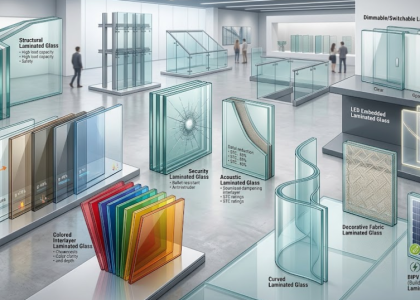
Laminated glass consists of two or more layers of glass bonded together with a plastic interlayer, typically polyvinyl butyral (PVB) or ethylene vinyl acetate (EVA). When broken, the interlayer holds the fragments in place, maintaining the integrity of the panel. This makes laminated glass the preferred choice for overhead glazing, structural applications, high-security installations, and any context where glass retention after breakage is critical. It also provides excellent acoustic insulation.Double and Triple Glazed Units
Insulated glazing units (IGUs) consist of two or three glass panes separated by a hermetically sealed air or gas-filled cavity. The cavity acts as a thermal barrier, dramatically reducing heat transfer through the glass. Double-glazed units are standard in most modern commercial and residential buildings; triple-glazed units are specified for very high thermal performance requirements. In Pakistan’s climate, double-glazed units with low-E coatings are particularly effective in reducing air conditioning costs.Low-Emissivity (Low-E) Coated Glass
Low-E glass is coated with an ultra-thin metallic oxide layer that reflects infrared radiation (heat) while allowing visible light to pass through. The result is a glass that admits daylight but significantly reduces the passage of heat either preventing solar heat gain in summer or retaining interior warmth in winter, depending on the type of coating. Low-E glass is an essential tool for energy-efficient building design.Ceramic Frit Glass
Ceramic frit glass has a ceramic coating partially or fully applied to one surface. The coating is fused into the glass surface during the tempering process. Frit glass is used to reduce solar glare, create privacy, add colour and pattern to facades, and achieve specific aesthetic effects. It is commonly used in curtain wall facades, spandrel panels, and decorative applications.Structural and Point-Fixed Glass
Structural glazing systems use minimal framing or no framing at all to support glass panels. Point-fixed systems attach glass panels to a structural framework using discrete fittings at the corners or edges of each panel, creating an almost frameless appearance. These systems are used for high-transparency facades, glass floors, glass bridges, and other applications where maximum visual openness is desired.Curtain Wall Glass
A curtain wall is a non-load-bearing external wall system consisting of glass panels (and sometimes opaque panels) supported on an aluminium framework that is attached to the building’s structural frame. The curtain wall carries only its own weight and resists wind loads; it does not support the building’s floors or roof. Curtain wall systems are the predominant facade system for modern commercial high-rise buildings.The Functions of Architectural Glass: What It Does in a Modern Building
Architectural glass is not simply a transparent wall. In a modern building, it performs a remarkable range of functions simultaneously structural, environmental, acoustic, safety-related, and aesthetic. Understanding these functions helps explain why glass has become such a dominant material in contemporary architecture.Admitting Natural Light
Natural light is one of the most valuable resources in any building. Research consistently shows that access to natural daylight improves mood, productivity, health, and wellbeing for building occupants. Architectural glass particularly in facades, skylights, and atria is the primary means by which buildings bring natural light into their interiors. Modern glass processing allows architects to maximise daylight admission while controlling glare and heat gain.Thermal Insulation and Energy Efficiency
Buildings account for a significant proportion of total energy consumption globally. A substantial part of that energy is used to heat or cool the interior. Poorly specified glazing can account for the majority of heat loss in winter and heat gain in summer. Modern architectural glass particularly double-glazed and low-E coated systems dramatically reduces thermal transfer, contributing to buildings that are cheaper and more sustainable to operate.Solar Control
In climates with high solar radiation and Pakistan’s climate certainly qualifies uncontrolled solar heat gain through glass can create uncomfortably hot interiors and impose massive air conditioning loads. Solar control glass, through reflective coatings, tinted glass, ceramic frit patterns, or combinations of these, allows architects to precisely calibrate how much solar energy enters the building at different orientations and seasons.Acoustic Performance
Glass is often assumed to be acoustically poor and standard single-pane glass certainly is. However, laminated glass, double-glazed units with acoustic interlayers, and asymmetric double-glazed units (where the two panes are of different thicknesses) can provide excellent sound insulation. In urban environments, hotels, offices near airports or highways, and residential projects in noisy locations, acoustic glazing is an essential specification.Structural Contribution
Modern structural glazing systems allow glass to contribute directly to the structural integrity of a building. Glass balustrades resist lateral loads from crowds of people. Glass fins and beams provide lateral stability to large glazed facades. Structural glass floors carry pedestrian loads. These applications push the material beyond its traditional role and demonstrate the extraordinary structural capability that engineering has unlocked.Safety and Security
Safety is a non-negotiable requirement in any building. Tempered glass provides safety in breakage; laminated glass provides safety in both breakage and attempted penetration. Security glazing laminated glass with multiple layers and specialised interlayers can resist forced entry, blast pressures, and even ballistic impact. For banks, government buildings, embassies, and high-security commercial facilities, architectural glass is a primary element of the security envelope.Aesthetic and Architectural Expression
Beyond its performance functions, architectural glass is a powerful medium of aesthetic expression. It creates transparency and visual connection between spaces. It reflects sky, landscape, and surrounding buildings, making a structure appear to change throughout the day and across seasons. It can be coloured, patterned, frosted, etched, or printed to create specific visual effects. The interplay of glass, light, reflection, and transparency is one of the most distinctive and powerful tools in the contemporary architect’s vocabulary.Architectural glass is the only building material that performs simultaneously as structure, environmental filter, acoustic barrier, safety system, and visual medium all in a single, elegant product.
Architectural Glass in Building Facades: The Defining Application
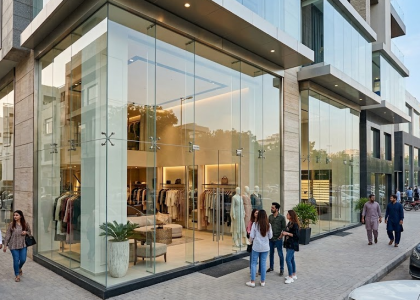
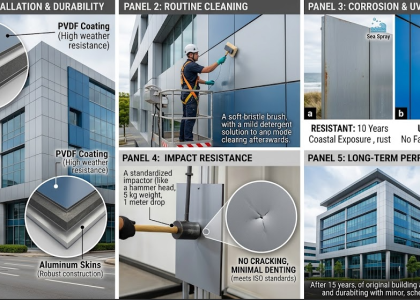
No application of architectural glass is more visible or more consequential than its use in building facades. The facade is the face of a building the surface that mediates between the interior and the exterior world, that expresses the building’s identity, and that determines its environmental performance. Modern glazed facades take many forms. The curtain wall is the most common system for commercial high-rises: a grid of aluminium mullions and transoms supports glass panels that span from floor to floor. The spider or point-fixed facade uses minimal hardware to create the impression that the glass is floating freely. The structural silicone glazing facade bonds glass panels directly to the aluminium frame with structural adhesive, eliminating projecting metal elements and creating a completely flush external surface. Each of these systems has its own aesthetic character, structural logic, and performance profile. The choice between them depends on the building’s height, the required thermal and acoustic performance, the budget, the maintenance strategy, and the architect’s design intent.The Curtain Wall in Pakistani Architecture
Pakistan’s commercial construction sector has embraced the glass curtain wall with enthusiasm. Corporate headquarters, shopping centres, hotels, and mixed-use towers across Lahore, Karachi, and Islamabad are increasingly specified with full-height curtain wall systems. Green Glass Designer is one of Pakistan’s leading specialists in curtain wall glass supply and installation, providing high-specification glazed facade solutions to commercial projects across the country.Glass in Interior Architecture: Partitions, Skylights, and Beyond
While facade glazing gets the most attention, architectural glass plays an equally important role inside buildings. The use of glass within interior spaces has transformed the way buildings function and feel.Glass Office Partitions
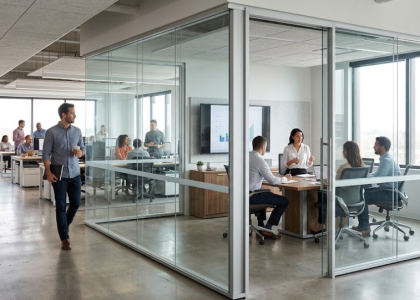
The open-plan office has been one of the dominant trends in commercial interior design for decades. But pure open-plan creates acoustic problems and removes the private spaces that many types of work require. Glass partitions offer an ideal solution: they maintain visual connectivity and the sense of openness while providing acoustic separation and allowing private conversations. Frameless glass partition systems, in particular, create interiors that feel simultaneously open and ordered.Glass Skylights and Atria
Skylights bring natural light deep into buildings where it would otherwise be inaccessible. A well-designed glass skylight can transform an interior flooding a corridor, staircase, or atrium with daylight that changes character throughout the day and across seasons. Modern skylight glass typically laminated, double-glazed, and thermally broken provides daylight admission without significant heat gain or acoustic intrusion.Glass Staircases and Balustrades
Glass balustrades on staircases, mezzanines, terraces, and balconies provide required safety barriers without blocking sightlines or creating visual mass. Structural glass fins can replace traditional solid balustrade posts, creating a fully transparent barrier that is both safer and more elegant than traditional alternatives. These details, which might seem minor in isolation, have a significant cumulative effect on the spatial quality of a building.Glass Ceilings and Feature Walls
Architectural glass is also used extensively for ceiling features, decorative wall panels, kitchen splashbacks, and feature installations. Backpainted glass, digitally printed glass, and textured glass bring colour, pattern, and visual interest to interior surfaces while providing the practical benefits of glass durability, cleanability, and light reflection.Architectural Glass and Sustainability: Building for the Future
Architectural Glass and Sustainability: Building for the Future
Sustainability is no longer an optional add-on in building design it is a fundamental requirement. Buildings must be designed to consume less energy, generate less waste, and contribute positively to the health of their occupants and communities. Architectural glass plays a central and growing role in sustainable building design.Reducing Energy Consumption
The single most significant environmental contribution of modern architectural glass is the reduction of building energy consumption through improved thermal performance. Double and triple-glazed units with low-E coatings reduce heat flow through glazed surfaces by 70 to 80 percent compared to single-pane glass. At the scale of a large commercial building, this translates into massive reductions in heating and cooling energy demand and corresponding reductions in carbon emissions.Maximising Daylight to Reduce Artificial Lighting
Electric lighting accounts for a significant proportion of energy consumption in commercial buildings. By maximising the use of natural daylight through well-designed glass facades, skylights, and interior glazing, buildings can dramatically reduce their reliance on artificial lighting. Modern daylight-redirecting glass systems can deliver usable daylight deep into building plans, well beyond what conventional windows can achieve.Recyclability
Glass is one of the most recyclable construction materials available. At the end of a building’s life, glass can be recovered and recycled into new glass products. The glass manufacturing industry has made significant investments in recycling infrastructure, and the environmental footprint of glass is declining as a result.Long Service Life
Architectural glass is an exceptionally durable material. High-quality architectural glass installations regularly achieve service lives of thirty years or more with minimal maintenance. This longevity is itself a form of sustainability a material that does not need to be replaced, repaired, or retreated contributes less to the consumption of resources and the generation of waste over the life of a building.Architectural Glass in Pakistan: Trends and Opportunities
Pakistan’s construction industry is in a period of significant expansion. Rapid urbanisation, growing commercial real estate investment, an expanding hospitality sector, and increasing consumer expectations for quality in residential development are all driving demand for premium architectural glass products and systems. The trend toward glazed facades in commercial buildings is clearly established. Major corporate developments in Lahore’s Gulberg district, Karachi’s DHA and Clifton business zones, and Islamabad’s Blue Area are increasingly specified with full or partial glass curtain wall systems. Hotel developments across major and secondary cities are specifying glazed facades, glass-canopied entrances, and glass-partitioned public areas. In the residential sector, the growing appetite for contemporary architecture among Pakistan’s affluent and upper-middle-class homeowners is creating demand for premium glazing: large-format sliding glass doors that open living spaces to gardens and terraces, glass balustrades on rooftop terraces, glass partitions and staircases in luxury interiors, and decorative glass features throughout.Green Glass Designer: Leading Pakistan’s Architectural Glass Sector
Green Glass Designer has been at the forefront of Pakistan’s architectural glass industry for over fifteen years. PEC-registered and ISO-certified, the company provides a comprehensive range of architectural glass products from tempered and laminated panels to double-glazed units, curtain wall systems, point-fixed facades, skylight glazing, and structural glass installations to commercial, residential, and institutional clients nationwide. The company’s technical expertise spans the full project lifecycle: from initial consultation and specification support to custom fabrication, nationwide delivery, professional installation, and long-term after-sales support. Every project benefits from the team’s deep knowledge of glass engineering, the quality of its imported glass stock, and its commitment to on-time, on-budget delivery. Whether the project is a high-rise commercial tower requiring a full glass curtain wall, a luxury villa requiring premium frameless glazing systems, a hotel lobby requiring decorative and structural glass features, or a corporate interior requiring glass partitions and balustrades Green Glass Designer has the expertise, capacity, and quality standards to deliver.“We bring world-class architectural glass solutions to Pakistan. Our goal is simple: to help architects, developers, and builders create buildings that are more beautiful, more sustainable, and more human.” Green Glass Designer
Choosing the Right Architectural Glass: A Practical Guide
Selecting the right architectural glass for a project is a complex, multi-variable decision. Here is a practical framework to guide the specification process.- Define the Performance Requirements First: Before thinking about aesthetics, establish the performance requirements: What level of thermal insulation is needed? What solar control is required at each facade orientation? Are there acoustic performance requirements? What safety and structural requirements apply? The answers to these questions will establish the minimum technical specification.
- Consider the Climate: Pakistan’s diverse climate from the intense heat of Karachi’s coastal summer to the cold winters of the northern highlands demands careful climate-responsive specification. In hot-climate zones, solar control is the priority. In cooler zones, thermal insulation takes precedence. Low-E coated double-glazed units are effective across most Pakistani climate zones.
- Align Glass Specification with Facade Design: The glass specification must be compatible with the facade system. Curtain wall systems, spider facades, structural silicone systems, and frameless systems each have specific glass thickness, size, and processing requirements. Engage your glass supplier early in the design process to ensure compatibility.
- Plan for Safety and Building Regulations: All glass used in locations where human impact is possible must be safety glass either tempered or laminated. Overhead glazing must be laminated. Structural glass applications require engineering certification. Ensure that the glass specification complies with all applicable codes and regulations.
- Think About Maintenance: Glass requires maintenance cleaning, inspection of sealants and fixings, and periodic replacement of failed insulated units. Specify glass that is compatible with the building’s maintenance strategy and that can be practically cleaned and maintained given the building’s height and configuration.
- Work with a Trusted Specialist: Architectural glass is a highly technical product category. Engaging a specialist supplier with proven experience, quality-certified products, and comprehensive installation capability like Green Glass Designer — is the single most effective way to ensure a successful outcome.