Table of Contents
Picture two contractors standing in front of the same commercial plaza, both asked for a quote on the same façade. One comes back with a number that sounds almost too good to be true. The other quotes nearly double. On paper, they’re both selling “ACP wall cladding.” In reality, they’re often selling two entirely different materials, two different installation standards, and two very different outcomes five years down the road.
This is exactly where most property owners in Pakistan get stuck when they start researching ACP cladding costs. A quick search turns up wildly different quotes for what looks like the same product, with no obvious explanation for the gap. If you’re planning a shop front, an office exterior, a hospital wing, or a home renovation, that gap isn’t noise you can ignore it’s the difference between a façade that still looks sharp in a decade and one that starts peeling, warping, or fading within two monsoon seasons.
This guide breaks down exactly what drives ACP wall cladding pricing in Pakistan, what a fair quote should actually include, where contractors quietly cut corners to win a lower bid, and how to compare quotes properly before you commit a budget to your project.
The Cost Picture in Brief
ACP (Aluminium Composite Panel) cladding pricing in Pakistan moves on a fairly wide scale, with standard commercial-grade panels sitting at the more economical end and fire-retardant, premium-coated, or design-intensive installations landing considerably higher. A fair per-square-foot rate isn’t just the panel itself it’s meant to cover the aluminum sub-frame, fixing hardware, sealants, fabrication, and labor, though as you’ll see below, not every quote in the market actually includes all of that, which is exactly why two quotes for the same building can look so different.
Rather than chasing a single number to anchor on, it’s more useful to understand what specifically pushes a project toward the lower or higher end of that scale, because the honest answer is that “ACP cladding” isn’t one product with one price. It’s a category, and the specific choices you make inside that category are what actually determine your final cost which is also why the most reliable way to know what your project will cost is a proper site-specific quote rather than a generic figure.
Factor One: Panel Core Type Is Doing More Work Than Most People Realize
The single biggest driver of ACP pricing is what’s inside the panel, not what you see on the surface. Aluminium composite panels are built as a sandwich two thin aluminum sheets bonded to a core material in the middle, and that core is where the real cost difference lives.
Standard polyethylene (PE) core panels are the most common and most affordable option in the Pakistani market, and they’re perfectly suitable for a large share of interior applications and lower-rise exteriors where fire code requirements are less strict. Fire-retardant (FR) core panels use a mineral-filled core that resists flame spread far better than standard PE, and they cost noticeably more per square foot as a direct result. For anything above a certain building height, for hospitals, schools, hotels, and high-occupancy commercial buildings, FR-rated panels aren’t really optional in most well-regulated projects, they’re what a responsible contractor should be specifying regardless of what a client initially asks for.
This is worth understanding clearly before you compare quotes, because a contractor quoting PE-core panels for a mid-rise commercial exterior will always look cheaper than one correctly quoting FR-core panels for the same job, and the difference has nothing to do with one contractor being better at pricing. It has everything to do with one of them quoting a safer, more appropriate material for the actual application.
Factor Two: Coating Technology Changes the Panel’s Entire Lifespan
The second major cost driver is the surface coating, and this is where a lot of budget-focused buyers unintentionally shortchange themselves without realizing it.
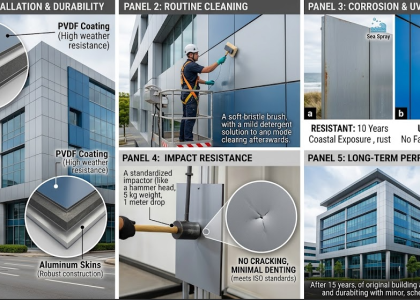
PE-coated (polyester) finishes are the entry-level coating, affordable upfront but noticeably more prone to fading, chalking, and color degradation under Pakistan’s intense summer UV exposure, particularly on south and west-facing façades that take direct sun for most of the day. PVDF-coated finishes use a fluoropolymer coating that holds color and gloss dramatically longer under the same UV exposure, and while they cost more per square foot at installation, they meaningfully extend the number of years before a façade starts looking tired and dated.
The practical way to think about this is less about the sticker price and more about cost per year of good appearance. A PVDF-coated panel that costs 15–20% more upfront but holds its finish for 15+ years, versus a PE-coated panel that needs visible refinishing or replacement in 6–8 years, often works out cheaper over the life of the building, even though it looks like the more expensive choice on day one.
Factor Three: Panel Origin and Brand Genuinely Move the Number
Pakistan’s ACP market includes a mix of internationally recognized brands and lower-cost regional or unbranded panels, and the price gap between them is real and not purely about marketing. Branded panels typically come with documented bond strength between the aluminum face and the core, consistent thickness tolerances, and manufacturer-backed warranties, all things that directly affect how the panel performs over years of thermal expansion, wind load, and weather cycling.
Lower-cost, unbranded panels can perform reasonably well for smaller, lower-exposure applications, but inconsistent core bonding is a known failure point in this segment specifically, it’s part of why delamination (the aluminum face separating from the core, often showing up as bubbling or warping) tends to show up disproportionately on cheaper, unbranded installations rather than branded ones. For a small interior feature wall, this risk may be acceptable. For a multi-story exterior façade exposed to Lahore’s summer heat or Karachi’s coastal humidity, it’s a much bigger gamble to take purely to save a modest amount per square foot.
Factor Four: Design Complexity Adds Cost Beyond the Panel Itself
A flat, single-color façade with straightforward butt joints is the most economical way to install ACP cladding, and it’s a completely legitimate, attractive choice for a large share of projects. But the moment a design calls for anything beyond that, 3D routed panels, perforated screens, curved sections, mixed-material bands, or intricate grooving for a logo or branding element, labor and fabrication cost rises independently of the panel material cost itself.
This matters because it’s one of the most common places a quote comparison goes wrong. If one contractor is pricing a simple flat installation and another is pricing a more architecturally complex design with CNC-cut detailing, comparing their per-square-foot numbers side by side tells you very little, you’re not comparing the same scope of work, even if both quotes say “ACP wall cladding” at the top.
Factor Five: The Substructure Is Often the Hidden Cost Nobody Mentions Upfront
This is arguably the single most overlooked line item in ACP cladding budgets. The panels themselves get all the attention, but what holds them onto the building, the aluminum sub-frame, brackets, fixing screws, and weatherproof sealants, is a substantial share of total installed cost and a common place where budget quotes quietly cut corners.
A properly engineered sub-frame accounts for thermal expansion (aluminum panels expand and contract measurably across Pakistan’s temperature swings), wind load on taller buildings, and adequate ventilation gaps behind the panels to prevent moisture buildup. A rushed or undersized substructure can look identical to a properly engineered one on installation day and still fail within a few years through panel bowing, joint gaps opening up, or water infiltration behind the cladding.
Worth Noting
When a quote for ACP cladding looks significantly lower than everything else you’ve collected, the substructure is one of the first places to ask specific questions. A lower price achieved by using a lighter, less robust framework isn’t really a discount, it’s a cost that’s been deferred to a future repair bill, usually a much larger one than the original saving.
Factor Six: Project Scale, Building Height, and Site Access
Larger contiguous projects generally bring the per-square-foot rate down slightly, since fabrication setup, transport, and crew mobilization costs get spread across more panel area. A small shop front under a few hundred square feet will typically carry a higher effective rate than a large corporate façade running into several thousand square feet, purely due to these fixed costs being absorbed by less total area.
Building height and site access work in the opposite direction. Cladding a multi-story exterior requires scaffolding or mechanical lifts, additional safety measures, and slower, more careful installation than ground-level or low-rise work, all of which add to labor cost independent of the panel material itself. A tight urban site with limited access for material delivery and equipment can add further cost on top of that, something worth flagging early with any contractor rather than discovering mid-project.
Factor Seven: Fire Rating Requirements
Building regulations and insurance requirements increasingly call for fire-retardant ACP cores on commercial, high-rise, and high-occupancy buildings specifically, a shift that’s become more pronounced across the industry globally following several well-documented cladding-related fire incidents internationally over the past decade. In Pakistan, this requirement varies by city, building height, and occupancy type, but it’s worth confirming directly rather than assuming standard panels are acceptable for your specific project.
As covered in Factor One, FR-rated cores cost more than standard PE cores, but for the buildings where it applies, this isn’t really a cost-optimization decision, it’s a compliance and safety baseline that a responsible contractor should be flagging to you even if you don’t ask about it directly.
Where Your Project Likely Falls on the Cost Scale
To bring these factors together into something usable, here’s roughly how ACP cladding projects tend to stack up against each other, from most economical to most premium, installed and inclusive of standard sub-framework:
Most economical — standard PE-core panels, a flat design with simple butt joints, and a basic coating. Suitable for smaller, lower-exposure interior work and budget-conscious shop fronts where fire rating isn’t a regulatory requirement.
Mid-range — branded PE-core or entry-level fire-retardant panels with a PVDF coating and a flat or lightly detailed design. This tier covers most straightforward commercial exteriors and offices.
Higher-tier — fire-retardant (FR) core panels, premium branded material, and a PVDF coating, generally specified for mid-rise commercial buildings, hospitals, schools, and other high-occupancy structures.
Premium / design-intensive — FR-rated, premium-coated panels combined with 3D routing, perforated screens, curves, or heavy branding detail, where fabrication complexity adds cost on top of the material tier itself.
Because raw material pricing, exact building height, site access, and design detail all shift the final number, the only reliable way to know where your specific project lands is a proper itemized quote based on your actual drawings and site conditions, rather than a generic published figure. What matters most at this stage is knowing which tier your project genuinely needs, so you can make sure any quote you receive is actually specifying panels and workmanship that match it.
Request a Detailed Quote For Your Project
Where ACP Sits Against Other Cladding and Façade Materials
It’s worth briefly placing ACP cost in context against the alternatives most property owners are actually weighing it against, since “is ACP the right choice” is usually as important a question as “what does ACP cost.”
Against natural stone cladding, ACP is almost always the more affordable option, often by a significant margin, while still delivering a premium, modern appearance, which is a major part of why it’s become the default choice for commercial façades across Pakistan’s major cities over the past decade. Against exterior paint or texture coating, ACP costs considerably more upfront but requires far less recurring maintenance and holds its appearance more consistently over time, particularly against Pakistan’s dust, pollution, and UV exposure. Against glass façade systems, ACP is typically the more budget-friendly choice for solid wall sections, while glass remains the better choice for transparency-driven applications like storefronts and lobbies, which is exactly why most well-designed commercial buildings actually use a combination of both rather than treating it as an either-or decision.
Hidden Costs Worth Asking About Before You Sign
A handful of cost items get left out of quotes more often than they should, not always out of dishonesty, sometimes simply because a contractor assumes they’re understood. It’s worth asking about each of these directly.
Old façade removal and disposal, if you’re re-cladding an existing building rather than working on new construction, removing and disposing of the previous surface material is genuine labor and cost that should appear as a line item, not get absorbed silently into a padded overall price. Scaffolding or lift rental, for anything beyond single-story work, confirm whether equipment rental is included in the quoted rate or billed separately, since this can be a meaningful add-on for taller buildings. Sealant and waterproofing detail work around windows, corners, and panel joints is where most long-term water infiltration problems originate, and it’s worth confirming this is treated as a proper line item rather than an afterthought. Warranty terms, a genuine material and workmanship warranty, ideally in writing with specific years and specific coverage, should be part of any serious quote, and its absence is a meaningful red flag rather than a minor omission.
A Quick Self-Check: Is Your ACP Quote Actually Complete?
Before comparing numbers across contractors, it’s worth running each quote through a short checklist rather than comparing the bottom-line figure alone.
Does the quote specify the exact core type, standard PE or fire-retardant, rather than simply saying “ACP panel”? Does it name the coating type, PE or PVDF, and ideally the brand or manufacturer? Does it clearly break out sub-framework and fixing hardware as part of the price, or is that detail missing entirely? Does it include a written warranty period for both material and installation workmanship separately? And does it account for your building’s actual height and access requirements, or does it read like a generic flat-rate quote that hasn’t actually accounted for your specific site?
If a quote is vague on several of these points, that vagueness is usually where the eventual cost gap between “cheap quote” and “actual finished project” quietly hides.
Applying This to Different Project Types
Retail shop fronts and small commercial signage bands generally don’t need FR-rated cores for smaller-scale applications, making standard PE-core panels with a good PVDF coating a sensible, cost-effective choice that still holds color well under direct sun exposure on a busy street-facing wall.
Corporate offices and mid-rise commercial buildings sit in the segment where fire rating requirements start to matter more seriously, and where a slightly higher spend on FR-rated, branded panels is usually the more defensible long-term decision given the scale of the investment and the visibility of the façade to clients and staff.
Hospitals, schools, and high-occupancy institutional buildings should generally treat fire-retardant cores as a baseline requirement rather than an optional upgrade, given both regulatory expectations and the genuine safety stakes involved in these building types specifically.
Residential exteriors and feature walls offer more flexibility, since scale is smaller and fire code requirements are typically less strict, making this a segment where design complexity, rather than core type, tends to be the bigger driver of final cost.
Renovation and re-cladding projects carry the added cost layer of old material removal discussed above, and it’s worth budgeting for that explicitly rather than being surprised by it mid-project.
Frequently Asked Questions
1. What is the average cost of ACP wall cladding per square foot in Pakistan?
There isn’t a single reliable figure to quote, since core type, coating, brand, building height, and design complexity all move the number independently, and a rate that’s fair for a simple flat installation can be badly out of range for a fire-retardant, design-intensive façade. The most accurate way to get a real number is an itemized, site-specific quote rather than a generic average.
2. Is fire-retardant ACP significantly more expensive than standard ACP?
It typically costs more, though the gap is usually smaller than people expect relative to the safety benefit, particularly for mid-rise and high-occupancy buildings where fire-retardant cores are the more appropriate, and often the required, choice.
3. Does cheaper ACP cladding mean lower quality?
Not automatically, but it very often correlates with either a lighter substructure, a less durable coating, an unbranded panel with less consistent core bonding, or some combination of the three. The honest answer is that a lower price is only a good deal if you can confirm what specifically was reduced to reach it.
4. How long does ACP wall cladding typically last in Pakistan’s climate?
Well-installed, PVDF-coated panels on a properly engineered substructure commonly hold their appearance and structural integrity for 15–20 years or more. PE-coated panels, or installations with an undersized substructure, tend to show visible fading, joint issues, or panel movement considerably sooner, sometimes within 6–8 years.
5. Can ACP wall cladding be installed on an existing building, or only new construction?
It can be installed on existing buildings, and re-cladding older façades is a common project type. The main additional consideration is the cost and scope of removing the old surface material first, which should be quoted as a distinct line item rather than folded silently into the overall price.
6. How much does design complexity, like 3D or perforated panels, actually add to the cost?
It varies by project, but complex CNC-routed, curved, or perforated designs generally add a meaningful premium over flat, simple installations, since the added cost comes primarily from fabrication labor and machine time rather than the raw panel material itself.
7. Is it worth paying more for a branded ACP panel over an unbranded one?
For larger, higher-exposure, or multi-story exterior applications, generally yes, since branded panels tend to offer more consistent core bonding and documented performance specifications, both of which directly affect long-term durability. For smaller, lower-exposure interior applications, the case for paying a premium for a branded panel is comparatively weaker.
8. What’s typically included in a fair, complete ACP cladding quote?
A complete quote should specify the panel core type and coating, the brand or manufacturer, the sub-framework and fixing hardware, sealant and waterproofing detail, site-specific access requirements like scaffolding, and a written warranty covering both material and workmanship separately.
Turning This Into an Actual Budget
Understanding what drives ACP cladding cost is genuinely useful, but translating it into a real number for your specific building depends on details a general guide can’t fully account for, your exact wall area, building height, existing surface condition, local fire code requirements, and the finish you actually want your building to project to the people walking or driving past it. Rather than anchoring on a single per-square-foot figure pulled from a search result, it’s worth requesting a detailed, itemized quote that specifies core type, coating, brand, and substructure explicitly, so you’re comparing genuinely equivalent options rather than guessing at what’s actually behind each number.
A façade is one of the most visible, longest-lived investments a commercial or residential property makes, and getting the cost conversation right at the start does more to protect that investment than almost any decision made later in the project. If you’d like a detailed, itemized ACP wall cladding quote for your specific building, reach out for a free site consultation or message us directly on WhatsApp to get started.