Table of Contents
If you’ve come across the term “frit glass” while researching office partitions, a shopfront renovation, or a bathroom privacy window, and you’re not entirely sure what it actually means, you’re not alone. It’s one of those terms that shows up constantly in architectural and interior design conversations without ever being clearly explained, and most people encounter it for the first time through a photo or a product listing rather than a straightforward definition.
This guide is built to fix that. Whether you’re a homeowner exploring privacy options for a bathroom window, a business owner planning an office fit-out, or simply someone who saw a beautiful dotted or patterned glass wall somewhere and wants to know what it’s called and how it works, this is the plain-language starting point. By the end, you’ll understand exactly what frit glass is, how it’s made, where it’s typically used, and how to tell whether it’s the right fit for whatever you’re picturing.
Fired, Not Painted
The pattern on frit glass is permanently fused into the glass surface at high temperature, not applied as a removable coating
Functional Origin
Frit glass was originally developed for solar control on large commercial buildings, not as a decorative product
Nationwide
Green Glass Designer supplies and installs frit glass for residential and commercial projects across Pakistan
What Frit Glass Actually Is
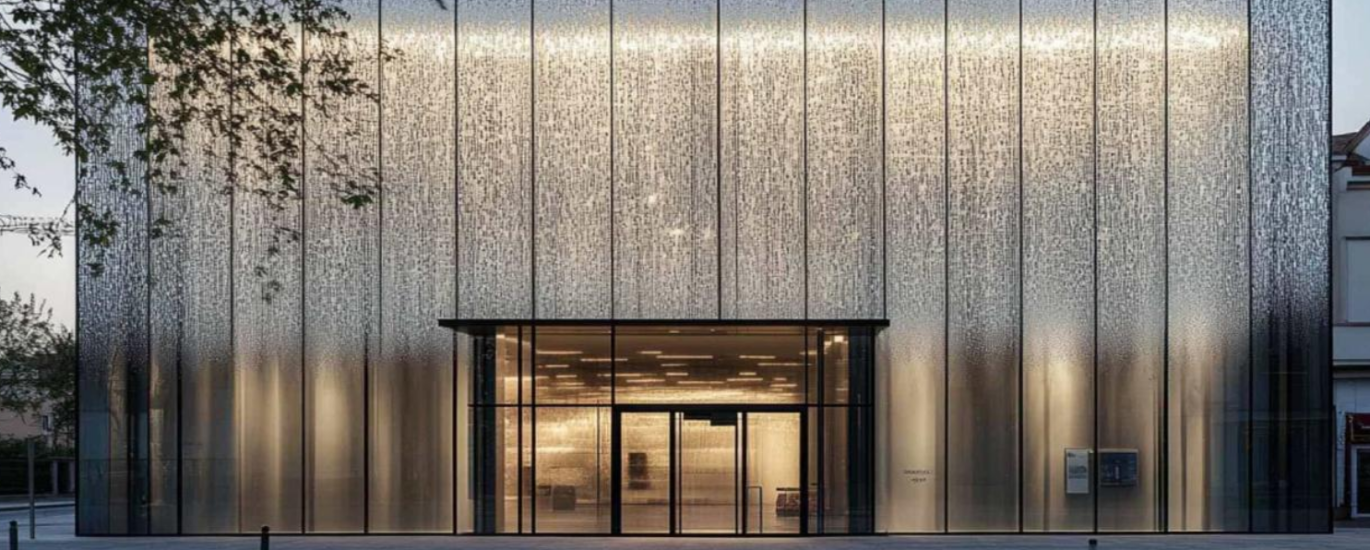
Frit glass, sometimes called ceramic frit glass or fritted glass, is ordinary clear glass that has had a ceramic paint or enamel pattern permanently fused onto its surface through a high-temperature firing process. The result is a glass panel with a durable, opaque or semi-opaque pattern, commonly dots, lines, or a custom design, that controls how much light and visibility passes through it, without relying on color the way stained glass does.
The most important thing to understand about frit glass is that word “fused.” The ceramic pattern isn’t painted on top of the glass the way you’d paint a wall, where the coating sits as a separate layer that could eventually chip, peel, or wear away. It’s fired into the glass surface at high heat, becoming a permanent part of the glass itself. This is what gives frit glass its durability and why it holds up so well over decades of use without fading, peeling, or needing to be refinished.
A Simple Way to Picture It
Think of frit glass as clear glass with a permanent, baked-in pattern, similar in concept to how a ceramic mug’s glaze becomes a permanent part of the mug once it’s fired in a kiln, rather than a coat of paint sitting on the surface. That’s the same basic principle behind how a frit pattern becomes part of the glass.
Where Frit Glass Actually Came From
Frit glass wasn’t originally invented as a decorative product, and understanding its actual origin helps explain why it looks and behaves the way it does today. It was developed primarily for solar control in commercial architecture, a way to reduce heat gain and glare on large glazed façades and curtain walls without sacrificing natural light entirely. Architects and engineers needed a way to let daylight into large commercial buildings while managing the sun’s heat and brightness, and a fired ceramic pattern applied across a glass panel turned out to be an effective, durable solution.
This functional origin still shapes where and how frit glass gets used today. It shows up disproportionately in office buildings, shopfronts, and large commercial glazing projects precisely because that’s the environment it was engineered to solve a problem in. Its decorative appeal, the clean, geometric, contemporary look a well-designed frit pattern creates, came later, as architects and designers realized a technically functional product could also be a genuinely attractive design element in its own right.
Worth Knowing
Frit glass being originally a functional, engineering-driven product rather than a purely decorative one is part of why it looks the way it does. Its patterns tend to be geometric, consistent, and architectural in character, dots, lines, gradients, rather than the free-flowing, colorful imagery associated with stained glass, because it was built to solve a light and heat problem first, and decoration second.
How Frit Glass Is Actually Made
Understanding the basic manufacturing process helps explain both why frit glass looks the way it does and why it’s such a durable, low-maintenance material for the applications it’s used in.
The base glass is prepared. Frit glass starts as standard clear float glass, the same basic glass used in most modern windows, cut to the size and shape needed for the final panel.
The ceramic frit pattern is applied. A ceramic-based enamel, in the desired pattern, dots, lines, a custom design, is applied to the glass surface, typically through a screen printing process that allows for precise, consistent, repeatable patterns across a panel or across multiple panels in a larger installation.
The glass is fired at high temperature. The glass, now carrying the applied ceramic pattern, is heated to a high temperature in a process that fuses the ceramic material permanently into the glass surface itself. This firing step is what transforms the pattern from a surface coating into a genuinely permanent part of the glass.
The glass is typically tempered for strength. Because frit glass is frequently used in large panels and structural or semi-structural applications, the firing process is often combined with, or immediately followed by, a tempering process that strengthens the glass significantly compared to standard annealed glass, an important safety and durability consideration for the large-scale applications frit glass is commonly used in.
Why the Firing Step Matters So Much
If you’re comparing frit glass to a printed or vinyl-coated glass film product, the firing step is the key difference to understand. A printed or applied film sits on the glass surface and can be scratched, peeled, or worn away over time. A properly fired ceramic frit pattern is fused into the glass itself and won’t peel, fade from UV exposure, or wear away with normal cleaning and use, which is exactly why it’s specified for long-term architectural applications rather than shorter-term decorative products.
Curious Whether Frit Glass Fits Your Specific Project?
Message us on WhatsApp with a quick description of your space, we’ll tell you honestly whether frit glass makes sense or if another option would serve you better.
What Frit Glass Actually Looks Like
One of the most common points of confusion for someone encountering frit glass for the first time is picturing exactly what it looks like, since the term covers a genuinely wide range of visual patterns and effects.
Dot patterns. This is probably the most recognizable frit glass style, rows of small ceramic dots across the glass surface, often in a gradient, denser in some areas and more sparse in others, which is a common technique for controlling light and privacy gradually across a single panel rather than uniformly.
Line patterns. Horizontal or vertical lines, evenly spaced or in a custom rhythm, create a different visual character than dots, often reading as slightly more modern or minimalist, and are common in office partition and façade applications.
Gradient patterns. A frit pattern that shifts gradually from more opaque to more transparent across a single panel, useful for applications where you want strong privacy or heat control at one part of a window and more visibility or light at another, a glass door with a frosted lower half and clearer upper half, for example.
Custom patterns and motifs. Beyond standard geometric dots and lines, frit glass can be produced with genuinely custom patterns, a company logo, a specific decorative motif, or a design that matches an existing architectural or interior theme, since the screen printing process used to apply the ceramic pattern is flexible enough to accommodate custom artwork.
Color options. While frit glass is most commonly seen in white, gray, or black ceramic patterns against clear glass, colored ceramic frits are also possible, offering another design dimension beyond just the pattern itself.
How This Differs From What You Might Be Picturing
If you’ve seen photos of colorful glass with imagery or storytelling scenes and assumed that’s frit glass, you’re likely thinking of stained glass instead. Frit glass reads as considerably more geometric, neutral, and architectural in character. If you’re not sure which one you’re actually picturing for your project, our guide comparing stained glass versus frit glass walks through the visual and functional differences in detail.
What Frit Glass Is Actually Used For
Frit glass shows up across a genuinely wide range of residential and commercial applications, and understanding the common use cases helps clarify whether it’s the right fit for whatever you’re picturing.
Office and workspace partitions. This is one of the most common applications for frit glass today. It allows an open floor plan to be divided into private offices and meeting rooms without losing the light-filled, open feel a fully solid wall would eliminate, striking a balance between privacy and natural light that a plain glass partition can’t offer.
Shopfronts and commercial façades. Retail storefronts and commercial building façades frequently use frit glass both for its clean, contemporary appearance and its genuine functional benefit, reducing glare and heat gain on large glazed surfaces exposed to direct sun for much of the day.
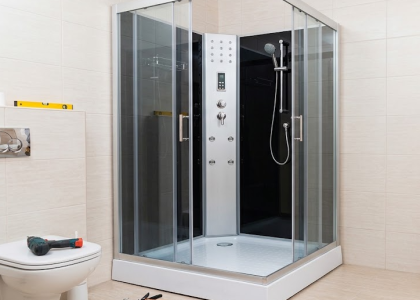
Bathroom and shower privacy. For homeowners wanting privacy in a bathroom window or shower enclosure without going fully opaque or losing natural light entirely, a frit pattern offers a clean, contemporary look that works well alongside modern bathroom fixtures and tile.
Conference room and meeting space glazing. Similar to general office partitions, frit glass on conference room walls provides visual privacy for meetings while keeping the space from feeling closed off from the rest of the office.
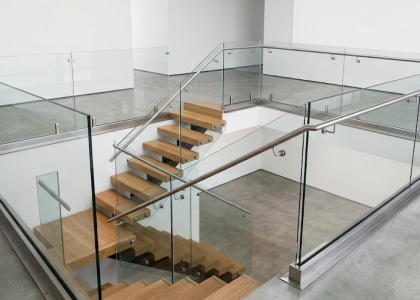
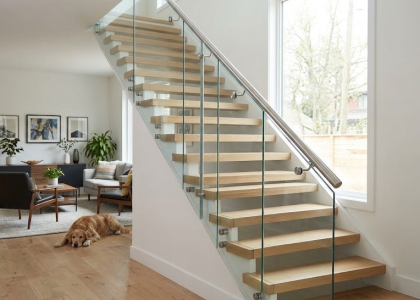
Stair and balcony railings. Frit patterns are sometimes applied to glass railing panels, both for a decorative touch and as a practical visibility marker, helping people notice the glass is there rather than risking someone walking into a fully transparent panel.
Skylights and overhead glazing. In applications where glass is overhead, a skylight or an overhead glazed ceiling, frit patterns help manage glare and heat from direct overhead sun exposure in a way that clear glass alone wouldn’t.
A Quick Way to Know If Frit Glass Fits Your Situation
If your main goal is privacy or glare control on a larger glazed area, and you want a clean, neutral, contemporary look rather than color and storytelling, frit glass is very likely a strong fit. If you’re picturing something colorful and decorative as a focal point, that’s more often a sign you’re actually thinking of stained glass instead.
Not Sure Which Application Fits Your Space?
Whether it’s an office partition, a bathroom window, or a shopfront, send us a photo of your space and we’ll help you figure out the right frit pattern and glass specification.
Frit Glass vs. Other Types of Privacy and Decorative Glass
Since frit glass is often considered alongside a few other glass types serving similar purposes, it’s worth briefly clarifying how it differs from the most common alternatives.
Frit glass vs. frosted or sandblasted glass. Frosted and sandblasted glass achieve privacy by physically etching or roughening the entire glass surface, or a large section of it, creating a uniform, translucent appearance across the whole treated area. Frit glass instead uses a specific printed pattern, dots, lines, gradients, allowing for more design control and the ability to vary opacity across a single panel rather than treating the whole surface uniformly.
Frit glass vs. tinted glass. Tinted glass changes the color of the glass throughout its entire body, reducing light and glare uniformly across the whole panel, but doesn’t create a visual pattern or texture the way frit glass does. Tinted and frit treatments can also be combined on the same glass panel for projects wanting both benefits.
Frit glass vs. window film. Adhesive window films can create a similar visual effect to frit glass at a lower upfront cost, but they sit on the glass surface as an applied layer rather than being fused into the glass itself, meaning they’re more prone to peeling, bubbling, or wearing over time, particularly with direct sun exposure, and typically need replacement periodically in a way properly fired frit glass doesn’t.
Frit glass vs. stained glass. As covered in more detail in our dedicated comparison guide, stained glass versus frit glass really come down to different goals entirely frit glass is primarily about pattern, privacy, and light or heat control, while stained glass is primarily about color and visual storytelling through light transmission.
Frit Glass Compared to Common Alternatives
| Material | How It Creates Privacy/Effect | Design Flexibility | Durability Over Time |
|---|---|---|---|
| Frit Glass | Fired ceramic pattern fused into glass | High, custom patterns and gradients possible | Excellent, won’t peel or fade |
| Frosted/Sandblasted Glass | Uniform surface texture across treated area | Lower, generally uniform effect | Excellent, permanent physical treatment |
| Tinted Glass | Color throughout the glass body | Lower, uniform color and tone | Excellent, color doesn’t fade |
| Window Film | Adhesive film applied to surface | Moderate, wide range of printed designs | Lower, can peel or bubble over years |
Common Questions People Have When First Learning About Frit Glass
Is frit glass expensive compared to regular glass?
Frit glass does cost more than plain, untreated glass, given the additional manufacturing steps involved, ceramic pattern application and firing, but it’s generally a cost-effective choice for large-scale applications like office partitions and façades compared to more elaborate decorative alternatives like custom stained glass, particularly given how efficiently it can be produced in large, consistent panels.
Does frit glass block all visibility, or can you still see through it?
This depends entirely on the specific pattern and its density. A dense, closely spaced dot or line pattern provides strong privacy with limited visibility through the glass, while a lighter, more sparse pattern allows considerably more visibility while still providing some glare reduction and a decorative visual effect. This is one of the most useful conversations to have during a consultation, since pattern density can be tailored to exactly how much privacy versus visibility a specific application needs.
Can frit glass be used outdoors?
Yes, frit glass is commonly used in outdoor and exterior applications, shopfronts, building façades, given that the fired ceramic pattern is inherently weather-resistant and won’t degrade from UV exposure or outdoor conditions the way an applied film might over time.
Is frit glass safe, or does it need to be paired with another type of safety glass?
Frit glass is very commonly tempered as part of its manufacturing process specifically because it’s used in large panels and structural applications where safety glass requirements apply. For specific applications requiring even higher safety standards, frit patterns can also be applied to laminated glass, which adds an additional layer of safety performance beyond tempering alone.
A Question Worth Asking Any Supplier
If you’re sourcing frit glass for your project, confirm directly whether the glass will be tempered (or laminated, for applications requiring it) as part of the frit process, since this is a genuine safety consideration for larger panels, not just an aesthetic detail. A reputable supplier should address this proactively rather than requiring you to ask.
How to Start Thinking About a Frit Glass Project of Your Own
If this guide has you thinking frit glass might genuinely fit something you’re planning, a few starting questions are worth considering before your first real conversation with a supplier.
What’s the primary goal privacy, glare control, or a decorative visual effect?
Understanding which of these matters most helps determine the right pattern density and style for your specific space.
How much visibility do you actually want to retain?
Some frit applications are meant to almost fully obscure visibility (a bathroom window), while others are meant to allow considerable visibility while just reducing glare and adding visual interest (an office partition in an open-plan space).
What’s the scale of the area you’re covering?
A single bathroom window and an entire office partition wall have very different scale and cost considerations, and it’s useful to have a rough sense of the area involved before your first conversation with a supplier.
Do you want a standard pattern or something custom?
Standard dot or line patterns are generally faster and more cost-effective to produce than fully custom artwork or motifs, which is worth factoring in if your timeline or budget is a significant consideration.
You Don’t Need All the Answers Yet
If you’re still not entirely sure how to answer these questions, that’s genuinely normal at this stage, and it’s exactly what a proper consultation is designed to help you work through. Our guide on what a free stained and frit glass design consultation actually involves walks through what that conversation looks like in practice.
Frequently Asked Questions
Is frit glass the same thing as etched glass?
No, though they can look somewhat similar from a distance. Etched glass creates a translucent effect by physically abrading or chemically treating the glass surface, while frit glass creates its pattern by fusing a ceramic material onto the glass through a firing process. Both achieve privacy and light diffusion, but through genuinely different manufacturing methods with somewhat different visual and durability characteristics.
How long does frit glass actually last before it needs replacing?
Because the ceramic pattern is fused permanently into the glass rather than applied as a surface coating, frit glass doesn’t degrade, fade, or peel under normal use and typical weather exposure, meaning a well-installed frit glass panel should last as long as the glass itself, decades, without needing replacement or refinishing specifically due to the frit pattern wearing out.
Can frit glass be cleaned the same way as regular glass?
Yes. Since the pattern is fused into the glass surface rather than sitting as a removable coating, frit glass can generally be cleaned with standard glass cleaning products and methods without risk of damaging or removing the pattern, which is a genuine practical advantage over film-based alternatives that require more careful, film-safe cleaning products.
Can I get a custom pattern, or am I limited to standard dot and line designs?
Custom patterns, including logos, specific motifs, or designs matching an existing architectural theme, are genuinely possible with frit glass, since the screen printing process used to apply the pattern is flexible enough to accommodate custom artwork, not just standard, pre-set designs.
Is frit glass a good option for a residential home, or is it mainly for commercial buildings?
While frit glass’s origins and most common current applications are commercial, it works very well in residential settings too, particularly for bathroom windows, shower enclosures, and any home application where you want privacy and a clean, contemporary look without going fully opaque.
How do I know if I actually want frit glass or stained glass for my project?
The simplest gut check is asking whether your primary goal is color and visual storytelling (stained glass) or pattern, privacy, and light control with a neutral, contemporary look (frit glass). Our dedicated comparison guide on stained glass versus frit glass walks through this decision in much more depth if you’re still weighing the two.
Does frit glass come in different glass thicknesses, or is it always the same?
Frit glass can be produced across the range of standard glass thicknesses used in architectural glazing, and the appropriate thickness for your project depends on the panel size, whether it’s a structural or semi-structural application, and any relevant safety glazing requirements for that specific use, which is exactly the kind of detail worth confirming directly with a supplier for your specific project.
Your Next Step
Frit glass is a genuinely versatile, durable material once you understand what it actually is clear glass with a permanently fired ceramic pattern, built originally to solve a real light and heat control problem and now widely used for exactly that reason across office partitions, shopfronts, bathrooms, and countless other applications. If you’re picturing something for your own space and want to know whether frit glass is the right fit, the next step is a straightforward conversation about your specific space and goals.
Schedule a free consultation to talk through your project in detail, or if you already have a clear picture of what you want, get an instant quote via WhatsApp and we’ll respond quickly with next steps.