Table of Contents
If you’re reading this, you’ve probably already had the thought that’s brought most retail owners to this exact question your shop front is the first thing a potential customer sees, and in the handful of seconds it takes someone to walk past, that front either pulls them in or lets them keep walking. You might be planning a new storefront, renovating a tired-looking entrance, or just trying to understand why some shops on your street always seem busier than others despite selling similar products at similar prices. A lot of that difference comes down to something you can actually control the glass front itself.
This guide walks through ten specific glass shop front designs that genuinely influence buying behavior, why each one works from a customer psychology standpoint, and which type of business each design tends to suit best. Nothing here assumes you’ve already picked a direction this is meant to help you understand the actual options and the reasoning behind them, so that whatever you eventually choose is based on what will actually work for your specific shop, not just what looks nice in a photo.
Why Your Shop Front Matters More Than You Might Think
Before getting into specific designs, it’s worth understanding why glass shop fronts have such an outsized effect on sales in the first place. Retail research has consistently found that customers form an impression of a store, and largely decide whether to enter, within just a few seconds of seeing its front, often before they’ve read a sign or noticed a promotion. That split-second decision is driven almost entirely by what they can see how open the space feels, how much product is visible, how much light comes through, and whether the entrance itself feels inviting or like a barrier.
A solid wall with a small door does none of that work for you. A glass front, when designed intentionally, does all of it at once. It turns your storefront into a passive, always-on advertisement that works even when your shop is closed, showcasing your product, your lighting, and your brand identity to everyone who walks past, whether they were planning to stop or not.
✓ The Core Idea in One Sentence
A well-designed glass shop front doesn’t just look attractive, it actively reduces the psychological barrier between a passerby and your product, which is exactly the mechanism through which better shop front design translates into more foot traffic and more sales.
1. Full-Height Frameless Glass Fronts
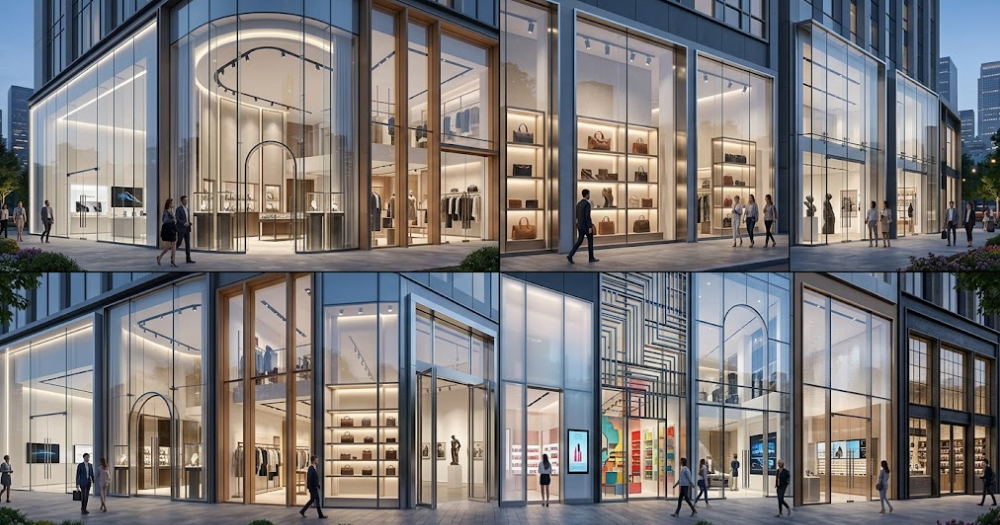
Frameless glass fronts use large, structurally engineered glass panels with minimal or no visible metal framing, creating an almost invisible boundary between the street and your store’s interior. Rather than a customer’s eye being interrupted by mullions and frame lines, they get an unobstructed, edge-to-edge view straight into the shop.
This design works because it removes visual clutter entirely, letting your product displays and interior lighting become the sole focus. It’s particularly effective for boutiques, cosmetic stores, and mobile or electronics shops where the products themselves are visually appealing and benefit from being seen clearly and completely, rather than through a grid of frame lines breaking up the view.
Best suited for: boutiques, cosmetics and beauty stores, electronics and mobile shops, jewelry showrooms.
2. Curved and Angled Glass Corner Entrances
For shops on a corner plot, a curved or angled glass front wraps around the building’s corner rather than stopping at a flat wall, dramatically increasing the visible surface area of your store from two directions of foot traffic instead of just one. This design captures attention from customers approaching from either street, effectively doubling your storefront’s visibility for a corner location that would otherwise only present one flat face to passersby.
Curved glass, in particular, has a strong visual “wow” effect that flat glass simply can’t replicate, since bent and curved glass fabrication is more technically demanding and immediately signals a higher level of investment and design intent to anyone walking by.
Best suited for: flagship stores, corner retail units, showrooms in high-traffic commercial plazas.
3. Double-Height Glass Fronts for Multi-Level Showrooms
For shops with a mezzanine level or double-height ceiling, floor-to-ceiling glass extending across both levels creates a dramatic, open feel from the street that signals scale and ambition in a way a standard single-story front can’t. Passersby can see straight up into the full height of the space, which works particularly well for showrooms displaying larger products, furniture, vehicles, or high-end retail where the sense of scale itself communicates quality and seriousness.
Best suited for: furniture showrooms, car dealerships, high-end fashion flagship stores, large format retail.
4. Frosted and Fritted Glass Accent Panels
Not every part of a shop front benefits from being fully transparent, and this is one of the more counterintuitive but genuinely effective design choices. Frosted or fritted glass panels used strategically, along a lower wall section, around a fitting room area, or as a branded accent strip, add visual interest and a premium, considered look while still allowing plenty of light through and keeping the majority of the front fully transparent where it matters most.
This design works especially well for stores that need some degree of interior privacy near changing rooms or back-office areas, without resorting to a solid wall that would break up the overall openness of the front. A fritted logo or pattern integrated into the glass itself also doubles as a subtle, permanent branding element that doesn’t rely on a separate signboard.
Best suited for: clothing and fashion retailers, salons and spas, optical stores.
5. Illuminated Glass Fronts With Integrated LED Lighting
Shop fronts that incorporate LED lighting directly into the glass structure, whether through edge-lit glass panels, backlit signage integrated into the glazing, or simply well-placed interior lighting designed to showcase through the glass after dark, extend a store’s selling power well beyond business hours. A glowing, well-lit storefront at night continues to work as a passive advertisement long after the shop has closed, catching the eye of anyone walking or driving past in the evening.
This matters more than many shop owners initially assume, since a dark, unlit glass front at night can actually look less inviting than a solid wall, while a properly illuminated one becomes one of the most visible features on an entire street after sunset.
Best suited for: restaurants and cafés, mobile and electronics shops, pharmacies, 24-hour or extended-hours retail.
A Simple Way to Picture the After-Hours Effect
Think about the last time you walked past a row of closed shops at night. The ones that actually caught your attention almost certainly weren’t the ones behind solid shutters, they were the ones still glowing softly through glass, showing off their interior even with no staff or customers inside. That’s a shop front continuing to sell your brand while you’re not even open.
6. Automatic Sliding Glass Entrance Doors
The entrance itself is a design decision, not just a functional necessity, and automatic sliding glass doors remove one of the smallest but most persistent friction points in the customer journey the physical act of pushing or pulling a door open, particularly when hands are full with bags or a stroller. Automatic doors also keep the overall glass front looking cleaner and more seamless, since there’s no visible door handle or hinge breaking up the transparency of the entrance.
Beyond the practical convenience, automatic doors carry a subtle but real signal of modernity and premium service, an association customers pick up on even if they don’t consciously register why a store feels more upscale than its neighbor.
Best suited for: pharmacies, supermarkets and grocery stores, malls and shopping plazas, high-end retail and showrooms.
7. Double-Glazed Glass Fronts for Climate and Noise Control
Double-glazed shop fronts, using two panes of glass with an insulating air gap between them, address a problem that doesn’t show up in photos but directly affects how comfortable a shop feels to actually shop in temperature control and street noise. A shop front exposed to intense sun or a busy, noisy street can make the interior uncomfortably hot or distracting, both of which are known to shorten how long customers actually stay inside and browse.
Double glazing keeps interior temperatures more stable, reducing strain on air conditioning during hot months, while also cutting down on the amount of traffic and street noise reaching the shop’s interior, making for a more comfortable, longer browsing experience that translates directly into more time spent looking at product and higher likelihood of a purchase.
Best suited for: shops on busy or noisy commercial roads, businesses in extreme-heat climates, cafés and restaurants where ambiance matters.
8. Laminated Safety Glass Fronts
Laminated glass, built from two or more glass layers bonded together with a flexible interlayer, addresses security and safety concerns without requiring heavy shutters or grilles that hide a shop front when closed. Because laminated glass holds together even when cracked rather than shattering into loose, dangerous shards, it offers a genuine security benefit against forced entry attempts while still allowing a shop to keep its glass front fully visible and open-feeling around the clock, rather than disappearing behind a metal shutter every night.
This is particularly relevant for businesses carrying higher-value inventory, jewelry, electronics, and mobile phones, where security is a real, practical concern that shouldn’t have to come at the cost of an inviting, transparent storefront during business hours.
Best suited for: jewelry stores, electronics and mobile shops, high-value retail, businesses in areas with security concerns.
9. Branded Color-Coated and Tinted Glass Fronts
Color-coated or tinted glass allows a shop front to incorporate brand colors directly into the glazing itself rather than relying entirely on separate signage and paint. A subtle brand-colored tint along the top or edges of a glass front, or a bolder full-color glass panel used as an accent, creates instant visual recognition for repeat customers and makes a store distinctly identifiable from a distance, well before someone can read a sign.
This design choice works especially well for franchise operations and chain retailers that need visual brand consistency across multiple locations, since color-coated glass can be specified precisely to match brand guidelines and reproduced identically at every new location.
Best suited for: franchise and chain retailers, brand-focused fashion and cosmetics stores, corporate-owned retail outlets.
10. Folding and Bi-Fold Glass Fronts for Open-Air Retail
Folding glass wall systems allow an entire shop front to open completely, effectively removing the barrier between the street and the interior during business hours and creating a genuinely open-air retail or café experience. Rather than customers seeing the shop through glass, they’re invited to walk directly into a space that feels like an extension of the street itself, an approach that has become especially popular for cafés, juice bars, and casual dining concepts looking to create a lively, accessible atmosphere.
At night or during closing hours, the same folding system closes completely to provide full security, giving a business the best of both an open, inviting daytime presence and a fully secured, closed storefront overnight.
Best suited for: cafés and juice bars, casual dining restaurants, bakeries, ice cream and dessert shops.
Glass Shop Front Designs at a Glance
| Design | Primary Sales Benefit | Best Fit |
|---|---|---|
| Full-height frameless glass | Unobstructed product visibility | Boutiques, cosmetics, electronics |
| Curved/angled corner glass | Double-direction visibility on corner plots | Flagship stores, corner units |
| Double-height glass fronts | Signals scale and premium positioning | Furniture, auto, high-end fashion |
| Frosted/fritted accent panels | Privacy without losing openness | Fashion, salons, optical stores |
| Illuminated LED-integrated glass | Extends visibility after closing hours | Restaurants, pharmacies, mobile shops |
| Automatic sliding glass doors | Removes entry friction, signals premium service | Pharmacies, supermarkets, malls |
| Double-glazed fronts | Comfortable browsing environment | Busy roads, hot climates, cafés |
| Laminated safety glass | Security without hiding the storefront | Jewelry, electronics, high-value retail |
| Branded color-coated glass | Instant brand recognition | Franchises, chain retailers |
| Folding/bi-fold glass walls | Fully open, immersive retail experience | Cafés, bakeries, casual dining |
How to Think About Choosing the Right Design for Your Shop
With ten distinct options on the table, it’s worth being honest that there’s rarely a single universally “best” design, the right choice depends heavily on your specific business, location, and customer behavior. A few factors are worth thinking through as you narrow things down.
What are you actually selling, and does it benefit from being seen? A store built around visually appealing product, clothing, cosmetics, electronics, benefits enormously from maximum transparency and a frameless or full-height design. A business built more around service or ambiance, like a spa or a professional office, might benefit more from a mix of transparency and frosted privacy panels.
How much foot traffic passes your location, and at what hours? A location with strong evening foot traffic benefits disproportionately from illuminated glass, since that’s exactly when a glowing storefront stands out most against a darkened street. A daytime-only location on a hot, sun-exposed street benefits more from double glazing to keep the interior comfortable.
Is security a genuine concern for your inventory? Higher-value inventory categories benefit from laminated glass specifically, since it addresses security without requiring a solid shutter that hides the store when closed.
Do you operate multiple locations or plan to? If brand consistency across locations matters, color-coated and tinted glass options are worth prioritizing early, since they can be specified precisely and reproduced identically as you expand.
Why a Real Look at Your Specific Storefront Matters
These ten designs cover the range of what’s genuinely effective, but the right combination for your specific shop depends on your storefront’s dimensions, orientation, foot traffic patterns, and what you’re actually selling. That’s exactly the kind of detail that benefits from an actual site visit and consultation rather than picking a design purely from a list.
Frequently Asked Questions
Do glass shop fronts actually increase sales, or is this more about appearance?
Both, and they’re connected. A more visible, inviting storefront genuinely increases the number of people who notice your shop and choose to walk in, which is the first and most fundamental step in the sales process. Retail behavior research consistently shows that visibility and perceived openness directly influence a customer’s decision to enter a store, which is exactly why shop front design has such a measurable effect on foot traffic and, ultimately, sales.
Is frameless glass more expensive than a standard framed glass front?
Generally yes, since frameless systems require thicker, structurally engineered glass and more precise fabrication and installation to achieve the same strength and safety a framed system gets partly from its supporting frame. The additional cost is often worth it for businesses where the completely unobstructed view is central to the sales strategy, though a well-designed framed front can still achieve a clean, modern look at a lower cost.
Can I combine more than one of these designs in a single shop front?
Absolutely, and in practice most well-designed storefronts do combine elements rather than relying on just one approach. A shop might use a frameless main display area, a frosted accent panel near the entrance for subtle branding, and integrated LED lighting for after-hours visibility, all within the same overall front.
How do I know if my shop’s location and foot traffic actually justify a premium glass front investment?
This depends on factors like your foot traffic volume, the value of your average sale, and how competitive your immediate surroundings are. A shop on a high-traffic commercial street with strong walk-in competition generally sees a faster return on a premium storefront investment than a shop in a low-traffic area where customers primarily come through deliberate visits rather than casual foot traffic.
Is laminated glass necessary for every shop front, or only for high-value retail?
Laminated glass offers meaningful safety and security benefits for any storefront, but it becomes a genuinely important consideration specifically for businesses carrying high-value, easily resold inventory like jewelry, electronics, and mobile phones, where forced entry risk is a real and specific concern.
How long does it typically take to design and install a new glass shop front?
Timelines vary considerably based on the complexity of the design, whether custom fabrication like curved or bent glass is involved, and the size of the storefront, but most straightforward glass shop front installations can be completed considerably faster than a traditional masonry or brick storefront renovation, which is part of why glass has become such a popular choice for business owners who need to minimize disruption to ongoing operations.
Does a glass shop front require special maintenance to keep it looking good?
Glass fronts generally require routine cleaning to stay looking their best, since fingerprints, dust, and street grime show more visibly on clear glass than on a painted or textured surface. Beyond regular cleaning, a properly installed glass front, particularly one using laminated or double-glazed glass, is durable and doesn’t require the kind of ongoing repainting or resealing that some traditional storefront materials eventually need.
Getting a Real Design Recommendation for Your Storefront
Everything above is genuinely useful for understanding which glass shop front approaches actually influence buying behavior and why, but it isn’t a substitute for looking at your specific shop, its location, dimensions, and the type of business you’re running. The right design, or more likely the right combination of designs, depends on details that are difficult to generalize accurately from a list alone.
If you’re planning a new shop front or considering a renovation, it’s worth understanding what a proper glass shop front installation would actually look like for your specific storefront before committing to a design or budget. A proper look at your space, including its foot traffic patterns, orientation, and what you’re actually selling, is the only way to get a real, specific recommendation instead of a generic design that may not match how your business actually operates.
A Simple Way to Think About Next Steps
You don’t need to have already picked a design from this list before reaching out. Working through those specifics together is exactly what a proper consultation is for. If you can point to a storefront that feels outdated, closed-off, or like it’s not pulling in the foot traffic it should, that’s already enough of a starting point.
A shop front is one of the few pieces of a retail business that works constantly, all day, every day, whether or not a customer ever speaks to a staff member. Getting that design right isn’t a cosmetic afterthought, it’s one of the highest-leverage decisions a retail business can make, and the right glass front is often the difference between a passerby who keeps walking and one who actually steps inside.
If you’re ready to see what that would actually look like for your specific storefront, schedule a free consultation to talk through your shop, your customers, and what a realistic glass front design would involve, or get an instant quote via WhatsApp if you already have a clear picture of what you’re working with.